



Home
›
Buying Guides
›
How to Choose Pear Halo Engagement Ring That Looks Luxurious Without Overspending

How to Choose Pear Halo Engagement Ring That Looks Luxurious Without Overspending
by zhousamuel on Sep 28 2026
A pear-shaped halo engagement ring can create an unusually generous visual impression. The tapered center stone leads the eye along the finger, while the surrounding halo adds brightness and width. The result may look elaborate and substantial without requiring the budget of a much heavier center stone.
That visual advantage, however, does not make every inexpensive ring a good value. An affordable ring can still have an uneven pear outline, an overly dark bow-tie, a vulnerable point, unclear gemstone disclosure, or a return policy that makes an online purchase difficult to reverse. The most reliable way to shop is to compare design, material, durability, documentation, and after-sales terms together.
This guide explains how to do that. It answers the practical question behind the search for an affordable pear shaped engagement ring: how can you obtain a distinctive, well-proportioned ring online without confusing a low price with genuine value?
Why the Pear Halo Design Has Such Strong Visual Impact
A pear-shaped diamond is a “fancy shape,” meaning it is a diamond shape other than a round brilliant. Its outline combines a rounded end with a tapered point and shares visual characteristics with both round and marquise shapes. The silhouette is recognizable, directional, and adaptable to classic, vintage, nature-inspired, and contemporary designs.
A halo is a border of smaller gemstones surrounding the center stone. It can increase the ring’s face-up spread, which is the area the finished ring appears to occupy when viewed from above. The halo does not increase the center stone’s actual carat weight. It changes the visual composition by adding a second layer of outline and sparkle.
This is why a halo can be useful for a controlled budget. Instead of paying entirely for a larger center stone, a buyer may allocate part of the budget to a carefully proportioned surround. The right design can make a modest center stone look intentional rather than undersized.
The effect depends on proportion. A halo that is too wide may make the pear look blunt. A halo that is too narrow may appear uneven around the shoulders and point. The best result is one in which the halo follows the center stone’s outline and leaves the pear shape clearly legible.

The First Budget Decision: What Should the Center Stone Be?
The center stone determines not only the price but also the ring’s visual personality, care requirements, and the wording that should appear in the product description. A seller should identify the material plainly. “Diamond alternative” is not precise enough by itself.
|
Center-stone material |
Main visual and practical advantage |
Suitable buyer |
What to verify before purchase |
|
Mined diamond |
Natural diamond identity and familiar diamond brilliance |
Someone who specifically wants a mined diamond |
Shape quality, color, clarity, report, treatments, and point protection |
|
Laboratory-grown diamond |
A diamond with essentially the same optical, physical, and chemical properties as a mined diamond, but not mined from the earth |
Someone who wants a diamond while managing the initial budget |
Clear “laboratory-grown” or equivalent disclosure, grading documentation, and actual stone specifications |
|
Moissanite |
Strong brilliance, pronounced fire, and high scratch resistance; GIA reports a Mohs hardness of 9.25 |
Someone who prioritizes sparkle and face-up size |
The listing must identify it as moissanite rather than diamond; review color, size, and optical appearance |
|
Sapphire |
A durable colored-gemstone option with a Mohs hardness of 9 for corundum |
Someone who wants color or a less conventional engagement ring |
Natural or laboratory-created origin, treatment information, color, and setting protection |
|
Cubic zirconia |
Very low initial cost and a bright appearance when new |
Occasional or fashion wear |
It is an imitation material; assess whether its long-term wear profile suits an engagement ring |
|
Other colored gemstones |
Personal symbolism and distinctive color |
Someone who values individuality over a traditional diamond appearance |
Hardness, toughness, stability, treatments, and appropriate care instructions |
The table is a decision framework, not a ranking. No material is automatically “best.” A wearer who wants diamond identity should not be pushed toward moissanite simply because it is less expensive. Conversely, a buyer who wants maximum visible size and lively rainbow flashes may prefer moissanite over a smaller diamond.
A note on durability
Mohs hardness measures resistance to scratching, but it does not fully measure whether a gemstone will survive impact. GIA explains that durability also involves toughness and stability. Toughness concerns resistance to breaking and chipping, while stability concerns resistance to heat, light, chemicals, humidity, and other environmental stresses.
This distinction matters for a pear-shaped ring because the point is exposed and vulnerable. A hard stone can still chip if it receives a sharp blow at an unprotected area. The setting and the wearer’s habits therefore matter as much as the stone’s hardness number.
How to Judge a Pear Shape Online
1. Evaluate the outline before the carat weight
The pear should have balanced shoulders, smoothly curved wings, and a clearly defined point. GIA advises buyers to look for symmetry and to be cautious of high shoulders, flat or bulging wings, undefined points, and uneven proportions.
Imagine a line running from the rounded end to the point. The two sides do not need to look mechanically identical, but they should appear visually balanced. A slightly smaller pear with a clean outline can look more refined than a larger stone with an awkward shoulder or a crooked point.
Online product photography can hide asymmetry. Ask for a face-up photograph taken straight on and a video that shows the ring or loose stone from several angles. A heavily filtered image is not enough evidence for a high-value purchase.
2. Treat the length-to-width ratio as a preference, not a grade
The length-to-width ratio is calculated by dividing the pear’s length by its width. A ratio of 1.60:1 describes a longer, slimmer shape than 1.40:1. GIA notes that many experts prefer ratios between approximately 1.50:1 and 1.75:1, while also emphasizing that no ratio alone determines beauty.
|
Approximate ratio |
General appearance |
Halo-design implication |
|
1.35:1–1.49:1 |
Fuller and wider |
Can support a broad, softer-looking halo |
|
1.50:1–1.64:1 |
Balanced teardrop profile |
Usually versatile with a classic round halo |
|
1.65:1–1.80:1 |
Longer and more elongated |
Can create a slender visual line along the finger |
|
Above 1.80:1 |
Dramatically elongated |
Requires careful halo proportions to avoid a narrow or stretched appearance |

3. Look for a bow-tie that is lively, not distracting
Many pear-shaped diamonds show a darker horizontal pattern across the center, commonly called a bow-tie. GIA explains that a bow-tie can range from light gray to black and that a darker or larger effect can detract from the face-up appearance.
A small amount of contrast is not automatically a defect. Contrast can help a stone look lively. The concern is a broad, persistent dark band that remains obvious as the stone moves.
When shopping online, ask to see the stone in more than one lighting environment. Daylight, diffuse indoor light, and direct spot lighting can reveal different aspects of the stone’s performance. If a retailer will not provide a video or answer a straightforward bow-tie question, that lack of information is itself a reason to delay the purchase.
4. Inspect the table, culet, and inclusions
The table is the large facet near the center of the crown. Recommends checking that the table is centered on the pear’s line of symmetry because an off-center table can make the facets appear unbalanced. The culet should also be positioned symmetrically.
Pay particular attention to inclusions near the point. The tip is more exposed to damage, and inclusions in a vulnerable area may matter more than a small difference in a clarity grade. For a budget-conscious buyer, eye visibility and location are often more useful than choosing the highest clarity label automatically.
A lower clarity grade can be acceptable when the stone is eye-clean and structurally appropriate. It is not a bargain if an inclusion is plainly visible in the center or if the report indicates a feature that warrants additional care.

Choosing a Halo That Looks Designed, Not Merely Larger
The halo should support the pear’s identity. A classic round-stone halo creates a clean border and is often straightforward to compare across retailers. A hidden halo places additional stones beneath the center stone and can add side-view sparkle without materially increasing the top-view width. A double halo creates more drama, but it also introduces more settings to inspect and maintain.
A mixed-shape halo can echo the pear’s shoulders and point, while a cluster setting can create a floral or vintage impression. Neither is inherently better than a classic halo. The important questions are whether the outline is even, whether the point remains protected, and whether the center and surrounding stones are accurately described.
Ask whether the halo stones are natural diamonds, laboratory-grown diamonds, moissanite, or another material. It is entirely possible for a ring to combine a moissanite center with moissanite side stones, or a lab-grown diamond center with moissanite accents. That may be a sensible design decision, but the product page should make the combination clear.
Be cautious with the phrase total carat weight. It may include the center stone, halo, band, and side stones together. Ask for the center-stone weight and the accent-stone weight separately.
Point Protection Is a Non-Negotiable Detail
The point as the most vulnerable part of a pear-shaped diamond and recommends either a V-prong at the tip or a bezel setting around the stone. A V-prong protects the point while preserving more of the pear’s outline. A bezel surrounds the edge and can provide stronger coverage, although it creates a different visual style and may show less of the stone’s perimeter.
The same design principle applies to pear-shaped gemstones generally, although each material has its own toughness and stability profile. A secure setting is not a substitute for reasonable care, but it reduces the consequences of ordinary contact with hard surfaces.
Inspect close-up photographs of the tip, prongs, and halo junctions. The point should not look exposed, and the prongs should not appear excessively thin or uneven. Ask how the retailer handles loose stones, missing accent stones, or a repair claim after delivery.

Which Metal Offers the Most Practical Value?
The World Gold Council explains that gold’s karatage expresses purity. Eighteen-karat gold contains 75 percent gold, while 14-karat gold contains approximately 58.3 percent gold. Alloying gold with other metals increases durability and changes the color of the finished metal.
For many daily-wear engagement rings, 14K gold is a practical middle ground between gold content, durability, color options, and purchase price. This is a general buying consideration, not a guarantee about a particular ring. Construction quality, band thickness, prong design, and wear habits also influence longevity.
|
Metal |
Potential value advantage |
Important considerations |
|
10K gold |
Usually the lowest-karat gold option in markets where it is permitted |
Contains less gold; exact alloy and skin compatibility should be confirmed |
|
14K gold |
Often balances price and daily-wear practicality |
Confirm whether it is solid gold and whether the stated karat applies to the whole ring |
|
18K gold |
Higher gold content and a richer color |
Often more expensive; the alloy and setting design still determine practical performance |
|
Platinum |
Naturally white metal with high precious-metal content |
Usually more expensive and denser; confirm purity and the jeweler’s care guidance |
|
Sterling silver |
Low initial price |
Can tarnish and may be a less suitable choice for a valuable daily-wear center stone |
White gold is commonly alloyed with white metals and often rhodium plated for a bright surface finish. Ask whether future replating is expected. If the wearer has a metal sensitivity, ask the retailer for the alloy information rather than assuming all white gold is the same.
How to Check an Online Listing Before Paying
The Federal Trade Commission states that jewelry claims should be accurate, non-deceptive, and accompanied by material information consumers need to make an informed decision. The FTC specifically addresses the disclosure of laboratory-created diamonds, simulated diamonds, moissanite, gemstone treatments, and diamond weight.
Before checkout, verify the following information:
• The center stone is identified as a mined diamond, laboratory-grown diamond, moissanite, sapphire, or another material.
• A simulated or imitation stone is not presented as a diamond or as an unqualified natural gemstone.
• The center-stone weight is separated from the total carat weight of the ring.
• The metal is identified by karat or fineness and not only by a color description.
• Treatments are disclosed when they affect value, permanence, care, or stability.
• The product photos are actual photographs or are clearly labeled as representative images.
• The listing gives measurements, not only a carat number.
• The point protection and setting style can be identified from photographs or specifications.
• The exact ring size, resizing limits, production time, shipping cost, taxes, and return period are available before purchase.
• The retailer provides reachable customer service and written warranty or repair terms.

Responsible-Sourcing Claims Need Evidence
Responsible sourcing should be evaluated with the same care as gemstone quality. The Responsible Jewellery Council’s Code of Practices covers ethical, social, human-rights, environmental, supply-chain due-diligence, and product-disclosure practices across relevant parts of the jewellery supply chain.
A retailer’s use of words such as “ethical,” “sustainable,” or “conflict-free” should be specific enough to evaluate. Ask what material the claim applies to, which part of the supply chain it covers, and whether any third-party standard or documentation supports it. Do not assume that one positive sourcing statement proves every material in a multi-stone ring has the same origin.
This is also why laboratory-grown and mined diamonds should not be presented as interchangeable purchasing decisions. They may share essential physical and optical properties, but their origins, market narratives, documentation, and buyer preferences differ. Clear wording respects both the customer and the material.
A Better Way to Allocate a Limited Budget
A budget should be divided by risk and importance, not only by the center stone’s carat weight. The following order is practical for most online buyers:
- Protect the vulnerable point. Choose a V-prong, bezel, or another clearly engineered protective solution.
- Prioritize outline and visual performance. Check symmetry, bow-tie strength, table position, and the real face-up appearance.
- Choose the stone identity deliberately. Decide whether you want a mined diamond, lab-grown diamond, moissanite, sapphire, or another gemstone.
- Select an appropriate metal. Compare karat, alloy, finish, skin compatibility, and expected maintenance.
- Reserve money for fit and aftercare. Include resizing, insurance, cleaning, repairs, and possible replating.
- Add decorative complexity last. A double halo, extensive pavé, engraving, or custom detail is valuable only after the fundamentals are sound.
A modest pear with a balanced outline and secure halo can be a better purchase than a larger pear with a distracting bow-tie and an exposed tip. The ring should look convincing both in the product photograph and in the written specifications.
Final Thought
The appeal of an affordable pear halo engagement rings is not simply that the halo makes the ring look larger. Its real strength is the way proportion can create presence: the pear supplies a distinctive directional silhouette, and the halo frames it with additional light and visual width.
To shop intelligently, evaluate the pear’s symmetry and bow-tie, protect the point with an appropriate setting, identify every gemstone accurately, compare metal purity, and read the retailer’s return and repair terms before paying. Romalar’s Pear Cut Engagement Rings collection is a reasonable place to begin comparing pear-cut categories.
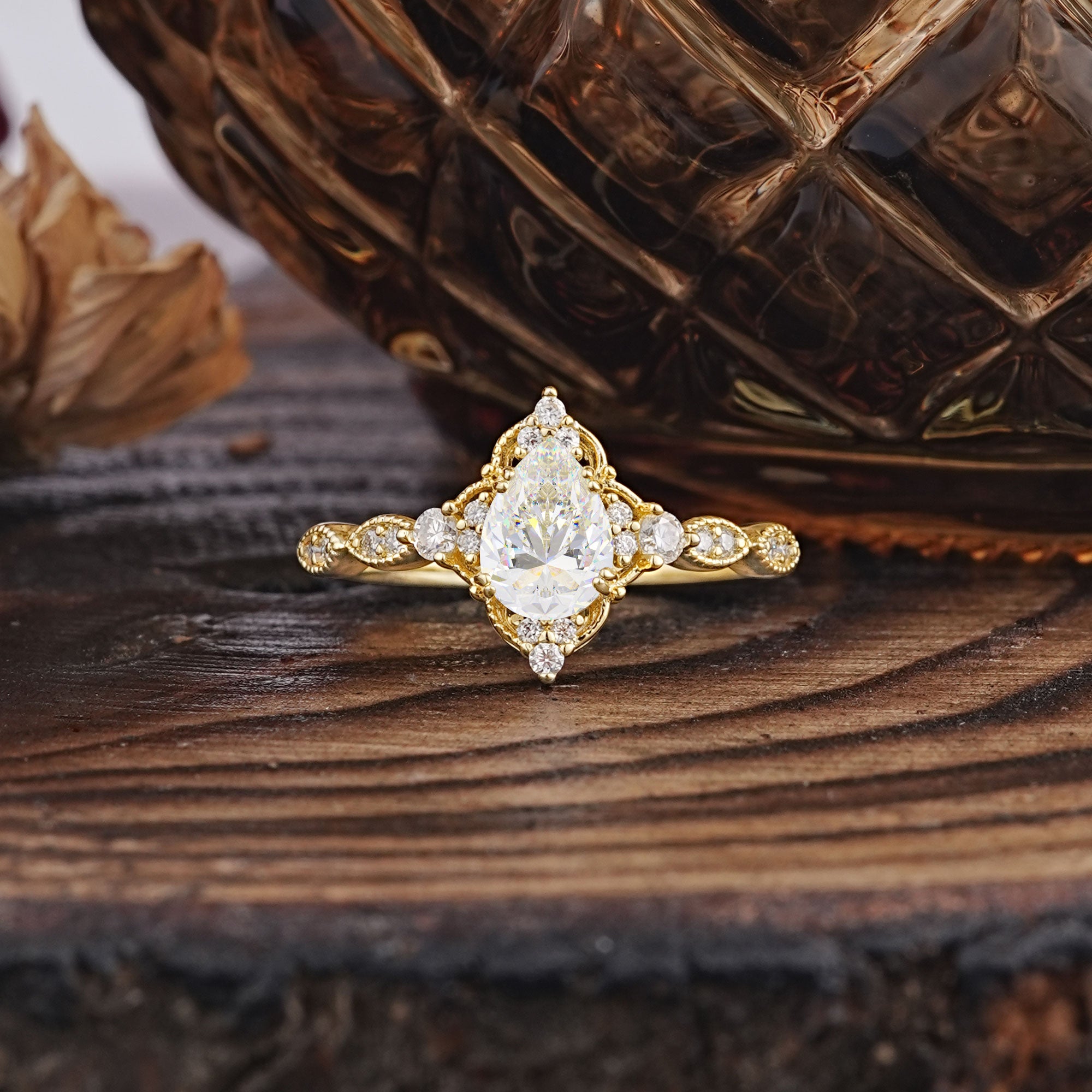 Antique Pear-Cut Moissanite Engagement Ring
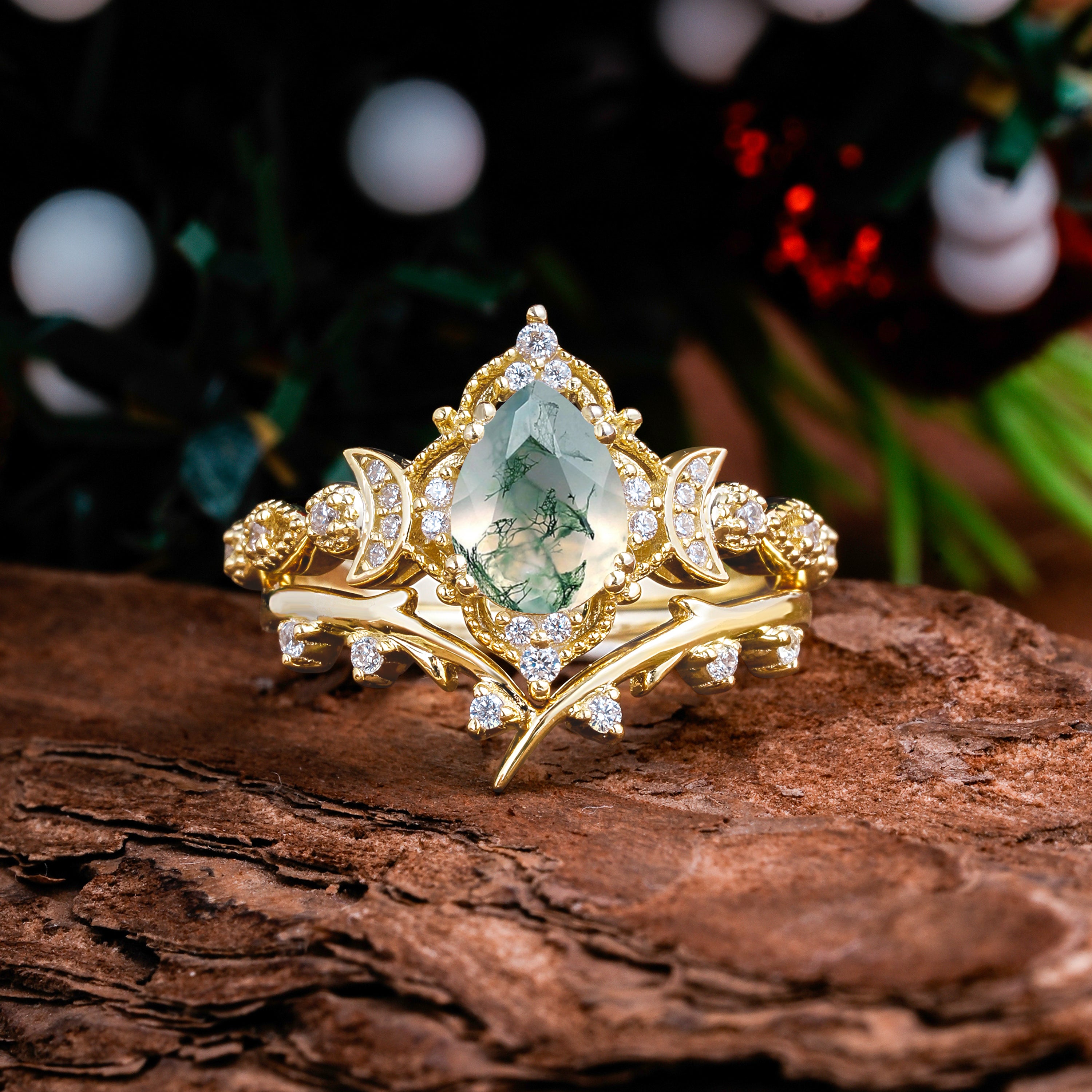 Unique Pear Cut Moss Agate Bridal Ring Set
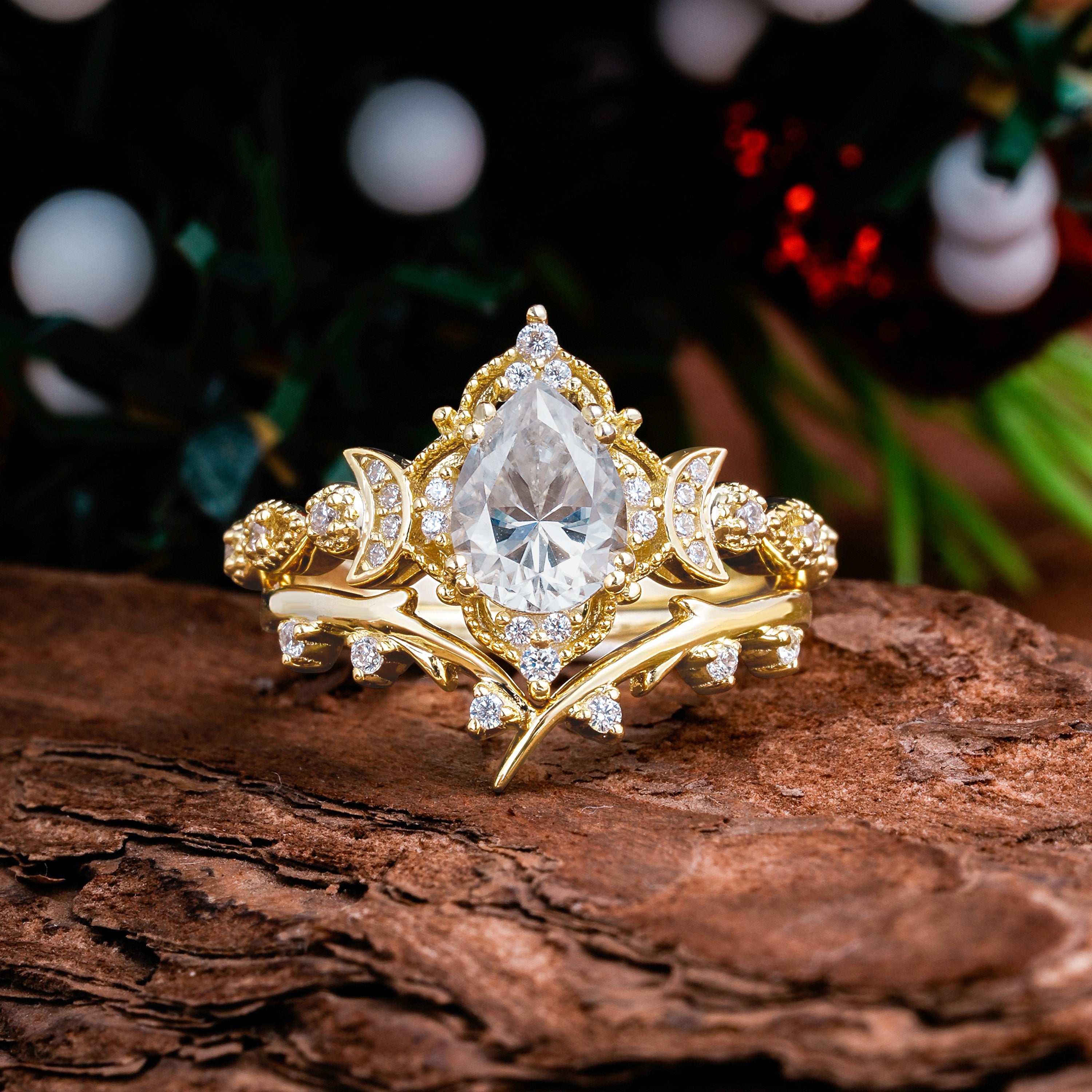 Unique Pear Shaped Moissanite Bridal Ring Set
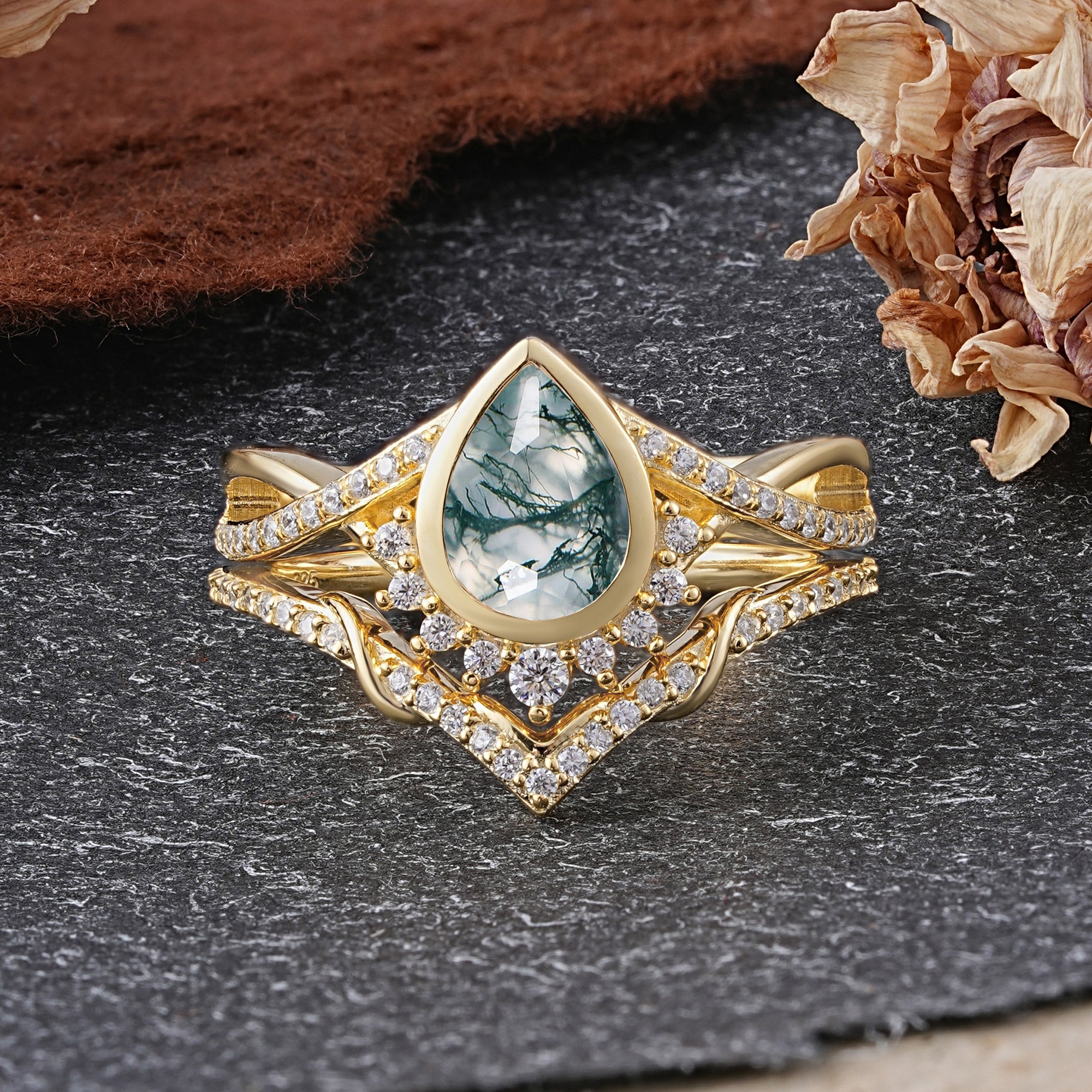 Ultra Luxurious Vintage Pear-Cut Natural Moss Agate Bridal Ring Set
The best affordable choice is not the ring with the loudest promise. It is the ring whose design remains attractive, whose materials are clearly disclosed, whose vulnerable areas are protected, and whose total cost still makes sense after the romantic first impression has become an everyday piece of jewelry.
FAQs
Can I find an affordable pear halo engagement ring online?
Yes. Online retailers offer pear halos with mined diamonds, laboratory-grown diamonds, moissanite, sapphires, and other gemstones. Affordability depends on the complete combination of center stone, accent stones, metal, setting, craftsmanship, shipping, taxes, resizing, and return terms. Compare the complete specification rather than the headline price.
Is a pear halo ring more affordable than a round halo ring?
It can be, but there is no universal price rule. A pear halo may create strong face-up spread with a smaller center stone, and fancy shapes can offer different value from round brilliants. The actual price still depends on origin, carat weight, color, clarity, cut quality, metal, halo material, and retailer.
Is moissanite a diamond?
No. Moissanite is a distinct gemstone commonly used as a diamond simulant. GIA describes synthetic moissanite as a popular engagement-ring stone with high brilliance, intense fire, durability, and a Mohs hardness of 9.25. Its appearance is not identical to diamond, and the product listing should name it accurately.
What pear-shaped ratio looks best?
Many experts discuss approximately 1.50:1 to 1.75:1 as a useful range, but there is no universally correct ratio. A lower ratio looks fuller, while a higher ratio looks longer and slimmer. Symmetry, bow-tie strength, point definition, table position, and the completed halo design are more important than a ratio viewed in isolation.
How should the point of a pear ring be protected?
A V-prong at the tip or a bezel around the stone can protect the most vulnerable area. GIA specifically recommends these approaches for pear-shaped diamonds. The ring should also be inspected periodically for bent prongs, looseness, or missing accent stones.
Is 14K gold suitable for an engagement ring?
For many wearers, 14K gold is a practical choice because it contains approximately 58.3 percent gold and gains durability from alloying. Suitability still depends on the ring’s construction, lifestyle, skin sensitivity, color preference, and care routine. Confirm that the seller is describing solid gold accurately and explain whether any surface plating is used.
Do I need a grading report?
For a higher-value diamond, an independent grading report can help confirm the disclosed characteristics. A lower-cost gemstone or fashion ring may not include a report, but the retailer should still identify the material, measurements, treatments, metal, and return terms accurately. A report is useful evidence, not a replacement for inspecting the actual design and setting.
Can I customize a pear halo engagement ring?
Often, yes. Buyers may be able to choose the center-stone material, halo material, metal color, karat, ring size, engraving, or setting style. Custom orders require extra caution because return and resizing rules may differ. Obtain the final specification and written terms before production begins.
Is a larger center stone always better value?
No. A larger pear with poor symmetry, a severe bow-tie, or an exposed point may be less attractive and less secure than a smaller, well-proportioned stone. Value should be judged by appearance, construction, documentation, durability, and total ownership cost.
References
GIA, Pear Shaped Diamond: Tips for Picking the Perfect One
GIA, More than the Mohs Scale – Understanding Gem Durability
GIA, An Introduction to Simulants or Imitation Gem Materials
Share