


Practical Guide to Choosing Men's Ruby Jewelry
The phrase "high-quality men's ruby jewelry" can hide several different questions. Is the ruby natural or laboratory-grown? Has it been heated, fracture-filled, diffused, or dyed? Is the metal solid gold, plated silver, or another alloy? Does the setting protect the stone? Is the red color vivid in person, or is it intensified by photography? Can the seller provide a report, treatment disclosure, sizing information, and a usable return policy?
What Makes Men's Ruby Jewelry "High Quality"?
Quality has two layers in men's ruby jewelry. The first is gemological quality, which concerns the ruby's color, clarity, cut, size, origin, and treatment. The second is jewelry quality, which concerns the metal, construction, setting, finish, comfort, sizing, and after-sales support.
A ring can contain an attractive ruby but still be a poor purchase if the stone is loose, the band is too thin for daily wear, or the treatment is undisclosed. Conversely, a smaller, treated ruby can be an excellent choice when its treatment is clearly stated, its price reflects that treatment, and the setting is designed for practical wear.
The Gemological Institute of America identifies color as the most important quality factor for ruby. The finest examples show a pure, vivid red to slightly purplish red, with strong saturation but without appearing too dark or too light. Most rubies contain inclusions and that origin alone does not guarantee quality. GIA evaluates ruby characteristics and treatments; it does not assign ruby a single universal grade in the way many consumers associate with diamond color-and-clarity grading.
For an online buyer, the central principle is simple: quality is the relationship between the stone, the setting, the disclosure, and the intended use.
Why Ruby Works Particularly Well in Men's Jewelry
Ruby is the red variety of corundum, the mineral species that also includes sapphire. Corundum ranks 9 on the Mohs hardness scale and has excellent toughness with no cleavage, making ruby a strong candidate for rings and other jewelry exposed to daily wear.
Hardness is not the same as invulnerability. Mohs hardness measures resistance to scratching. Toughness measures resistance to chipping or breaking. Stability concerns resistance to heat, chemicals, light, and treatment-related change. A ruby with a surface-reaching fracture or a treatment-sensitive filler may require more care than an untreated or conventionally heat-treated stone.
Ruby's visual character also suits restrained men's design. A dark red stone can function like a color accent in clothing: it may be the only strong hue in an outfit, but it gives the entire composition direction. In a signet ring, the color can look traditional. In a clean bezel setting, it can look architectural. In a vintage or engraved band, it can carry a more personal and symbolic feeling.
Ruby is also associated with July, passion, courage, vitality, protection, and enduring commitment. These meanings are cultural and personal rather than scientific, but they help explain why ruby is often chosen for wedding bands, anniversary gifts, signet rings, and milestone jewelry.
The Four Ruby Quality Factors to Check Online

1. Color: look for saturation and brightness, not just "red"
Color is the first feature to inspect. A quality listing should show the stone in neutral lighting and avoid relying exclusively on highly saturated red product photography.
GIA describes the finest ruby color as pure, vivid red to slightly purplish red. If a ruby is too dark, it can lose brightness. If it is too light, it may fall into the commercial category of pink sapphire rather than ruby, depending on the laboratory and market context.
The phrase "pigeon's blood" should also be treated carefully. It is a traditional trade expression associated with a desirable red appearance, but it can be interpreted inconsistently and should not replace an actual description or laboratory report. A famous geographic name is not a substitute for evaluating the stone itself.
When reviewing an online listing, ask:
• Is the color described as red, purplish red, pinkish red, or another shade?
• Are the photographs taken in natural or neutral light?
• Does the seller provide a video as well as still images?
• Is the stone transparent enough to show brightness, or does it appear opaque and overly dark?
• Is the color natural to the material, or has it been created or enhanced by treatment?
A vivid color is valuable only when the buyer knows how that color was produced and what care it requires.
2. Clarity: inclusions are normal, but fractures deserve attention
Unlike diamonds, rubies are not generally expected to be completely free of inclusions. Inclusion-free rubies are practically nonexistent and that value depends on how visible the inclusions are and whether they reduce transparency or brightness.
Some inclusions can contribute to the visual character of a ruby. Intersecting rutile needles, commonly called silk, can scatter light and soften the appearance of the color. In other stones, inclusions can create asterism, or a star effect, when the ruby is cut as a cabochon.
The main concern for a daily-wear ring is not simply the number of inclusions. Significant surface-reaching fractures can create durability risks. A seller should not describe a visibly fractured stone only with a positive phrase such as "natural character" without explaining the implications for care and value.
For an online purchase, request a close-up photograph and ask whether the stone has surface-reaching fractures. If the ring is expensive, an independent identification report is a sensible safeguard.
3. Cut: judge light return, windowing, and symmetry
Ruby rough is expensive, so cutters may try to retain weight. Shallow cutting can allow light to escape through the stone, creating a see-through area known as a window. A heavily windowed stone can appear pale or transparent in the center even when its color looks strong around the edges.
A well-cut ruby should appear reasonably balanced and bright for its material. The exact ideal proportions vary by shape and crystal structure. Common ruby shapes include oval and cushion, while round, emerald, pear, and marquise shapes are also available. Larger, fine-quality stones in unusual shapes are less common.
For men's jewelry, cut should also be considered in relation to the setting. A low-profile cabochon may work well in a signet or bezel ring. A faceted oval ruby can provide more brilliance in a raised setting. A rectangular or step-cut stone can create a more understated, tailored appearance.
4. Carat weight and dimensions: size is not the same as presence
Carat is a unit of weight, not a direct measurement of visual size. Two rubies with the same carat weight can have different face-up dimensions because of their shape and depth.
Fine-quality rubies above one carat are very rare and that price per carat can rise significantly as ruby size increases. For men's jewelry, dimensions can be more useful than carat weight alone. A buyer should look for the stone's length, width, and depth, as well as the total dimensions of the finished piece.
|
Ruby detail |
What it tells you |
Why it matters in men's jewelry |
|
Color |
Hue, tone, and saturation |
Determines whether the stone looks vivid, dark, soft, or overly brownish in daily light |
|
Clarity |
Visibility and location of inclusions |
Helps distinguish normal internal features from fractures that may affect durability |
|
Cut |
Proportion, symmetry, and light return |
Influences brightness and whether the stone looks lively or windowed |
|
Carat weight |
Weight of the ruby |
Useful for comparison, but should not replace actual length and width measurements |
|
Treatment |
How appearance or clarity was enhanced |
Affects value, care, stability, and the wording that should appear in the listing |
|
Origin |
Geographic source, when documented |
May be relevant to provenance, but does not independently prove quality |
Ruby Treatments: The Question That Separates an Informed Buyer from a Surprised Buyer
Most rubies on the market have been treated in some way. GIA advises buyers to ask for treatment information in writing. Treatment is not automatically a defect. Heat treatment, for example, is widely used and can produce attractive, durable material. The important issue is whether the treatment is disclosed and whether the price and care instructions reflect it.
Common ruby treatments include:
• Heat treatment: Heating can improve color and clarity. Heat-treated ruby can remain durable, but the treatment should be disclosed.
• Lattice diffusion: Color is introduced into part of the stone. In shallowly treated material, surface damage or recutting can remove some of the treated color.
• Fracture filling: Glass is used to fill surface-reaching fractures. GIA warns that lead-glass-filled rubies require greater care because the filler can be damaged by chemicals, including relatively mild acids.
• Cavity filling or dyeing: These treatments can improve appearance but may be more treatment-sensitive and may require conservative cleaning.
• Laboratory-grown ruby: A man-made ruby should be identified as laboratory-grown, laboratory-created, or an equivalent term, rather than being presented as an untreated mined ruby.
Natural Ruby, Laboratory-Grown Ruby, and Ruby Simulants
These terms should not be treated as interchangeable.
A natural ruby is formed in the earth. It may still be heated, diffused, or filled. "Natural" describes origin, not treatment status.
A laboratory-grown ruby is man-made corundum with the same essential material identity as natural ruby, but its origin is the laboratory. It can be a legitimate and attractive choice when the listing identifies it clearly.
A ruby simulant is a different material used to imitate ruby's appearance. Glass, synthetic spinel, garnet, and other materials may appear in red jewelry, but they should not be marketed as unqualified ruby.
|
Product wording |
What it should mean |
Buyer response |
|
Natural ruby |
Ruby formed in the earth |
Ask about treatment and obtain a report for higher-value pieces |
|
Heated natural ruby |
Natural ruby with disclosed heat treatment |
Compare care, value, and documentation |
|
Laboratory-grown ruby |
Man-made ruby identified as created in a laboratory |
Consider it on its own merits; do not pay a natural-origin premium |
|
Lead-glass-filled ruby |
Ruby containing a fracture-filling glass treatment |
Require clear disclosure and follow conservative care instructions |
|
Ruby-colored or red stone |
May not be ruby at all |
Ask for the exact gemstone identity before buying |
|
Simulated ruby |
A different material that imitates ruby |
Treat it as an alternative gemstone, not as ruby |
Which Men's Ruby Jewelry Format Is Right for You?

Ruby rings and signet rings
Rings are the most visible and symbolically significant form of men's ruby jewelry. A signet ring can use a flat or cabochon ruby for a traditional appearance. A bezel-set round ruby offers a clean outline and protects the stone's perimeter. A prong-set ruby can show more of the stone but requires closer inspection of the prongs and exposed edges.
For daily wear, look for a ring with a substantial band, a secure setting, smooth edges, and a stone that does not sit so high that it catches on clothing or equipment. A pointed or angular ruby may need additional protection at its corners.
Ruby wedding bands
A ruby wedding band can be a meaningful alternative to a diamond-centered design. It may use one central ruby, a row of small stones, or a ruby accent integrated into a patterned band. The key questions are whether the stones are channel-set, bezel-set, or held by individual prongs, and whether the band can be resized without disturbing the setting.
Ruby bracelets
Bracelets receive more movement and impact than many buyers expect. Ruby beads, cabochons, or accent stones should be secured in a way that prevents repeated contact with hard surfaces. Check clasp quality, link construction, bracelet length, and the retailer's repair policy.
Ruby pendants and necklaces
A pendant may be a lower-impact choice than a ring because it is less likely to strike a countertop or tool. It also allows a larger ruby or a more expressive design without requiring the stone to withstand the same degree of hand contact.
Ruby cufflinks and small accessories
Cufflinks can use ruby as a concentrated color detail. Because they are worn less continuously than a ring, they may suit a more delicate setting or a higher-fashion design. Verify the back mechanism, plating, stone identity, and care instructions.
Metal Choices for Men's Ruby Jewelry

The metal affects appearance, durability, weight, allergies, and price. Yellow gold creates a traditional contrast with red ruby. Rose gold intensifies the warm side of the color. White gold, platinum, or sterling silver create a cooler contrast that can make the red appear more pronounced.
|
Metal |
Visual effect with ruby |
Practical considerations |
Questions to ask online |
|
10K gold |
Warm but usually less saturated than higher-karat gold |
Lower gold content; alloy composition varies |
Is the piece solid 10K gold and is the fineness clearly marked? |
|
14K gold |
Balanced contrast and common daily-wear option |
Often combines durability and moderate precious-metal content |
Is the entire mounting 14K, and is any plating used? |
|
18K gold |
Richer yellow or warmer color |
Higher gold content; often more expensive and may be softer in some constructions |
Is the price difference justified for the intended wear? |
|
Platinum |
Cool white contrast and substantial weight |
Usually more expensive; purity and construction should be specified |
What is the platinum purity and how is the setting engineered? |
|
Sterling silver |
Bright, accessible contrast |
Can tarnish; may be less suitable for a valuable daily-wear ruby ring |
Is the piece intended for everyday wear, and what finish protects it? |
|
Stainless steel or other base metal |
Modern, utilitarian contrast |
May be durable but has different precious-metal and resale characteristics |
Is the metal solid, plated, hypoallergenic, and accurately described? |
How to Check Whether an Online Retailer Deserves Your Trust
A high-quality online jewelry retailer should make verification possible. Trust is not created by a polished photograph or a phrase such as "luxury quality." It is created by information that remains clear when the buyer asks difficult questions.
Check for the following:
1 A precise gemstone description. The listing identifies natural, laboratory-grown, treated, filled, or simulated material.
2 Treatment disclosure. The seller explains heat, diffusion, filling, dyeing, or other enhancements when relevant.
3 Exact dimensions. The product page gives stone measurements, not only an approximate visual size.
4 Metal disclosure. Karat, fineness, plating, and base-metal information are visible.
5 Setting photographs. You can see prongs, bezel edges, corners, the underside, and the band profile.
6 Independent documentation. A report is available or recommended when the stone's value warrants one.
7 A real return policy. The policy states the time limit, exclusions, custom-order treatment, and who pays return shipping.
8 Clear delivery information. Processing time is separate from shipping time, and duties or taxes are addressed.
9 Reachable support. The retailer provides an email, chat, phone number, or other practical way to ask questions.
10 Consistent product data. The title, images, specifications, and checkout options describe the same item.
The last point is particularly important. If a page title says "ruby" but the specification says "garnet," "moissanite," or "lab-grown ruby," do not guess which one is correct. Ask the seller to clarify in writing.
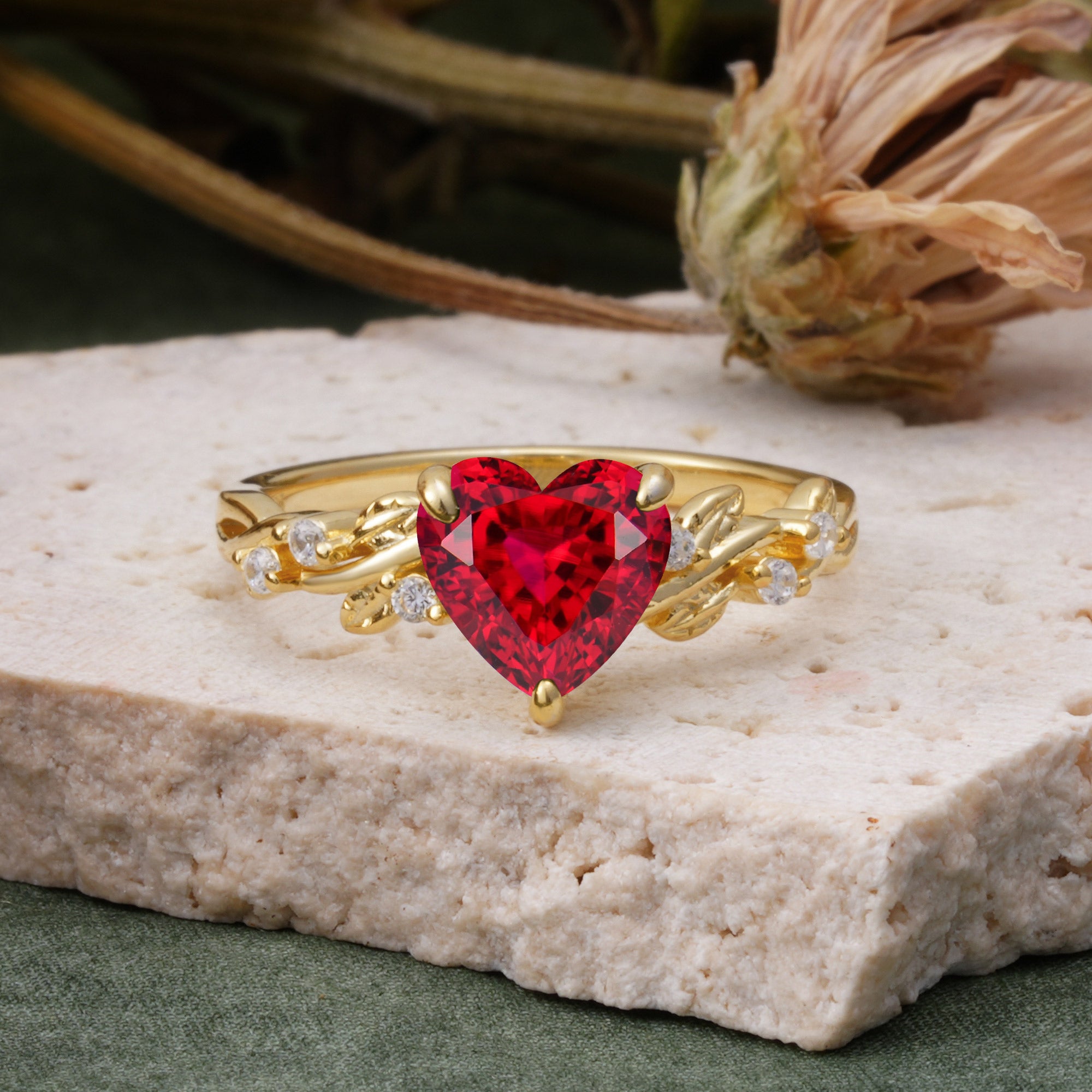
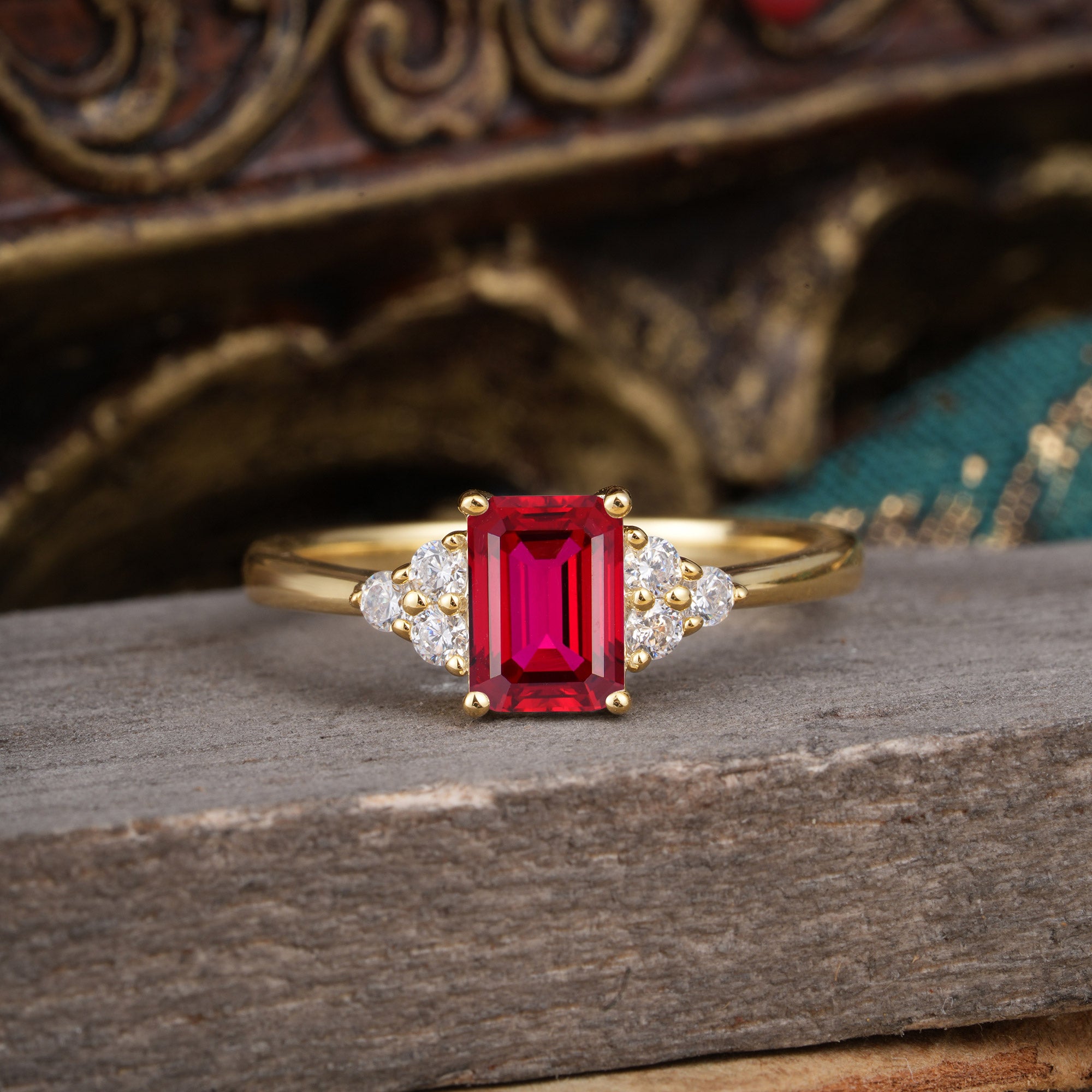
If you are looking for the perfect ruby ring, you can browse Romalar's collection of ruby rings.
Responsible Sourcing and Provenance Claims
Ruby origin can matter to collectors, but a geographic name should not be confused with a quality guarantee. GIA specifically advises buyers not to confuse origin with quality because every mining source can produce a broad range of material. If geographic origin is important, request an independent laboratory opinion rather than relying on a product title.
The Responsible Jewellery Council's Code of Practices covers responsible business practices across the jewelry supply chain, including human rights, due diligence, working conditions, environmental impacts, product disclosure, and responsible sourcing. This does not mean that every retailer without RJC certification is unreliable. It means that responsible claims should be specific enough to evaluate.
When a seller uses terms such as "ethical ruby," "responsibly sourced," or "sustainable jewelry," ask:
• Which material does the claim cover?
• Does it refer to the ruby, the metal, or the finished piece?
• Is the ruby natural, laboratory-grown, or a simulant?
• Is there a third-party standard, audit, or documentation behind the claim?
• Does the retailer explain limits or uncertainties in the supply chain?
Clear limits are a positive sign. A seller that distinguishes verified information from a general aspiration is usually more trustworthy than one that treats broad adjectives as proof.
Care for Men's Ruby Jewelry
Warm soapy water is safe for ruby, but fracture-filled, cavity-filled, or dyed material should be cleaned only with a damp cloth. Ultrasonic and steam cleaning may be safe for untreated, heat-treated, and lattice-diffusion-treated stones, but a buyer should not use those devices without knowing the treatment status.
For daily wear:
• Remove the jewelry before using strong chemicals, solvents, or abrasive cleaners.
• Remove rings before lifting heavy objects, working with tools, exercising with equipment, or performing activities that may create a sharp impact.
• Check prongs, bezels, clasps, and links periodically.
• Do not assume a durable ruby can tolerate every household chemical.
• Store ruby separately from softer gemstones to reduce scratching.
• Ask a jeweler to inspect the setting if the stone moves, a prong catches on fabric, or the metal shows a visible gap.
The best care routine depends on the treatment, not only on the word "ruby."
Final Thought
The strongest online purchase is not necessarily the piece with the largest ruby or the most dramatic red photograph. It is the piece whose gemstone identity, treatment, setting, metal, craftsmanship, and after-sales terms remain clear when the marketing language is removed.
For a traditional direction, a bezel-set ruby men's ring can offer a clean outline and practical protection. For a more expressive piece, engraved bands, vintage details, or a ruby pendant can introduce color without overwhelming the wearer's style. Romalar's lab-grown ruby men's ring offers one accessible design example, but its page also demonstrates why careful buyers should verify the live specification block rather than rely on the product title alone.
Think of the ruby as the piece's visual signature. The signature is convincing only when the paper beneath it—the material disclosure, treatment information, metal specification, and return policy—is equally legible.
FAQs
Where can I find high-quality men's ruby jewelry online?
Look for specialist jewelry retailers and established online jewelers that provide exact stone identity, treatment disclosure, metal fineness, dimensions, setting photographs, independent reports when appropriate, and a written return or repair policy. A high-quality retailer should answer questions about whether the ruby is natural, laboratory-grown, heated, diffused, or filled.
Is a laboratory-grown ruby a real ruby?
A laboratory-grown ruby is man-made corundum rather than a ruby formed in the earth. It should be identified clearly as laboratory-grown or laboratory-created. It may be a legitimate choice for a buyer who values color and design over natural origin, but it should not be priced or described as an untreated natural ruby.
Are most rubies heat treated?
GIA advises buyers to assume that a ruby has been heated unless a report or reliable documentation indicates otherwise. Heat treatment is common and is not automatically unacceptable. The buyer should understand the treatment, compare the price accordingly, and ask whether any additional treatment such as diffusion or fracture filling is present.
What is the best ruby color for a men's ring?
The most broadly prized color is a vivid, pure red to slightly purplish red that is neither too dark nor too light. Personal taste still matters. A deeper wine-red ruby may suit a signet ring, while a brighter red may create more contrast in a modern white-metal setting. View the stone in neutral light rather than relying on a heavily edited image.
Is ruby durable enough for everyday men's jewelry?
Ruby is generally a strong choice for everyday jewelry because corundum has Mohs hardness 9, excellent toughness, and no cleavage. Treatment-related risks and setting quality still matter. Fracture-filled, cavity-filled, and dyed rubies require more conservative care than untreated or conventionally heat-treated stones.
Should I buy a ruby ring without a laboratory report?
A report is especially useful when the ruby is expensive, claimed to be natural and untreated, associated with a premium origin, or difficult to evaluate from photographs. A lower-priced ring may not include a report, but the retailer should still disclose the stone identity, treatments, measurements, metal, and return terms accurately.
Is a bezel setting better for a men's ruby ring?
A bezel setting surrounds the stone's edge and can offer protection with a clean, modern appearance. It is not automatically better than prongs. The appropriate choice depends on the ruby's shape, vulnerable areas, design, access for cleaning, and the wearer's lifestyle.
How do I know whether a ruby product page is trustworthy?
Check whether the title, photographs, specifications, and checkout options agree. If one section calls the stone ruby and another calls it garnet, moissanite, or laboratory-grown ruby, ask for written clarification before ordering. Trustworthy shopping is based on consistent evidence, not on a product name alone.
What metal should I choose for a men's ruby ring?
14K gold is often a practical balance of precious-metal content and everyday wearability. 18K gold offers a higher gold content and richer color, while platinum provides a cool white appearance and substantial weight. Sterling silver or base metals can be appropriate for a lower-cost design, but their durability, tarnish behavior, and long-term value differ.
Share