



Home
›
Engagement & Wedding
›
How to Match an Engagement Ring and Wedding Band: Shape, Height, Metal, and Style

How to Match an Engagement Ring and Wedding Band: Shape, Height, Metal, and Style
by zhousamuel on Sep 04 2026
A wedding band is not a decorative afterthought to an engagement ring. Once both rings are worn on the same finger, they become a small piece of architecture: two circular objects sharing the same space, touching or nearly touching at changing angles throughout the day. The engagement ring contributes a center-stone footprint, a setting height, an under-gallery, shoulders, and a shank. The wedding band contributes its own width, thickness, edge profile, setting detail, and metal surface.
When those elements are considered together, the result can be seamless, intentionally spaced, softly contoured, graphic, vintage-inspired, or quietly mixed-metal. When they are not, two individually beautiful rings can compete for clearance, feel visually unbalanced, or create a gap that looks accidental rather than designed. The aim is not to make every pairing perfectly flush. It is to create a relationship that feels intentional in both top view and side view.
The Four Decisions That Make a Ring Pair Work
Before browsing wedding bands, identify the engagement ring’s physical constraints and the wearer’s aesthetic goal. Most successful pairings resolve four questions in sequence: the center stone’s shape and footprint, the setting’s height and clearance, the metal story, and the stack’s overall design language.
|
Decision |
What to examine |
Why it should be decided early |
|
Shape and footprint |
Center-stone outline, orientation, halo width, side stones, and points or corners. |
The footprint influences how closely another ring can approach the setting. |
|
Height and clearance |
Head, basket, bezel, bridge, gallery, shoulders, and lowest point beneath the stone. |
These features determine whether a straight band has space to sit near the shank. |
|
Metal and finish |
Metal color, karat or fineness, white-metal composition, finish, and care expectations. |
“White” and “gold” are not single materials; composition and finishing affect maintenance. |
|
Style and proportion |
Width, thickness, cross-sectional profile, detail level, stone coverage, and the desired degree of contrast. |
This turns a technically workable pair into a visually coherent stack. |
Begin with the question: Do you want a closely nested pair, a visible but intentional gap, or a more expressive stack? A fully flush look is one valid answer. A small space can be equally deliberate and may be the more practical choice for an existing low-set ring, a wide halo, or a setting with side detail.
Read the Engagement Ring in Side View

GIA describes three basic structural areas of a ring setting: the head, which holds the gemstone; the shoulders, which transition from the shank toward the head; and the shank, the circular band around the finger. Knowing these terms makes a fitting conversation more productive. Rather than asking only whether a ring is “high” or “low,” ask where the wedding band would actually travel in relation to the head and shoulders.
A raised solitaire may leave open space beneath its head, allowing a straight wedding band to sit close to the engagement-ring shank. A lower basket, bezel, broad halo, hidden halo, or side stones may occupy that space. Neither construction is inherently superior. A lower profile may be a good choice for a wearer who values a closer-to-the-finger silhouette; a higher profile may make a straight-band pairing easier. The wedding band should respond to the engagement ring’s existing structure, not force it into a generic solution.
GIA notes that prong settings leave much of a gemstone visible but may catch on fabrics and should be checked periodically. It describes full bezels as surrounding the stone’s edge with metal, offering strong perimeter protection and a smooth profile while covering more of the gem than a prong setting. [1] These are setting trade-offs, not rules about which style is “best.” The correct choice reflects the gemstone, the wearer’s routine, and the design priorities that matter most.
The First Fitting Question
Before choosing stones, engraving, or a band finish, ask the seller: “Can you show me how this exact engagement ring sits beside a straight band, a contour band, and an open band?” If the engagement ring already exists, bring it to the fitting. If it is being designed, ask for side-view imagery or a model that shows the base of the head and the clearance near the shank. A close top-down render is not enough.
Match the Wedding-Band Outline to the Center-Stone Shape
Center-stone shape changes more than the ring’s personality. It changes the amount of horizontal space occupied above the band and may change how a wedding ring can approach the setting. Round stones generally have a compact, symmetrical footprint. Oval, pear, marquise, elongated cushion, and emerald-cut shapes can project farther across the finger, especially with a wide halo, prominent prongs, or an east-west orientation.
The industry guide cited here identifies setting height and center-stone shape as major considerations for a flush fit. It explains that elongated forms such as oval, marquise, and pear may prevent a straight band from sitting fully flush, and it presents curved or open bands as common ways to create appropriate clearance. [2] Treat that as a useful starting framework. The individual ring—not the shape name alone—decides whether a particular band will fit.
Pointed shapes also need protection. GIA notes that V-shaped prongs are commonly used on vulnerable corners of heart, princess, pear, and marquise cuts to help protect them from chipping. A matching band should not visually crowd or physically press against that protective area.
Band Outlines and the Problems They Solve

|
Band outline |
Useful when |
Design character |
What to verify on the actual ring |
|
Straight band |
The engagement ring leaves adequate space beside or below the head. |
Classic, complete on its own, and easy to layer later. |
Test the pair in side view; a straight band should not be assumed to sit flush from a front-view image. |
|
Soft contour |
A low basket, halo, bezel, or elongated center stone blocks a straight band. |
Close, fluid, tailored, and quietly romantic. |
The curve should relate to the specific engagement-ring silhouette rather than look decorative in isolation. |
|
Chevron or V band |
The wearer wants a deliberate point or graphic line around the center stone. |
Directional, architectural, and often visually elongating. |
Check that the V clears prongs, halo edges, and the lowest part of the head. |
|
Open band |
Center clearance is needed but a literal contour feels too specific. |
Modern negative space with a light, framed effect. |
Inspect the symmetry of the opening and make sure the open ends do not catch or crowd the head. |
|
Notched or deep contour |
The engagement ring has a prominent head, wide halo, asymmetry, or unusual gallery. |
Close-to-custom, highly integrated, and sculptural. |
Ideally fit it to the actual engagement ring or an accurate model; the more exact the contour, the less interchangeable it may be. |
|
Intentional gap |
The wearer values separation, wants a band that stands alone, or prefers a looser stack. |
Airy, collected, and visibly layered. |
Make the spacing a conscious part of the design rather than an unexamined by-product of poor clearance. |
A contour is not evidence that the engagement ring has “failed” to fit a wedding band. It is a design language. The most effective examples echo one element of the engagement ring—a rounded halo, an oval’s curve, the arc of the shoulders, or the softness of a pear—without tracing every millimeter so closely that the band loses its independent identity.
Height: Decide Whether Flush Fit Is a Goal or a Constraint

“Flush fit” generally describes a wedding band that sits closely beside an engagement ring without a gap created by the center setting. It can create a clean, unified look, but it is not automatically more comfortable, more durable, or more beautiful than a deliberate gap. A low, protective bezel may be ideal for one wearer even if it calls for a contour band. A raised setting may accept a straight band more easily but may be more exposed in daily activity. GIA emphasizes that setting choice affects a gemstone’s security, light performance, and wearability.
Three approaches to clearance: a raised solitaire with a straight band, a low bezel with a soft contour, and a pear-shaped ring with an open band. The correct choice follows the actual head construction and desired visual relationship.
Do Not Force a Straight Band
If a perfectly straight wedding band is a non-negotiable priority, bring it into the conversation while the engagement ring is still being designed. Ask where the band will sit in relation to the head, whether the ring has a bridge or gallery clearance, and whether a matching straight band can be shown beside it. Do not accept a vague “it should fit” when a side-view drawing or physical sample is available.
If the engagement ring is already owned, allow its architecture to guide the next step. A close contour may be the best solution. An open band may create the room needed while staying visually light. A small intentional gap may make both rings easier to read. Practical caution is warranted when a band appears pressed tightly against a head or prong: inspect the contact point with a qualified jeweler rather than assuming that a tighter fit is preferable.
Metal: Coordinate the Color, Then Confirm the Material

Matching metals remains the simplest route to a cohesive bridal set: yellow gold with yellow gold, a white-metal engagement ring with a white-metal band, or rose gold repeated across both rings. But color consistency is a design choice, not a requirement. A yellow-gold engagement ring with confirmed white-metal prongs and a slim white-metal wedding band can look intentional if the cool metal is repeated elsewhere—in a pavé band, an accent edge, a second stacking ring, or the wearer’s everyday jewelry.
The technical distinction matters. The World Gold Council explains that pure 24-carat gold is alloyed with other metals to increase durability and change color. It identifies 18-carat gold as 75% gold and 25% other metals, and attributes rose gold’s pink tone to copper in the alloy. It also explains that white gold is created through alloying gold with white metals and is usually rhodium plated for a harder, brighter surface. [4]
GIA states that white gold can be alloyed with metals including nickel or palladium, copper, and zinc. It notes that rhodium plating gradually wears and may require occasional replating, and it cautions those with nickel allergies to avoid white-gold alloys containing nickel. [3] Because alloy recipes vary, do not identify a ring’s actual metal from color alone. Ask the seller to state the metal, karat or fineness, plating, and any relevant care instructions in writing.
A Metal-Matching Framework
|
Metal approach |
Visual result |
Questions to ask |
A strong execution |
|
Same metal and same color |
The most continuous, traditional set. |
Are the karat/fineness, finish, and edge profiles compatible? |
Repeat the same material and color, then vary width or stone detail gently if desired. |
|
Same color, different detail |
Cohesive but less obviously “matched.” |
Will the difference in polish, texture, or edge profile read as intentional? |
Pair a polished yellow-gold solitaire with a yellow-gold band in a different width, satin finish, or fine engraving. |
|
White-metal pairing |
Crisp, light-reflective, and diamond-forward. |
Is each ring white gold, platinum, palladium, or another disclosed alloy? Is replating expected? |
Repeat the white-metal effect while keeping accurate material documentation. |
|
Intentional two-tone stack |
Contemporary contrast and a collected-over-time look. |
Which metal is the anchor? Where will the second tone recur? |
Use one dominant metal and repeat the accent through prongs, a slim band, milgrain, or an adjacent ring. |
|
Rose-gold contrast |
Warm, romantic, and visibly individual. |
Does the warmth complement the stone and the wearer’s existing jewelry? |
Use rose gold as a main material or a clearly repeated accent, not an isolated third idea. |
The World Gold Council’s alloy examples are typical rather than exhaustive. Two rings described as “14K white gold” may not share the same alloy recipe, tone, nickel content, or plating history. GIA describes palladium as strong, light, hypoallergenic, and non-tarnishing; it describes platinum as dense, strong, less brittle than gold alloy, and hypoallergenic. Those characteristics support a more informed discussion, but an individual ring’s construction and care instructions should still come from the seller or jeweler.
The industry guide also notes that rings in different metals or karat weights may wear at different rates and that platinum can scratch a gold band over time. Treat this as a reason to inspect how a chosen pair contacts and moves—not as a blanket ban on mixing metals. A designer or jeweler can assess a particular stack’s contact surfaces, finish, stone setting, and maintenance expectations.
Style: Match Design Language Rather Than Copying Every Detail

After geometry and metal are resolved, style becomes the enjoyable part. A strong stack usually repeats one or two signals: a metal color, a band width, an edge profile, an era, a finishing treatment, a stone shape, or a level of sparkle. It does not need to repeat all of them. Exact duplication can feel heavy; a restrained echo often feels more considered.
Start with proportion. A broad engagement-ring shank beside an ultra-fine wedding band can be elegant if the thin band is meant to read as a deliberate line. It can also look disconnected if the wedding band disappears visually. Two wider rings can be confident and architectural, but the combined width should be tried on the intended hand before a final decision. The wearer’s comfort, finger proportions, and familiarity with rings all matter more than a preset width formula.
Then assess profile, the cross-sectional shape of the band. Rounded bands often create a soft, continuous relationship. A flat, knife-edge, or faceted band beside a rounded engagement-ring shank can create a sharper contemporary contrast. The industry guide observes that rounded profiles tend to nest more naturally, while mixed profiles can look intentional when balanced in person.
Style Formulas That Start the Conversation
|
Engagement-ring character |
Wedding-band direction |
Why it works |
|
Classic round or oval solitaire |
Straight plain band, slim pavé, or restrained contour. |
The center stone stays visually primary while the band controls the amount of sparkle and detail in the stack. |
|
Low bezel or east-west center stone |
Soft contour, open band, or planned gap. |
The companion band respects a broad, low silhouette instead of competing with it. |
|
Vintage-inspired ring with milgrain or engraving |
Plain engraved band, fine milgrain edge, or subtle bead-set detail. |
Repeating one period-style detail creates connection without replica styling. |
|
Halo or side-stone ring |
Plain polished band or narrow contour. |
A simpler companion gives an already detailed center ring visual breathing room. |
|
Minimal sculptural ring |
Chevron, open, or asymmetric companion band. |
The wedding band becomes a second intentional line rather than a conventional addition. |
A useful final question is: What is the sentence this stack is trying to say? It may be “classic with one clean modern line,” “vintage but edited,” “minimal with a trace of sparkle,” or “mixed metals with an intentional bridge.” If an option is beautiful but belongs to a different sentence, it is usually the wrong band for this stack.
The Practical Fitting Appointment: What to Bring and What to Test
The most reliable way to match an engagement ring and wedding band is to evaluate them together. If a local appointment is possible, bring the actual engagement ring and any bands you are considering. If a custom band is being made remotely, provide the retailer with accurate ring size, top and side photos, metal details, dimensions where available, and notice of any prior resizing or repair.
|
At the appointment |
What to do |
What you are trying to learn |
|
Top view |
Place the rings where they would normally sit and check the space, symmetry, and overall proportion. |
Does the stack look intentional from a normal viewing distance? |
|
Side view |
Look at head clearance, prongs, gallery, halo, and the band’s path beside them. |
Does the band touch or crowd a part of the setting that requires space? |
|
Movement test |
Close your fist, type, reach into a bag, and put on a sweater. |
Does the combined stack feel secure and comfortable in ordinary motions? |
|
Rotation check |
Notice whether either ring turns, shifts, or pushes the other out of position. |
Is the fit balanced enough for the wearer’s usual routine? |
|
Documentation check |
Ask about material, finish, sizing, resizing, service, and care in writing. |
Can the buyer make an informed decision before altering or committing to a design? |
Do not finalize a band from a product photo alone. Visuals are excellent for selecting a direction, but they rarely reveal under-gallery height, center-setting depth, or how a finished ring will respond to the wearer’s hand. If the rings seem likely to contact in a sensitive area, ask a jeweler to assess the exact pair.
Care and Future Flexibility
A wedding-band decision continues after the ceremony. Rings worn on one finger may contact each other during normal movement, so surfaces, settings, and maintenance expectations should be treated as part of the pairing—not as afterthoughts. Store the rings thoughtfully, follow the seller’s care instructions for the specific metal and stone settings, and arrange an inspection when wear is visible or at the interval recommended by a qualified jeweler.
GIA notes that prongs should be checked periodically. It also explains that channel-set bands can be difficult to resize, particularly when stones extend far around the band; pavé areas may also complicate resizing, and tension settings can be very difficult or impossible to resize. If the wedding band includes an eternity layout, extensive pavé, channel-set stones, or tension construction, ask about resizing before purchase and retain the answer in writing.
Future stacking is another reason to keep some design flexibility. If the wearer imagines adding an anniversary band, a slim plain band, or another contour later, consider how the first wedding band will function as part of a three-ring composition. You do not need to design the entire future stack today, but a small amount of planning can keep options open.
Final Thought: Match the Relationship, Not Just the Rings
A thoughtful bridal set is not defined by whether the metal colors are identical or whether the wedding band disappears into a perfect flush line. It is defined by whether the two rings acknowledge each other. The center stone has room to breathe. The setting is respected rather than crowded. The widths, surfaces, and metal tones have a clear relationship. The wearer can move through an ordinary day without the stack feeling like a compromise.
Start with geometry. Inspect the side view. Confirm metal identity instead of relying on appearance. Try the actual rings together wherever possible. Then let curve, width, finish, and sparkle do the expressive work. The strongest pairing is not the one that follows a single rule; it is the one that makes two distinct rings look as though they were always meant to share the same hand.
For a engagement ring & wedding band, Romalar’s offers related style inspiration. Use it as further on the orientation;
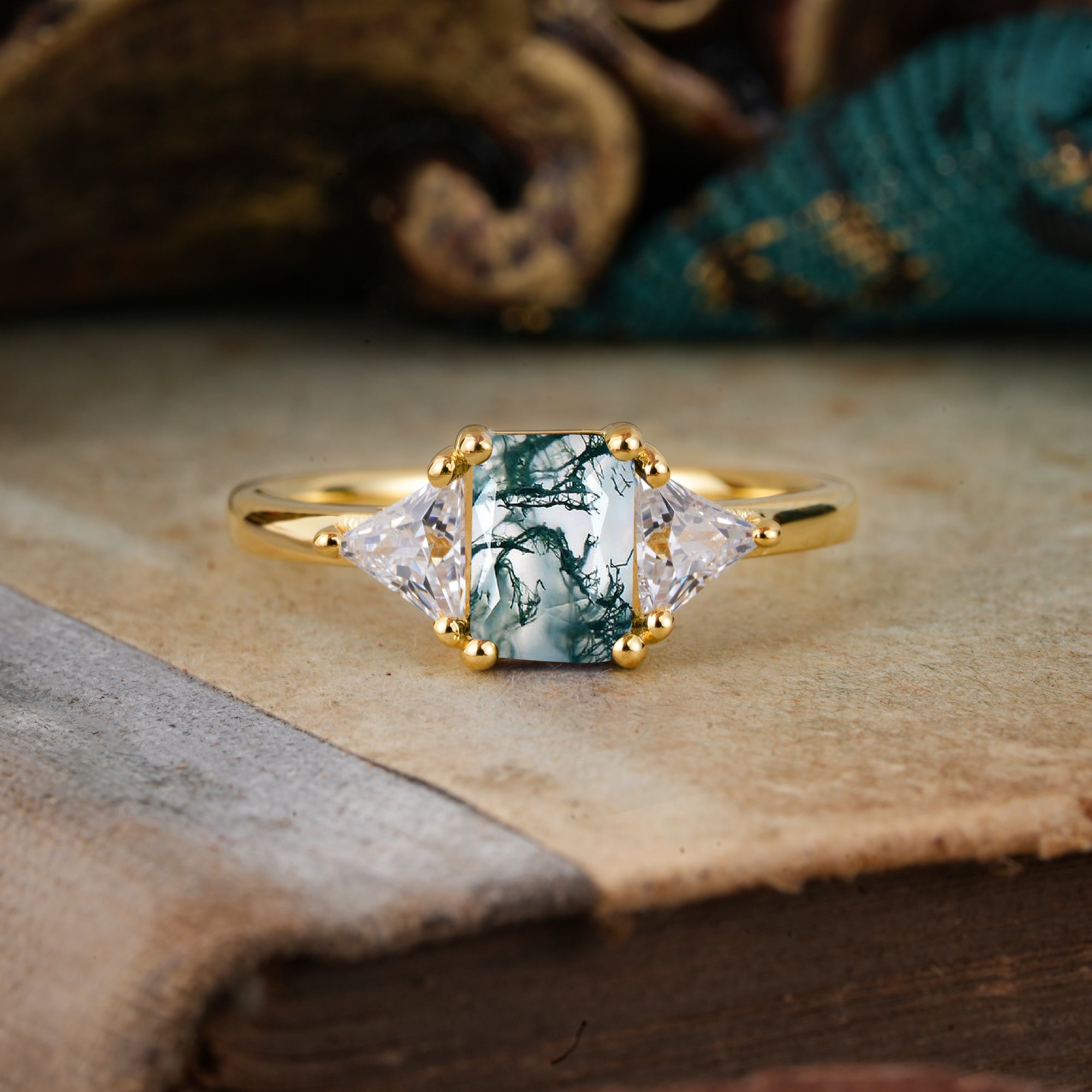 1CT Emerald Cut Moss Agate Three Stone Engagement Ring
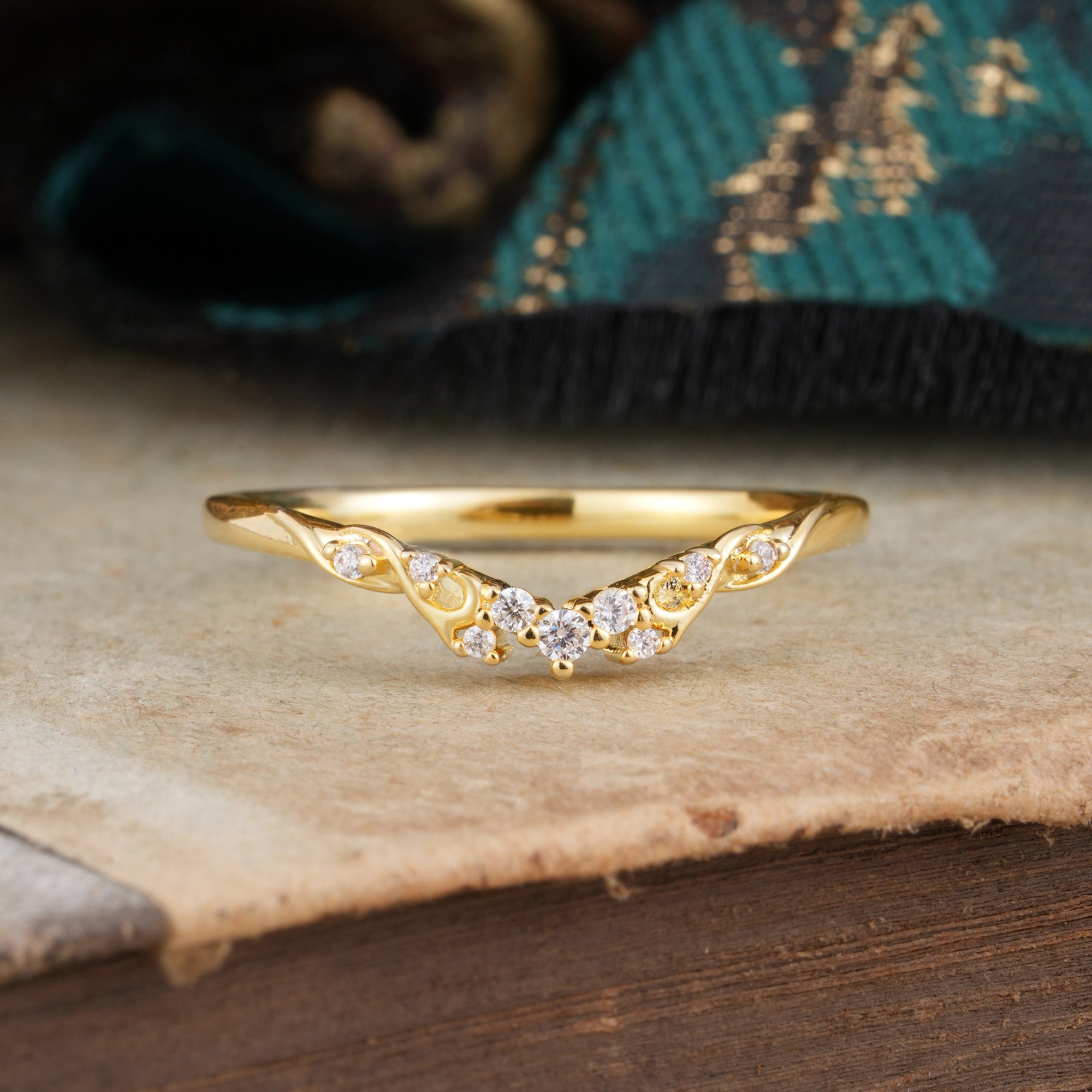 Luxurious Moissanite Curved Wedding Ring
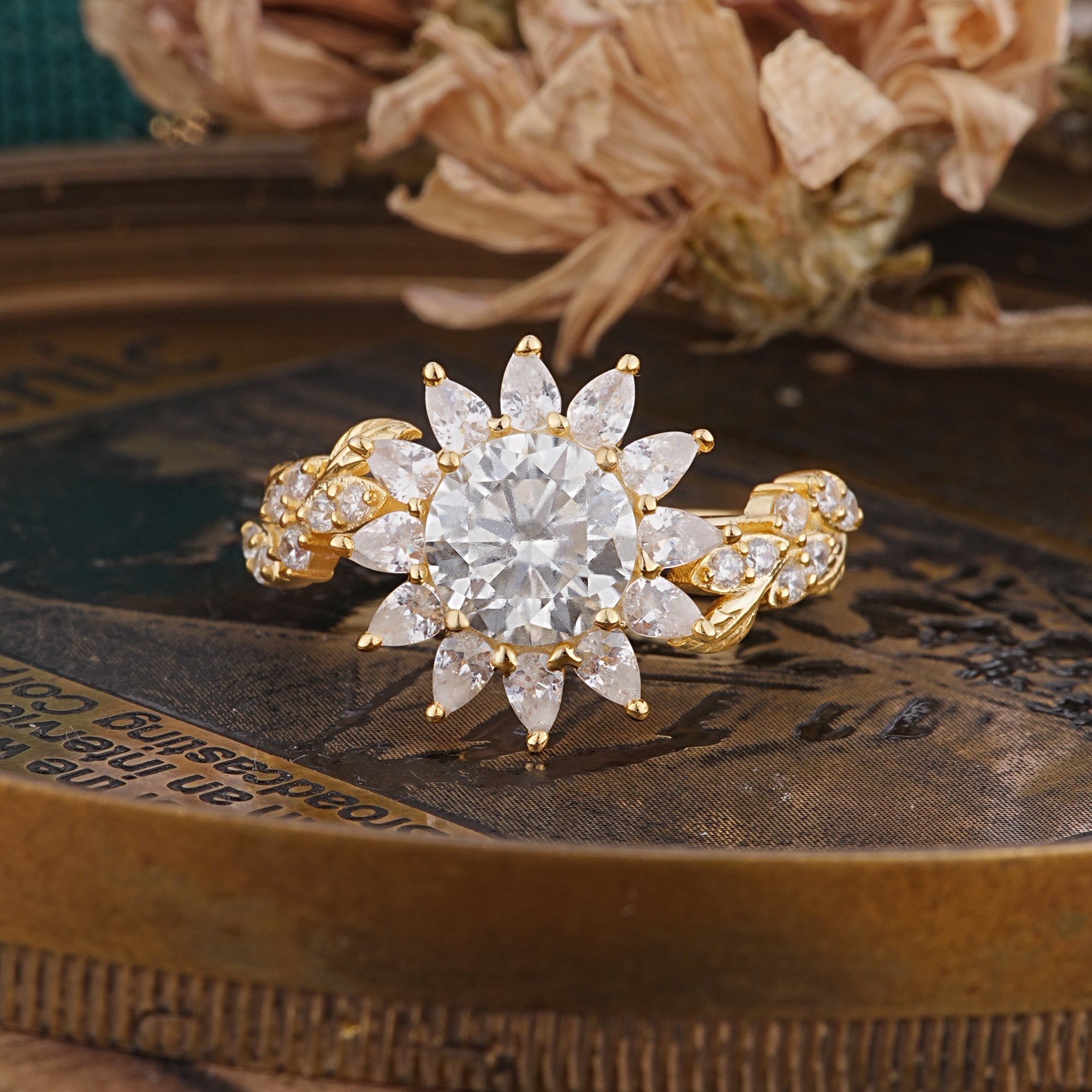 Nature-Inspired Sunflower 4-Prong Round Cut Moissanite Engagement Ring
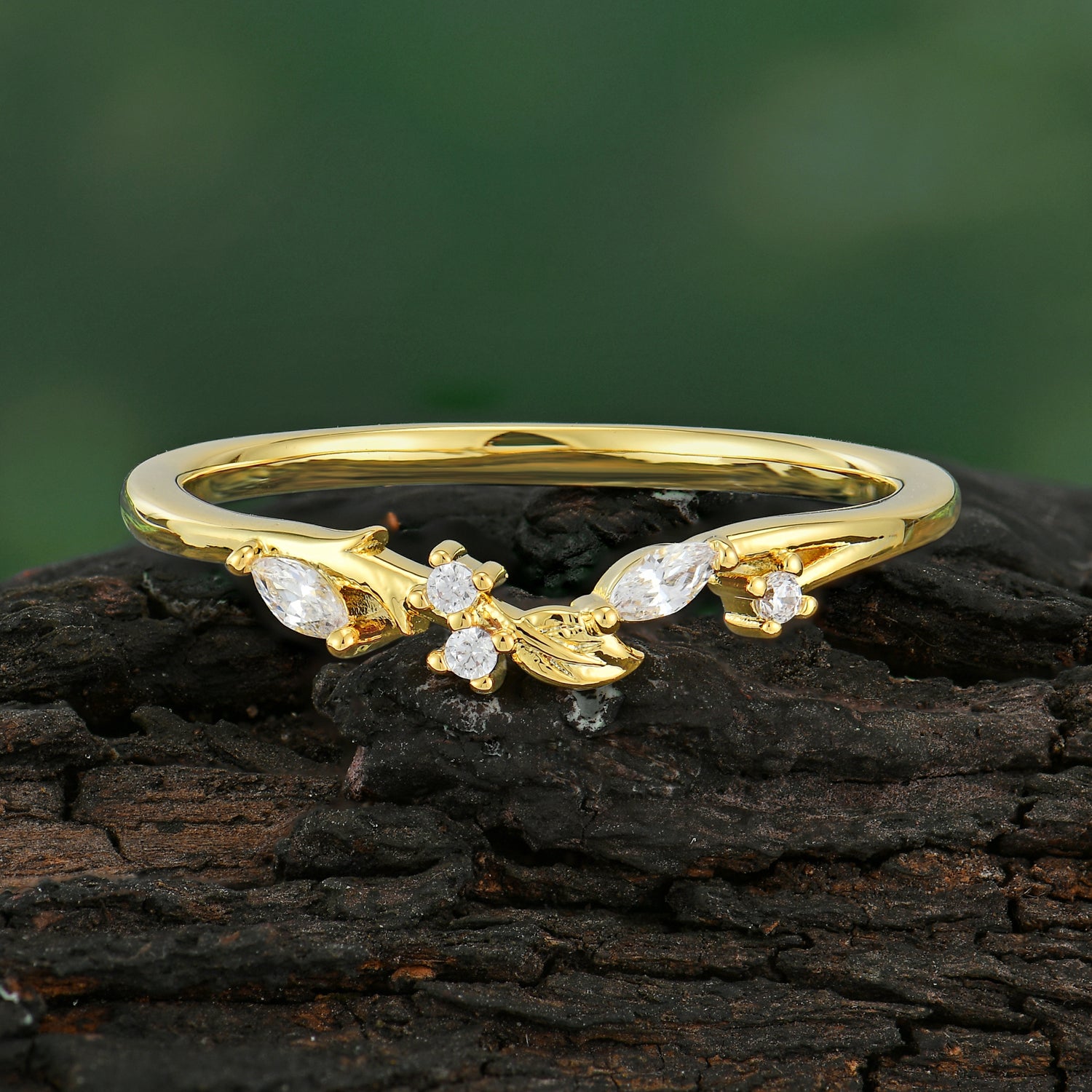 Nature-Inspired Exquisite Minimalist Moissanite Curved Wedding Ring
FAQs
Does a wedding band have to sit flush against an engagement ring?
No. A flush fit is an aesthetic preference, not a universal requirement. A contour, open band, or small intentional gap can be equally successful when it reflects the engagement ring’s geometry and the wearer’s style. The exact fit of a straight band depends on the individual setting’s clearance, not simply on whether a product is labeled high-set or low-set.
Can a low-set engagement ring work with a wedding band?
Yes. Low-set rings often pair naturally with soft contours, open bands, chevrons, or deliberate spacing. The industry guide cited here identifies low settings, decorative galleries, side stones, and hidden halos as features that may stop a standard straight band from sitting fully flush. The appropriate answer is not automatically to change the engagement ring; it is to choose a companion band that works with its actual side profile.
Should I buy the engagement ring and wedding band together?
Buying them together gives the strongest opportunity to assess clearance, comfort, proportion, metal coordination, and future stacking. It is especially helpful for halos, elongated stones, east-west layouts, low settings, and custom contours. If the rings cannot be purchased together, keep detailed dimensions and side-view photos and ask whether a later companion band can be fitted to the actual engagement ring.
Can I mix yellow gold and white metal in a bridal set?
Yes. The mix is most convincing when it is repeated intentionally—for example, a yellow-gold ring with confirmed white-metal prongs and a white-metal pavé band, or a yellow-gold set with a thin white-metal accent. Confirm each ring’s actual material rather than relying on color. White gold is commonly rhodium plated and may need replating over time; alloy composition also matters to people sensitive to nickel.
What band works best with an oval, pear, or marquise engagement ring?
There is no single best band. Curved and open options can provide useful clearance around elongated or pointed shapes, especially where a straight band would meet the head. Start with the engagement ring’s side view. A slim contour may echo the outline, an open band may frame the center stone, and a straight band may work if the setting provides sufficient space.
Do the two bands need to have the same width?
No. Matching widths create symmetry, while contrast can establish a visual hierarchy. A fine band beside a substantial engagement-ring shank can look refined if it is clearly intentional; two similarly weighted bands create a fuller, more unified stack. Try the combined width on the hand and judge it in ordinary light and at ordinary viewing distance.
Is it safe for rings to touch each other?
Some contact may occur when two rings are worn on the same finger. The practical issue is where and how they contact: plain metal edges, pavé sections, delicate finishes, or prongs may respond differently. The cited industry guide notes that different metals and karat weights may wear at different rates and that platinum can scratch gold. For a specific pair, ask a jeweler to inspect the contact points and describe expected maintenance.
Can a contoured or diamond-set wedding band be resized later?
It depends on the exact construction. GIA states that channel-set rings can be difficult to resize, especially when stones extend far around the shank; it also notes that pavé may complicate resizing and tension settings can be very difficult or impossible to resize. A contour by itself does not determine resizability. Obtain the seller’s written policy for the exact finished ring.
References
[1] GIA — Complete Guide to Engagement Ring Settings
[2] Brilliant Earth — How to Choose a Wedding Band Based on Your Engagement Ring
[3] GIA — Choosing Between White Gold, Platinum, Palladium, and Silver
[4] World Gold Council — Gold Jewellery: Colour, Carat & Purity
Share