



Home
›
Gemstone Education
›
Moss Agate vs. Black Rutilated Quartz: Inclusions, Durability, and Style

Moss Agate vs. Black Rutilated Quartz: Inclusions, Durability, and Style
by zhousamuel on Aug 28 2026
Moss agate and black rutilated quartz appeal to the same kind of jewelry buyer for one reason: the internal world of the stone is the design. Neither material is chosen for a blank, uniform face-up look. Moss agate can suggest a misty garden, weathered landscape, or a fragment of a forest seen through water. Black rutilated quartz can look like ink lines, shadowy architecture, or a constellation of dark threads suspended inside a quartz host.
The visual kinship is real. The material story is not. Moss agate is an agate/chalcedony variety within the quartz family. Its plant-like pattern is inorganic: Britannica describes grayish-to-milky-white moss agate as quartz containing dark, branching inclusions, mainly manganese and iron oxides, whose forms resemble vegetation. [1] Black rutilated quartz, by contrast, is a commercial label commonly used for quartz with very dark, needle-like internal features. When those needles have been identified as rutile, they are titanium-dioxide crystals: GIA documents acicular rutile inclusions in quartz, including an example radiating from a hematite core. [2]
That distinction changes how a thoughtful buyer shops. You need to assess not only the apparent pattern, but also the exact stone’s transparency, cut, edge thickness, treatment disclosure, and setting design. Both choices sit in a broadly similar quartz-family scratch-resistance range. Neither should be sold as a carefree replacement for diamond or sapphire. Their visible inclusions are part of their value—but they also make exact-stone inspection more important.
The decision in one sentence: Choose moss agate when you want a quiet, botanical, landscape-like composition with soft depth. Choose black rutilated quartz when you want dark linear contrast, visual direction, and a more graphic or architectural statement. Choose either only after you have seen the actual stone in multiple lighting conditions and received treatment/care information in writing.
This is a general educational guide, not a gem identification report, an appraisal, or a repair diagnosis. If the exact identity of a dark inclusion, the presence of a treatment, or the structural condition of a stone is material to your purchase, request seller documentation and seek qualified gemological advice where appropriate.
Start with the Inclusion Story, Not the Marketing Label
The most useful question is not “Which stone has better inclusions?” It is: What visual language does each inclusion pattern create, and how much certainty do you have about its identification?
Moss agate is read as a scene. Its body can be clear, gray, white, or softly cloudy, while branching inclusions can evoke moss, ferns, smoke, lichen, riverbanks, or an abstract ink wash. Britannica identifies the branching material as inorganic manganese- and iron-oxide inclusions. International Gem Society describes moss agate as a chalcedony variety made from component quartz crystals too small to distinguish with the naked eye; it also notes the familiar green, branch-like appearance that gives the material its name. The exact color, density, and distribution vary from stone to stone.

Rutilated quartz is read as line and direction. GIA’s documented example shows acicular rutile needles in a colorless quartz host. In commercial jewelry, the adjective black is often applied to quartz whose needles look very dark. That description may be visually useful, but it is not the same as a laboratory identification of the inclusion mineral in every individual stone. A responsible listing can describe what is visible; a stronger listing can also say how the inclusion material was identified.
The practical conclusion is reassuring rather than restrictive. You do not need a laboratory report to enjoy an inclusion-rich ring. You simply should not pay a premium for a mineral-specific claim that the seller cannot explain. If exact inclusion identity matters to you, ask what evidence supports it. If it does not, select the stone for the composition you can see and the condition you can inspect.
A Clearer Naming Guide for Black Needle Inclusions
|
Description a seller may use |
What the wording can safely communicate |
What the wording does not prove by itself |
Smart buyer follow-up |
|
Rutilated quartz |
Quartz with needle-like inclusions represented as rutile; GIA documents rutile as acicular titanium-dioxide inclusions in quartz. |
That every needle in every stone bearing the label has been laboratory confirmed as rutile. |
Ask whether the identification is based on a report, a supplier description, or a visual trade designation. |
|
Black rutilated quartz |
A commercial description of quartz with dark, needle-like features intended to be the visual focus. |
The exact mineral species, origin, treatment status, or permanence of the dark appearance. |
Request the exact material description and any treatment disclosure in writing. |
|
Included quartz |
A cautious visual description for quartz containing visible internal features. |
That the inclusions are insignificant, untreated, or structurally irrelevant. |
Inspect the stone for surface-reaching fractures, cloudy zones, chips, and edge condition. |
|
Moss agate |
Chalcedony/agate with branching inorganic inclusions that create a moss- or vegetation-like effect. |
That the pattern is botanical matter, that every moss agate shares the same inclusion assemblage, or that it is untreated. |
Confirm the exact stone, ask about dyeing or other treatment, and evaluate the pattern in ordinary light. |
Moss Agate vs. Black Rutilated Quartz: The Core Comparison
|
Feature |
Moss agate |
Black rutilated quartz |
Why it matters for a ring |
|
Host material |
Chalcedony/agate: a microcrystalline quartz aggregate. |
Transparent-to-translucent quartz host with dark, needle-like internal features. Where confirmed as rutile, the needles are titanium-dioxide crystals. |
Host structure affects translucency, texture, polish, and how the internal composition reads face-up. |
|
Inclusion character |
Branching, cloud-like, scenic, or landscape-like inorganic patterning. |
Linear, needle-like, intersecting, radiating, or directional dark features. |
Moss agate reads as atmosphere; black rutilated quartz reads as contrast and movement. |
|
Typical visual impression |
Misty, quiet, botanical, and depth-led. |
Graphic, high-contrast, directional, and line-led. |
The same mounting can feel romantic with moss agate or sharply modern with black needle inclusions. |
|
Mohs baseline |
Commonly stated at 6.5–7. |
Quartz host: Mohs 7. |
Both need considered ring care; a Mohs value alone does not assess fractures, treatments, or setting protection. |
|
Best visual buyer |
Someone drawn to nature, subtle asymmetry, watercolor softness, and a one-of-one miniature scene. |
Someone drawn to dark contrast, linework, geometric tension, and a bolder focal point. |
Style is usually the primary divider because practical scratch-resistance expectations are similar. |
|
Key purchase question |
“Does this pattern stay expressive in normal daylight, not only in a studio photograph?” |
“Do the dark lines create depth and direction without turning the stone visually flat?” |
Exact-stone images and video are more informative than a generic category image. |

Figure 1. Mohs values compare relative scratch resistance only. Moss agate’s reported 6.5–7 range and quartz’s Mohs 7 baseline should be considered alongside inclusion condition, treatments, cut, setting design, and the wearer’s routine. [3] [4] [5]
Why Exact-Stone Viewing Is Essential
With a calibrated diamond, a buyer often compares repeatable attributes: carat weight, shape, color, clarity, cut, and report data. Inclusion-rich quartz and chalcedony invite a different standard. The material is defined by variation. One buyer sees a dramatic inclusion as a storm; another sees it as visual clutter. One stone becomes luminous on skin; another becomes muted once mounted over a closed setting.
This does not make online buying unreasonable. It changes the evidence you should require. Ask to see the actual stone from more than one angle, in a short video, and—ideally—in daylight-equivalent lighting. Ask for at least one view over a light background. If the ring setting will be closed-backed or the stone will sit low, ask how the mounting affects the light passing through it.
For moss agate, judge the relationship between negative space and pattern density. A densely packed stone can be dramatic but lose the open, misty quality many buyers expect. A nearly empty stone may be elegant but fail to deliver the botanical effect promised by the listing. The strongest examples often feel balanced rather than symmetrical: enough translucent body to create spatial depth, enough inclusion density to create a visual narrative, and no dark patch that overwhelms the whole face-up view.
For black rutilated quartz, judge the direction, contrast, and rhythm of the needles. A few long lines can feel spare and modern. A dense mesh can feel mineral, cosmic, or intentionally chaotic. Lines that converge near a corner can animate a kite or shield cut, but they may appear lopsided in a classic oval. Lines crossing the center can create a focal point—or visually split the stone. There is no correct answer; there is only the composition you want to wear for years.

The purchase principle is simple: do not buy a category name; buy a particular internal composition.
Durability: Similar Scratch Resistance, Different Wear Decisions
Moss agate and included quartz are both quartz-family choices, so their scratch-resistance baseline is close. IGS gives moss agate a Mohs range of 6.5–7, while GIA lists rose quartz at Mohs 7 and notes that quartz is Mohs 7 in its durability guidance. That is a practical, wearable range for jewelry—but it is not a promise of indestructibility.
GIA defines gemstone durability through hardness, toughness, and stability. Hardness concerns scratching and abrasion; toughness concerns resistance to breaking and chipping; stability concerns response to heat, light, chemicals, humidity, and other environmental stresses. Mohs tells you only about the first category. It cannot tell you whether a stone has a thin edge, a surface-reaching fracture, a treatment-sensitive coating, or a setting that leaves its most exposed point unprotected.
That is especially important when visible inclusions are the reason to buy the stone. Inclusions are not automatically defects. In this category, they are often the feature. Yet a buyer should still inspect the whole gem rather than rewarding inclusion density alone. Ask about surface condition, edge polish, shallow cutting, visible fractures, and treatment history before deciding whether the pattern is worth the trade-off.
Moss agate: protect the edge and preserve the light path
Moss agate is often cut in broad ovals, kites, hexagons, pears, cabochons, or freeform shapes that maximize its scenic face-up area. That is visually effective, but a broad and shallow profile can leave a thin perimeter exposed to impact. IGS advises protective settings for active daily wear and specifically notes the chip risk of thin moss-agate edges.
A bezel, partial bezel, or lower-profile design can reduce edge exposure. GIA likewise recommends bezels, partial bezels, or V-shaped prongs to protect vulnerable points and corners in gemstones. These choices do not alter the stone’s mineral properties. They simply reduce the likelihood that a countertop edge, gym equipment, or a hard accidental knock meets the most vulnerable part of the cut.
Moss agate also rewards a clean light path. A translucent stone can look dramatically flatter when lotion, soap residue, or dust accumulates behind the gallery. Choose a setting that lets the stone be cleaned gently, and inspect the back as carefully as the face.

Black rutilated quartz: inspect the entire quartz host, not only the dark needles
A quartz stone with strong dark needles can look structurally simple from the front, but the needle pattern should not distract from condition. Examine the girdle, edge polish, surface-reaching fractures, cloudy zones, and the relationship between the inclusions and the chosen cut. Ask whether the stone has been stabilized, filled, coated, dyed, irradiated, or otherwise treated.
GIA explains that treatments can improve appearance but may also affect durability and special-care requirements. Its treatment overview notes that quartz can be coated or dyed and that transparent gems including quartz can potentially be fracture-filled when they have surface-reaching fractures. [6] That does not mean your particular stone is treated. It means treatment disclosure is a practical ownership issue rather than an optional detail.
The Wearability Comparison That Actually Helps
|
Decision factor |
Moss agate |
Black rutilated quartz |
Better choice when… |
|
Scratch-resistance baseline |
Mohs 6.5–7. |
Quartz host at Mohs 7. |
There is no meaningful winner on hardness alone; select the better exact stone and setting. |
|
Primary visual priority |
A translucent scene, branching mineral patterning, and organic depth. |
Dark linear inclusions, high contrast, and spatial drama. |
You know whether you prefer atmosphere or a graphic statement. |
|
Protective design priority |
Low-set bezel, partial bezel, or carefully placed protective prongs; especially helpful for broad, thin-edged cuts. |
Secure, low-to-medium profile; orient the needle pattern intentionally before setting. |
You want the metalwork to support, not compete with, the internal composition. |
|
Daily-wear approach |
Considerate daily wear may be realistic when the ring is removed for high-impact tasks and the buyer accepts normal surface wear over time. |
A similar approach; care should be particularly conservative if condition or treatment is uncertain. |
You will treat the ring as fine jewelry rather than as an indestructible object. |
|
At-home cleaning baseline |
Mild warm soapy water and a soft cloth or soft brush; avoid aggressive mechanical cleaning. |
Mild warm soapy water is a conservative quartz-family baseline; avoid ultrasonic and steam methods if treatment, fracture condition, or setting security is unknown. |
You prefer a low-tech, repeatable care routine. |
|
Long-term visual consideration |
Fine scratches can soften polish; residue behind the stone can mute its landscape effect. |
Fine scratches can soften the host’s crispness; dirt or cloudiness can reduce contrast around the needles. |
You are prepared to clean gently and arrange inspection if the ring becomes loose or catches. |
Style: Botanical Romance or Graphic Darkness?
Durability creates the guardrails. Style decides whether the ring feels like yours.
Moss agate: botanical, quiet, and layered
Moss agate is strongest when the design gives the stone room to breathe. Yellow gold can add warmth; rose gold can make the palette feel softer; white metal can sharpen the misty background. Brushed finishes, gentle engraving, milgrain, low bezels, and restrained accent stones can all work well because they support the internal scene without trying to outcompete it.
The design risk is overdecoration. A moss agate with dense patterning already carries a lot of information. If you add a large halo, elaborate shoulder engraving, multiple accent colors, and a heavy textured shank, the result may become visually crowded. A more confident approach is to choose one supporting gesture: a thin halo, a softly textured band, a small side-stone pair, a vintage edge, or a simple bezel.
Moss agate suits a wearer who likes soft contrast. Its appeal often appears at close range, in diffuse daylight, or during the small changes of ordinary life. It can be botanical without looking literal, romantic without looking conventional, and personal without needing a high-sparkle presence.
Black rutilated quartz: directional, intentional, and high-contrast
Black rutilated quartz usually creates a more graphic focal point. The eye follows the dark lines. Sparse, long needles can resemble ink strokes on glass; a dense mesh can look stormy, mineral, or celestial. That directional quality makes rotation part of the design. Turning a stone 90 degrees may transform its apparent balance.
This material often works naturally with elongated hexagons, shields, kites, east-west ovals, clipped corners, signet settings, and sharply defined bezels. White metals can make the dark lines feel crisp and contemporary. Yellow gold can add warmth and prevent the ring from feeling overly severe. Oxidized or blackened details can move the design toward a darker, more gothic interpretation.
The key is compositional intention. Do the needles lead the eye toward the center? Do they create balance on the long axis? Does the setting preserve the stone’s strongest orientation? When the inclusion pattern is the headline, the mounting should make that headline easier—not harder—to read.
Pairing Each Stone with Metal, Cut, and Accent Stones
|
Design choice |
Moss agate direction |
Black rutilated quartz direction |
|
Metal color |
Yellow gold for warmth, rose gold for softness, white metal for a cool misty effect. |
White metal for graphic contrast, yellow gold for warm drama, darker details for a bolder edge. |
|
Cut shapes |
Oval, pear, kite, hexagon, round cabochon, and freeform cuts that preserve a scenic view. |
Shield, kite, hexagon, elongated oval, and stepped or directional shapes that give the linework a role. |
|
Setting language |
Botanical engraving, milgrain, low bezels, soft halos, and organic side-stone clusters. |
Minimal bezels, compass prongs, geometric frames, signet shoulders, and deliberate negative space. |
|
Accent-stone approach |
Salt-and-pepper diamonds, white sapphires, muted greens, champagne diamonds, or no accents. |
White diamonds for contrast, black diamonds for drama, colorless sapphires, or a restrained side-stone pair. |
|
Styling cue |
“A landscape you can wear.” |
“Linework captured in crystal.” |
These are design directions, not restrictions. Moss agate can look exceptionally modern in a sharp geometric bezel. Black rutilated quartz can become surprisingly romantic in yellow gold with soft floral details. The more useful distinction is diffuse versus directional: do you want the eye to wander through a scene, or trace a series of lines?
If you are drawn to quiet botanical romance, explore Romalar’s Nature-Inspired Moss Agate Ring Collection. Featuring signature kite-cut and hexagon-cut stones embraced by delicate leafy vines and vintage milgrain details, these rings highlight the misty, underwater-forest depth of moss agate in protective low-profile settings.
If your style leans toward bold linear contrast, discover Romalar’s Dark Statement Black Rutilated Quartz Series. Ranging from architectural coffin cuts to classic vintage oval solitaires, these designs allow the dark, needle-like rutile inclusions to take center stage against high-polished 14K/18K solid gold or 925 sterling silver bands.
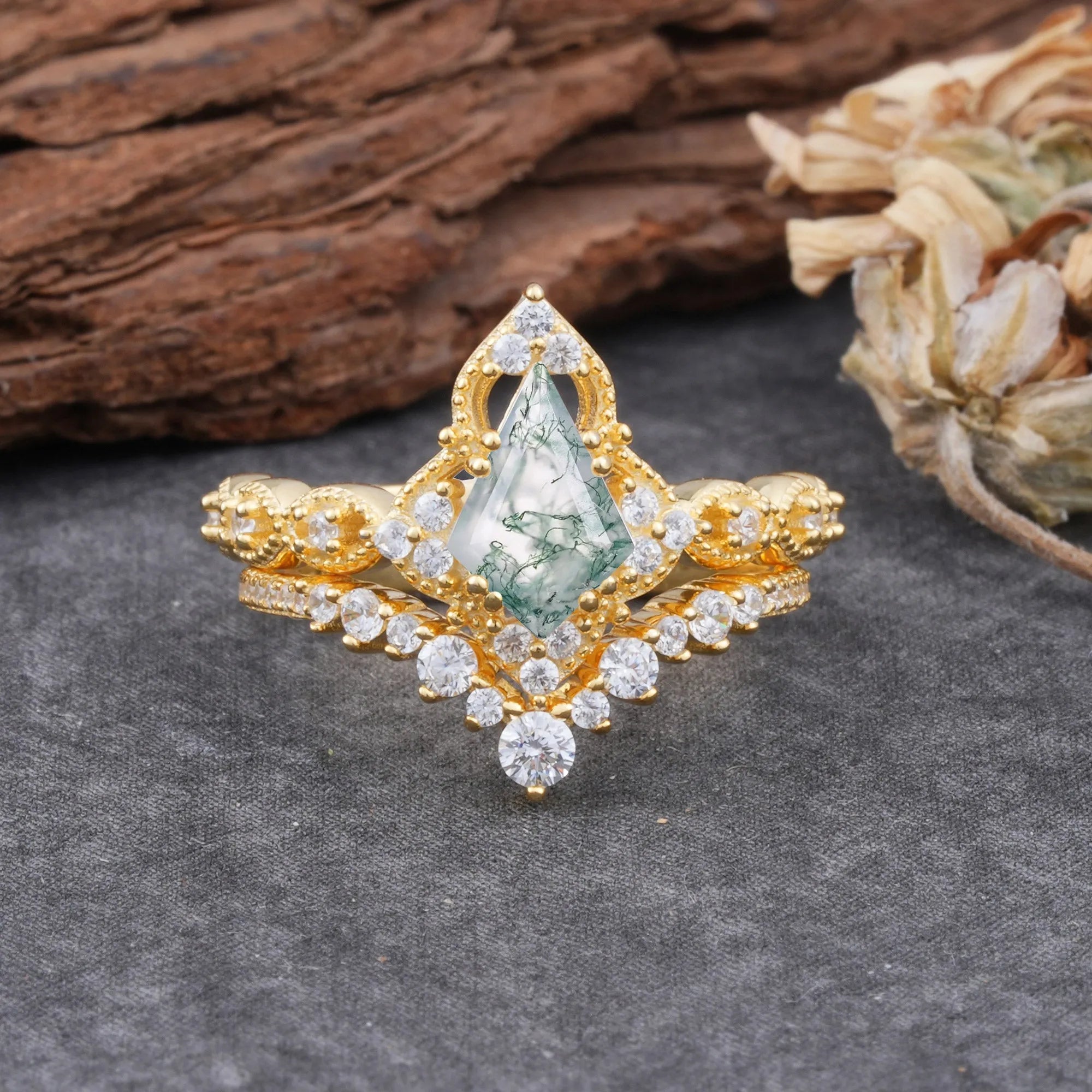 Unique Cut Kite Cut Natural Moss Agate Cluster Bridal Ring Set
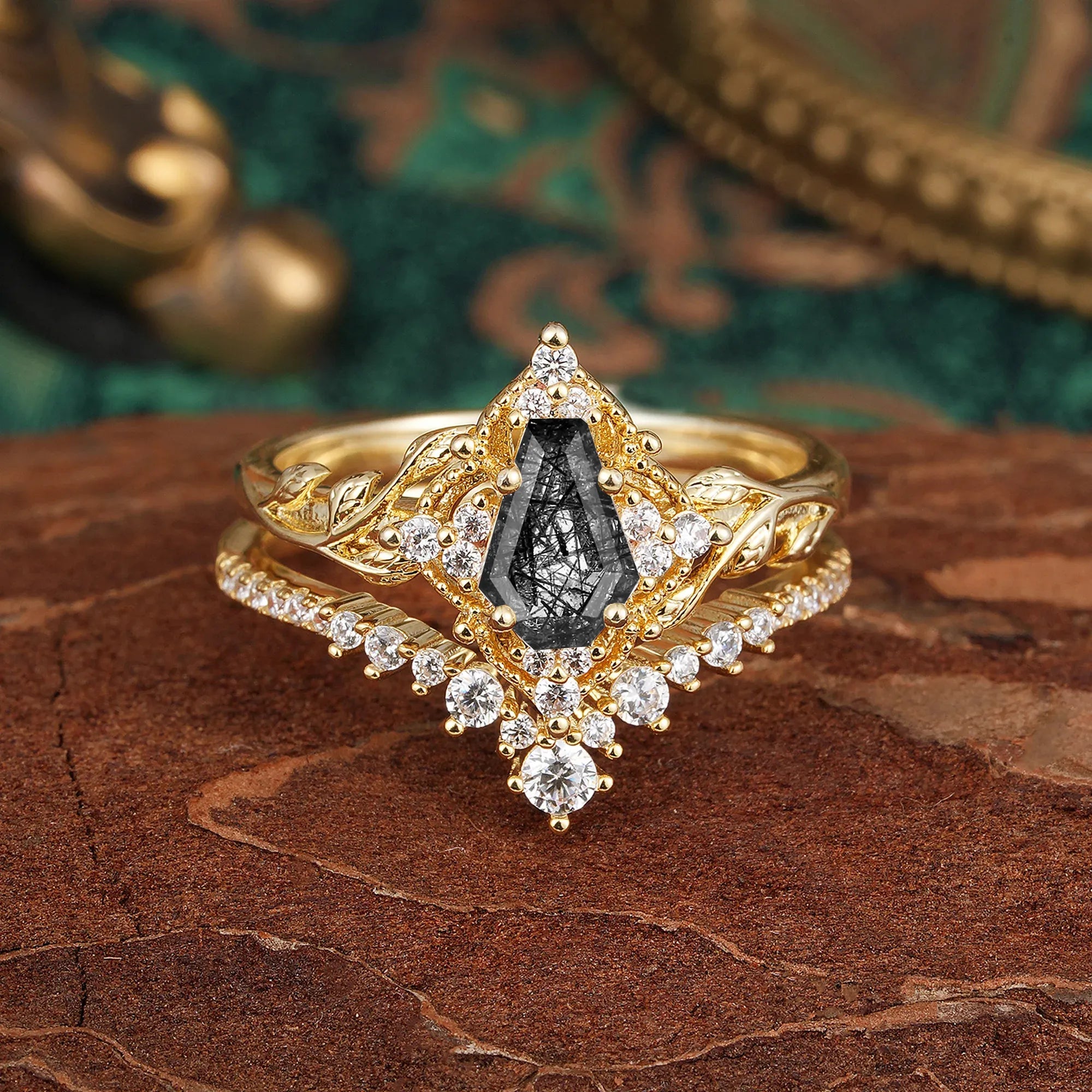 Minimalist Vintage 4-Prong Coffin-Cut Black Rutilated Quartz Bridal Ring Set
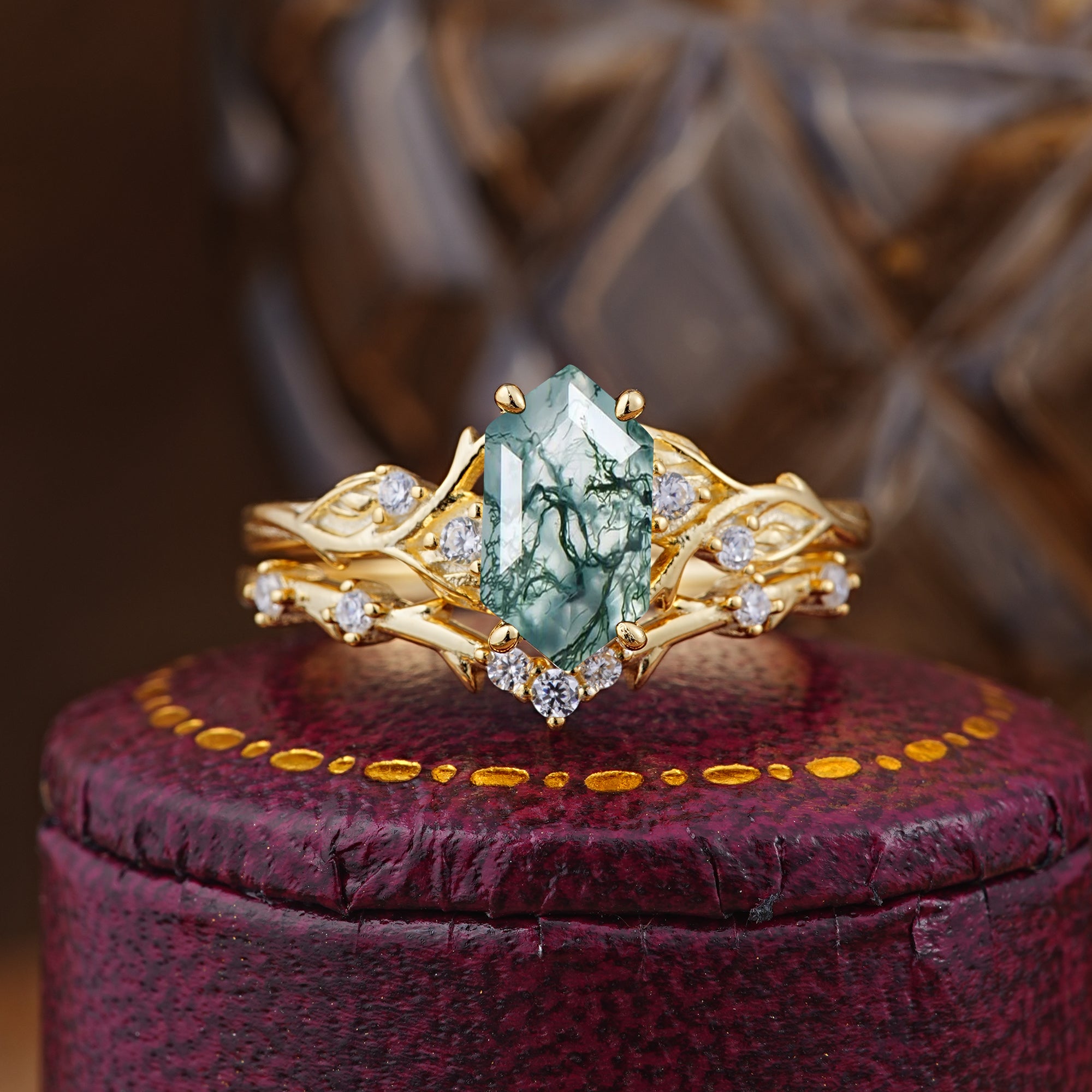 Hexagon-Cut Moss Agate Bridal Ring Set with Moissanite
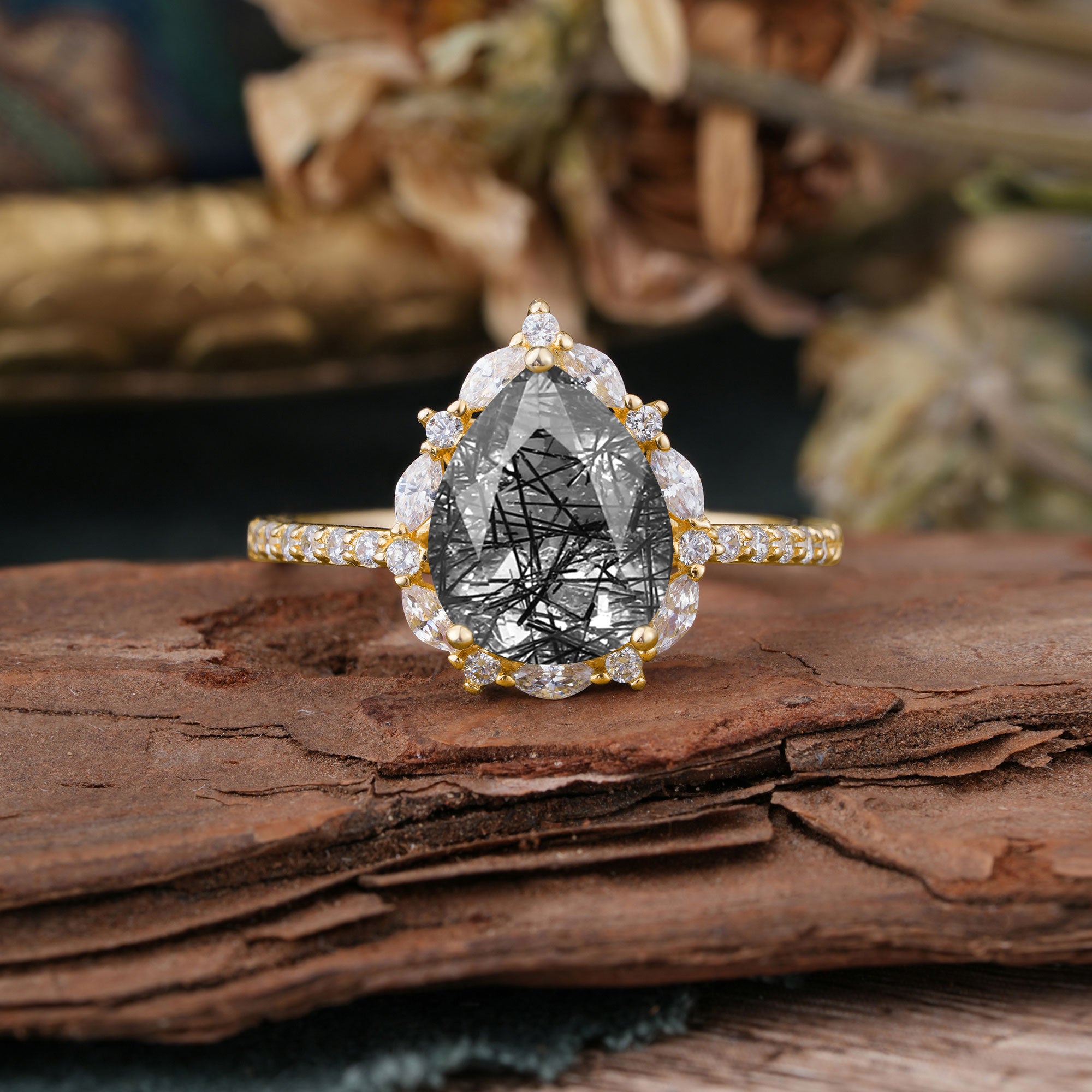 3 Carat Pear Cut Vintage 3 Prong Black Rutilated Quartz Pave Engagement Ring
Care: Protect the Pattern, Not Just the Polish
The best care routine is unglamorous and consistent. Remove the ring before weight training, gardening, home repair, climbing, contact sports, harsh-cleaner use, or any activity that brings a high likelihood of impact. Store it separately in a soft-lined compartment so that harder gemstones and loose jewelry do not abrade the surface.
For an at-home baseline, use warm water, mild soap, and a soft cloth or soft brush. GIA identifies warm, soapy water as safe for rose quartz and advises avoiding ultrasonic and steam cleaners. IGS gives moss agate similarly conservative guidance: mild soapy water and no mechanical cleaning systems.For a specific inclusion-rich stone, treat this as a cautious starting point—not a substitute for treatment-specific instructions.
If you do not know whether the material has been coated, dyed, fracture-filled, stabilized, or otherwise treated, do not experiment with solvents, steam, ultrasonic devices, or abrasive cleaners. GIA notes that treatments can affect durability and care requirements. Ask the seller or jeweler for written care guidance for the exact stone.
A loose setting changes the priority. Stop wearing the ring if the stone moves, catches, or makes noise in the mounting. GIA notes that setting condition is part of practical gemstone protection, because worn or broken prongs can expose vulnerable areas. Arrange a professional inspection rather than attempting to tighten the setting at home.
Five Questions That Prevent Most Regret
|
Question |
Why it matters |
|
Am I buying the exact stone shown in the listing? |
Inclusion-led gems are one-of-one materials. A stock image cannot guarantee the composition, color, or density of the stone you receive. |
|
What is the host material, and how are the visible inclusions described or identified? |
It distinguishes a precise mineral claim from a broad retail description. |
|
Has the stone been dyed, coated, fracture-filled, stabilized, irradiated, or otherwise treated? |
Treatments can change cleaning, repair, value discussion, and long-term care. |
|
Does the stone have surface-reaching fractures, thin edges, chips, or a very shallow cut? |
These features affect setting choice and risk from accidental impacts. |
|
Which cleaning method does the seller recommend in writing? |
It gives you a concrete ownership baseline and creates a record for future repair or maintenance conversations. |
Which One Should You Choose?
Choose moss agate if you are drawn to depth without conventional sparkle: a gem that can look different in rain, shade, sunlight, and candlelight; a stone that offers a miniature landscape rather than a uniform faceted flash. It is especially compelling for botanical, vintage, cottage, art-nouveau, and quietly modern directions. It rewards close looking and a willingness to embrace natural asymmetry.
Choose black rutilated quartz if you want contrast with intent: dark lines held inside a lighter host, visible geometry, and a ring that can feel minimal from a distance but intricate up close. It is especially effective for someone who likes black accents, architectural jewelry, celestial references, or a more gender-neutral visual language.
From a wear perspective, neither material decisively defeats the other. Their quartz-family hardness places both in a similar practical range. The more important difference is the particular stone: its edge thickness, cut, transparency, inclusion distribution, fracture condition, treatment disclosure, and mounting. A carefully selected and protectively set moss agate can be a better everyday choice than a poorly cut included quartz, and the reverse is equally true.
The final test is not a trend forecast. It is this: Which stone remains interesting after you have looked at it quietly for five minutes? Inclusion-rich jewelry often becomes more meaningful over time because the internal pattern continues to reveal a new line, shape, or depth cue.
FAQs
Is moss agate a real agate?
Moss agate is commonly described as an agate/chalcedony variety within the quartz family. Britannica identifies it as a quartz variety with dark branching inclusions, while IGS explains its chalcedony structure as a mass of component quartz crystals too small to see individually. 1 Classification language can vary in commercial use, so the practical priority is a clear material description and an exact-stone image.
Is the “moss” inside moss agate actual plant matter?
No. Britannica describes moss agate’s vegetation-like pattern as inorganic, with included materials mainly consisting of manganese and iron oxides. The appearance is botanical; the material is mineral.
What is black rutilated quartz?
The name is commonly used for quartz displaying dark needle-like inclusions. In the strict mineralogical use of rutilated quartz, the needles are rutile; GIA identifies rutile as a titanium-dioxide mineral and documents acicular rutile crystals within quartz. Because retail names can be broader than a lab report, ask how the dark material was identified if precise mineral identity matters to you.
Is black rutilated quartz more durable than moss agate?
Not in a way that should decide the purchase by itself. Moss agate is commonly stated at Mohs 6.5–7, while quartz is Mohs 7. Both require sensible protection from hard impacts, thoughtful storage, and gentle cleaning. The cut, existing condition, treatment history, and setting can matter more than the small difference in stated hardness.
Can I wear a moss agate or black rutilated quartz ring every day?
Many people can, provided they use considerate fine-jewelry habits. GIA stresses that durability includes hardness, toughness, and stability—not hardness alone. Choose a secure, lower-exposure setting where possible, remove the ring for impact-prone tasks and harsh-cleaner use, and do not treat either choice as indestructible.
Can I clean either stone with an ultrasonic cleaner?
A conservative answer is no unless a qualified professional has evaluated the exact stone, its inclusions, treatments, fracture condition, and setting. GIA recommends warm soapy water for rose quartz and advises avoiding ultrasonic and steam cleaning. IGS also advises avoiding mechanical cleaning systems for moss agate.
Are inclusions a flaw in moss agate or black rutilated quartz?
Not automatically. Inclusions are often the main visual feature and source of individuality in both categories. What matters is whether the pattern appeals to you and whether there are additional condition concerns—such as chips, surface-reaching fractures, or treatment-related vulnerabilities—that should affect care or price.
What setting is safest for moss agate?
A lower-profile bezel or partial bezel is often a strong choice for a broad or thin-edged moss agate because it can protect more of the perimeter. GIA recommends bezels, partial bezels, or V-shaped prongs for vulnerable points and corners in gemstones. The exact cut, edge thickness, and design goal should guide the final setting decision.
Why should I ask for treatment disclosure if the stone looks natural?
Natural-looking appearance does not prove that a gem is untreated. GIA explains that treatments can improve appearance but may also alter durability and care requirements; quartz and chalcedony can be dyed, coated, or potentially filled when surface-reaching fractures are present. Written disclosure helps you use the right cleaning method and compare value more confidently.
References
[1] Encyclopaedia Britannica — Moss Agate
[2] GIA — Well-Formed Rutile Star in Quartz
[3] International Gem Society — Moss Agate Engagement Ring Guide
[4] GIA — Rose Quartz Care and Cleaning
[5] GIA — More than the Mohs Scale: Understanding Gem Durability
Share