



Opal vs. Fire Opal: Color Play, Durability, and Ring Care Guide
by zhousamuel on Sep 22 2026
An opal ring can look like a small weather system on the hand: quiet one moment, flashing color the next. But opal and fire opal do not describe one fixed look, one fixed structure, or one fixed care routine. The terms point to different visual priorities, and the exact ring can also differ in construction, porosity, treatment history, setting design, and condition.
The most useful question is not, “Which is better?” It is: Do you want play-of-color, warm body color, or a particular combination—and can you support that exact stone with a realistic setting and care plan? GIA places opal between Mohs 5 and 6.5 and describes its toughness as very poor to fair. Opal can be used in jewelry, but it needs protection from scratching and breaking, as well as attention to heat and sudden temperature changes.
First, Separate Body Color From Play-of-Color

The most common source of confusion is treating every colorful opal as if its color comes from the same phenomenon. Body color is the underlying color you see when the stone is still: white, gray, black, translucent yellow, orange, red, or another direction. Play-of-color is the shifting spectral flash that appears as you move the stone, change the viewing angle, or change the light. A stone may be valued for one, the other, or both.
A classic precious-opal conversation often begins with play-of-color. The important consumer test is not a still image but a short, ordinary-light video of the exact stone moving through several angles. Does the flash appear across the face or only at a narrow angle? Which colors actually show? Is the visual field broad, pinpointed, or patchy? These are preference questions, not universal quality grades.
Fire opal brings a different first impression: a warm yellow, orange, or red body color, often with a transparent-to-translucent appearance. Some fire opals show play-of-color and some do not. Therefore, “fire opal” should not be used as shorthand for either guaranteed play-of-color or guaranteed absence of it. Ask the seller to identify the observed phenomenon in the exact stone, rather than inferring it from the product title or a saturated photograph.
|
Visual question |
Opal route |
Fire-opal route |
What to verify on the exact stone |
|
Primary appeal |
Moving play-of-color. |
Warm body color, with play-of-color assessed separately. |
Video in named lighting and at multiple angles. |
|
What changes as you move it |
The flash may strengthen, weaken, or change color. |
Body color can remain the key feature; any flash may be angle-dependent. |
Face-up, side, back, and motion views. |
|
What a still image cannot prove |
Brightness, distribution, construction, treatment, or condition. |
Transparency, actual hue, play-of-color, construction, treatment, or condition. |
Written material/construction/treatment disclosure. |
|
What not to assume |
A color flash alone does not prove solid natural opal or predict care. |
Orange/red body color alone does not establish play-of-color or care needs. |
Exact product description, report scope, and seller guidance. |
Opal Is a Material Question Before It Is a Color Question

A ring may be described as opal while still leaving important questions unanswered. Is it a solid opal? Is it assembled from an opal layer and a backing or cap? Is there a treatment? Is the stone mounted in a way that exposes a thin edge? Has it been repaired or re-polished? A visual description alone cannot answer these questions.
GIA’s Colored Stone Identification Report identifies and describes polished loose or mounted material and lists detectable treatments. Its Identification & Origin Report is available for listed materials that include opal. A report is useful evidence about identity and detectable treatment within its scope. It is not an overall beauty grade, a promise that a stone will not craze or crack, a price conclusion, a future repair plan, or a substitute for inspecting the actual setting.
Treatments matter because they can affect appearance and care. GIA explains that treatments may alter a gem’s color or clarity and can improve or, in some cases, diminish durability; they should be disclosed because special care can be needed. For opal specifically, GIA lists impregnation with oil, wax, or plastic, plus sugar and smoke surface treatments. Treat a disclosure as practical information, not a moral label. The relevant follow-up is: what exactly was done, what care does it require, and is that information on the invoice or report?
|
Identity or construction question |
Why it matters |
Appropriate next step |
|
Is the material described as solid or assembled? |
Layering, backing, adhesive, and cap construction can affect repair and cleaning instructions. |
Request side and back images, written construction description, and item-specific care. |
|
Is treatment disclosed? |
Oil, wax, plastic impregnation, sugar treatment, or smoke treatment can change appearance and care context. |
Ask for the exact treatment wording in writing. |
|
Is the stone hydrophane or otherwise notably porous? |
Selected hydrophane samples in a GIA study absorbed water differently and showed temporary appearance changes. |
Do not generalize from a photo; request stone-specific guidance. |
|
Does it have a report? |
A report can identify material and list detectable treatments within its scope. |
Read the actual report, not a summary label. |
|
Has the ring been repaired, resized, or reset? |
Heat and pressure during work may be relevant to a sensitive stone/construction. |
Ask the jeweler how the specific ring should be serviced. |
Durability: Why an Opal Ring Needs a Design Plan

Mohs hardness is only scratch resistance, and it is a relative, non-linear scale. GIA’s broader durability framework is hardness, toughness, and stability. The framework matters especially here because an opal’s story is not captured by “5–6.5” alone.
GIA says opal ranges from Mohs 5 to 6.5 and has very poor to fair toughness. That makes a ring possible, but not carefree. A hard impact can damage a stone; heat from intense light can cause craze lines, and high heat or sudden temperature change can fracture it. The responsible conclusion is not that every opal must be worn only occasionally, nor that every affordable opal ring is suitable for all routines. It is that the design, contact exposure, construction, and owner behavior should be considered together.
A full bezel, partial bezel, lower setting profile, or other protective perimeter can reduce exposure. GIA notes that bezels, partial bezels, and V-prongs can protect vulnerable points or corners in gemstones. This does not make a lower-toughness material immune to impact, heat, or treatment-related change. It is a risk-reduction decision.
Fire opal should receive the same material-first caution. Its warm body color does not override opal’s durability considerations. Do not choose a higher, more exposed setting solely because it photographs dramatically if the ring will regularly meet gym equipment, heavy tools, hard countertops, gardening, contact sport, or harsh cleaning tasks.
|
Ring-design factor |
More protective direction |
Why it helps |
What it cannot promise |
|
Profile height |
Lower or medium where the design permits. |
Less exposure to accidental knocks and snagging. |
No setting eliminates impact risk. |
|
Perimeter protection |
Bezel, partial bezel, or carefully positioned protective metal. |
Can shield edges and distribute visual attention around the stone. |
It does not establish construction or treatment. |
|
Shape and edge exposure |
Avoid leaving thin, elevated edges needlessly exposed. |
Reduces a likely contact point. |
Shape alone does not determine durability. |
|
Owner routine |
Remove for impact-prone work, harsh cleaning, major temperature exposure, and similar high-risk tasks. |
Matches wear to the gem’s actual sensitivity. |
No generic routine can replace item-specific guidance. |
|
Service plan |
Ask how resizing, resetting, inspection, and cleaning should be done for that ring. |
Helps prevent accidental care or repair mistakes. |
A report does not state a retailer’s service policy. |
Water, Hydrophane Opal, and the Danger of Universal Rules

Online opal advice often swings between opposite absolutes: “never let opal touch water” and “water is always harmless.” Neither sentence is a safe substitute for knowing the exact material and construction.
GIA’s care guide provides a conservative baseline: warm, soapy water is the only safe cleaning method for opal. The guidance does not give permission to soak any unknown construction indefinitely or to ignore an item-specific seller/jeweler warning. If a ring is assembled, treated, repaired, or described as hydrophane, get specific care guidance before immersion.
GIA’s hydrophane treatment lab note studied selected slices, not all opals. In those samples, non-uniform porosity produced different degrees of water absorption; pieces gained weight and became more transparent during immersion, then returned to their original weight and appearance over about a week. That evidence is important because it demonstrates why broad assumptions about all opal are unreliable. It does not prove that every hydrophane opal will behave identically, nor does it identify porosity from a product photograph.
The same study shows why treatment disclosure is practical. In its test pieces, oil increased transparency but destroyed play-of-color, while Opticon increased transparency while preserving play-of-color. Such outcomes were observed in those tested samples under those procedures. They are not a consumer method, not a home-care recommendation, and not a prediction for another stone.
Gentle Care Is a Routine, Not a Single Cleaning Event
GIA’s clearest instruction is also the simplest: clean opal only with warm, soapy water. Avoid ultrasonic and steam equipment. Do not use harsh chemicals, abrasive cleaners, or intense heat. Let the ring dry gently after cleaning and store it separately from harder jewelry so that a harder material does not abrade the surface.
Inspection is part of care. Check whether the setting remains secure and whether a new line, chip, looseness, lifting layer, or change in appearance appears. These observations do not diagnose the material, but they are reasons to stop wearing the ring for risky tasks and ask a qualified jewelry professional for item-specific advice.

Five Questions to Ask Before You Buy an Opal Ring
The strongest questions are specific and documented. Ask for answers linked to the exact ring rather than a category page.
|
Question |
Why it matters |
|
“Is this solid opal or an assembled construction, and may I see the side and back?” |
Construction can be visually hidden in a face-up image. |
|
“Does this exact stone show play-of-color, and can I see a short video in ordinary diffuse light?” |
Body color and moving flash are separate visual decisions. |
|
“What treatments or repairs are disclosed, and what does that change about cleaning or service?” |
Treatments can alter durability/care needs. |
|
“What is the mounted profile height and how are exposed edges protected?” |
Setting affects contact exposure. |
|
“What written terms currently apply to sizing, service, returns, repairs, shipping, and warranty?” |
Gem education cannot establish a seller’s current commercial terms. |
Final Thought
Choose a classic opal route when play-of-color is the visual experience you want to see in motion. Choose a fire-opal route when warm body color is the central appeal, then verify separately whether that individual stone also has play-of-color. In both cases, the more important decision is whether you can obtain clear written disclosure about material, construction, treatment, condition, and care—and whether the ring’s setting and your daily routine match those facts.
Opal jewelry can be deeply personal and visually extraordinary. The durable choice is not the most dramatic product photograph. It is the exact, documented ring whose visual behavior, protective design, service boundaries, and gentle-care routine you are prepared to sustain.
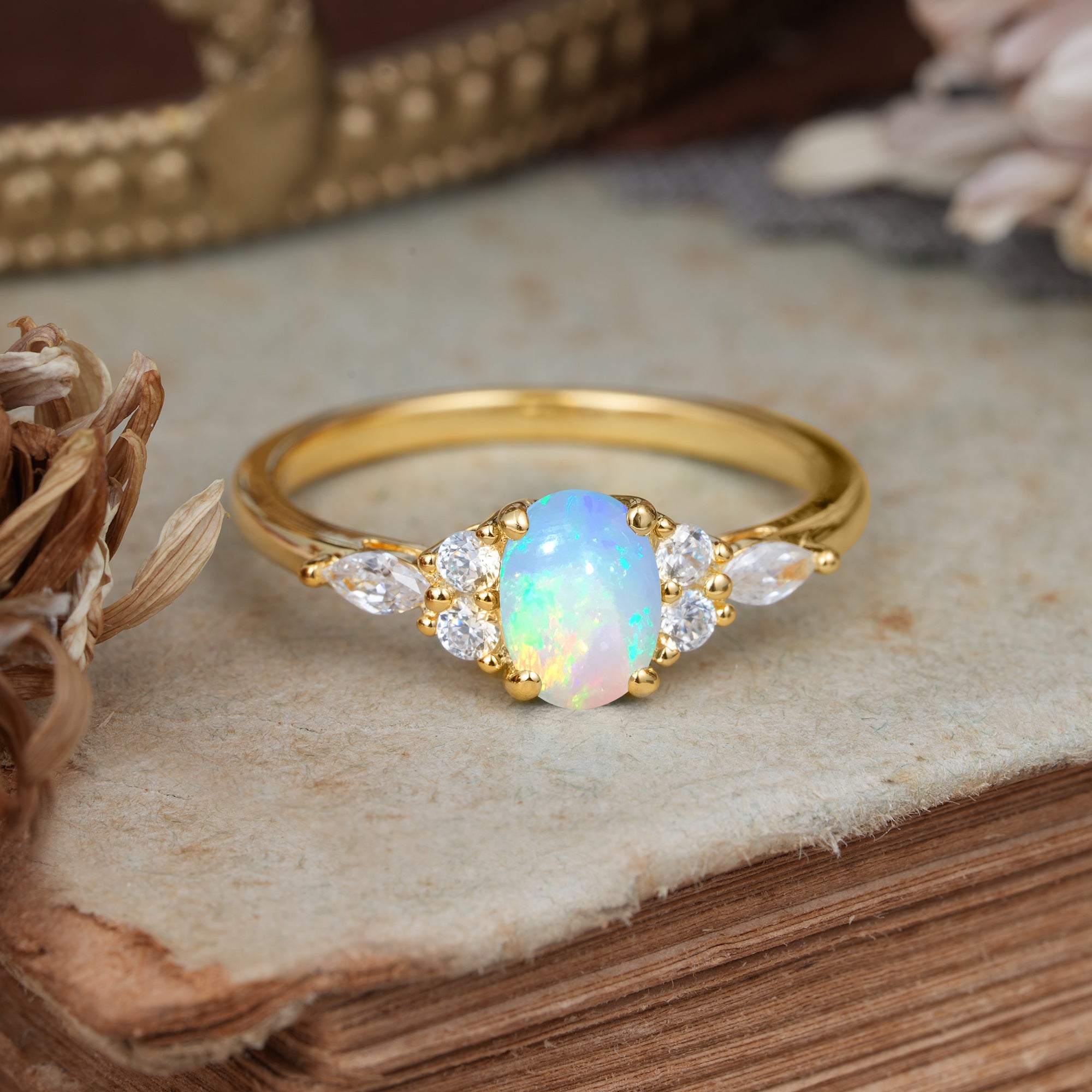 Oval Cut Opal Classic Side Stone Engagement Ring
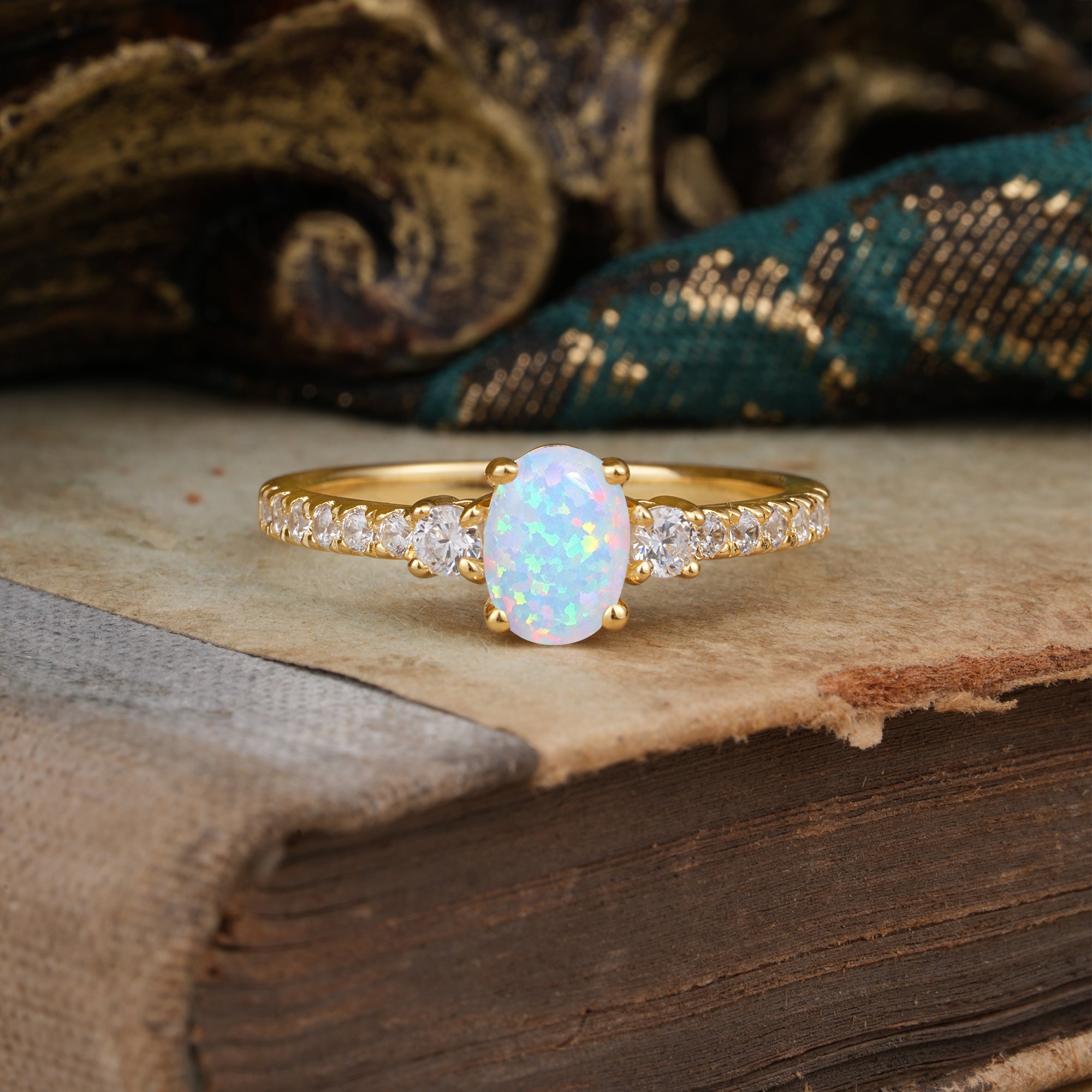 1 Carat Oval Cut 4 Prong Three Stone Opal Promise Ring Classic Engagement Ring
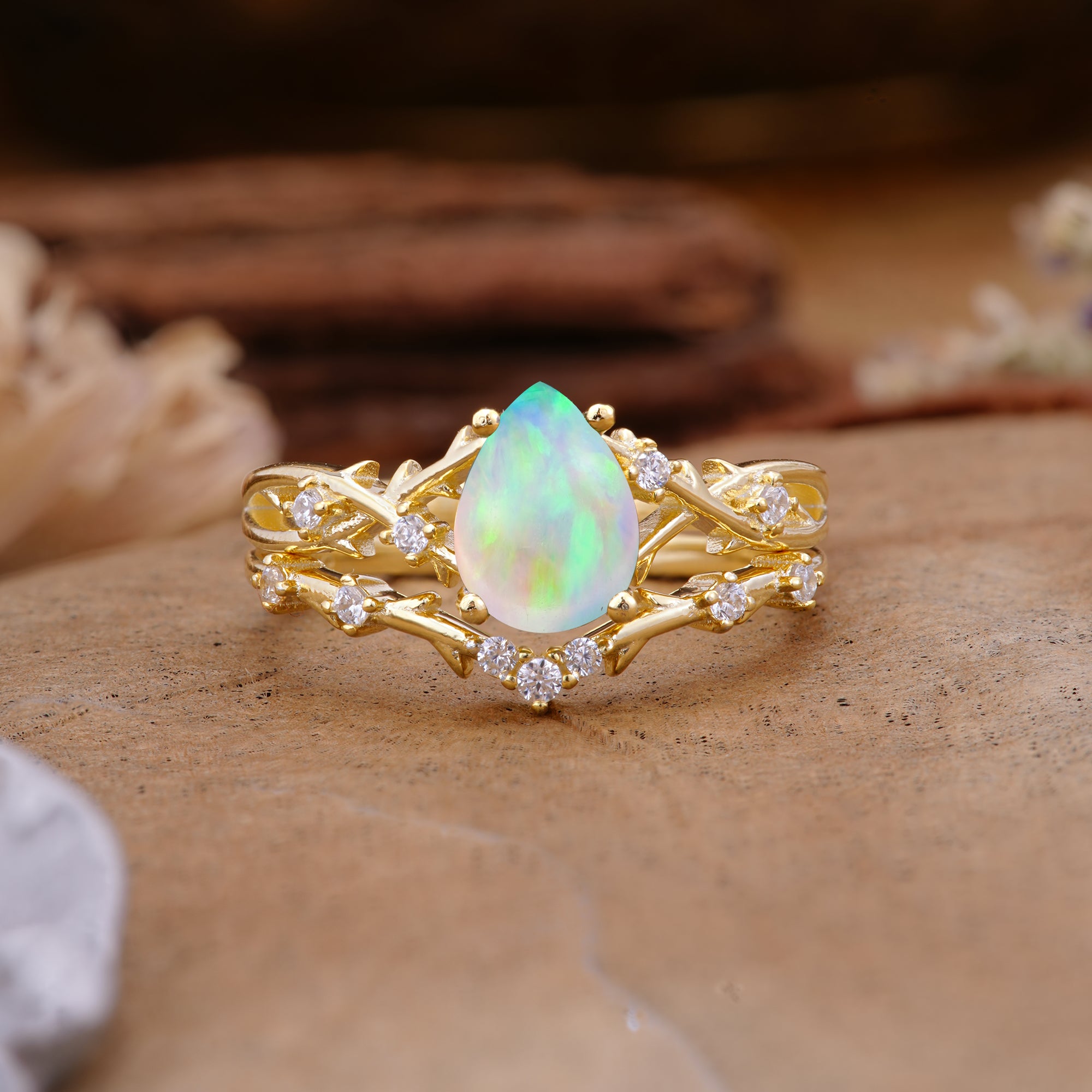 Nature-Inspired Pear-Cut Fire Opal Bridal Ring Set
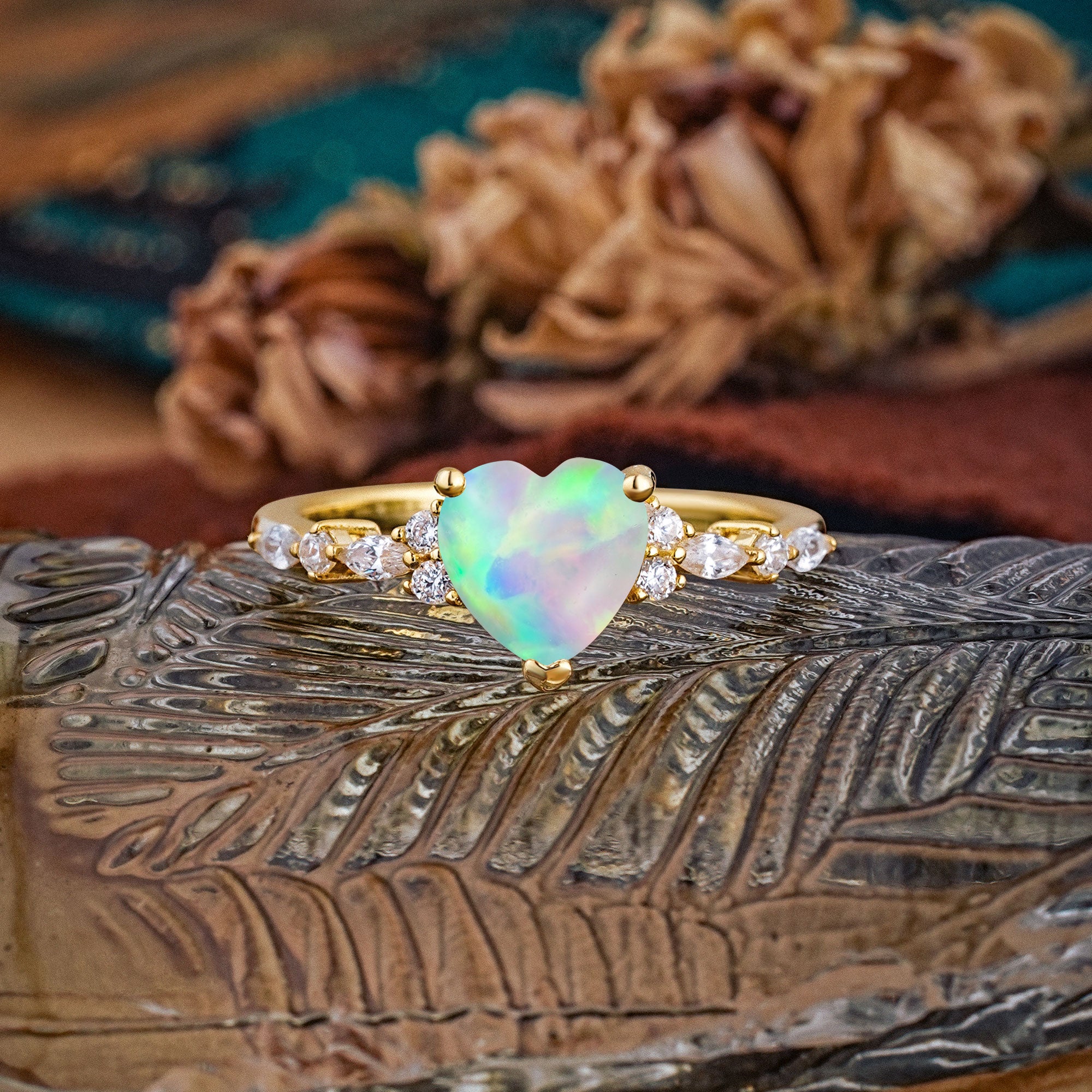 Heart Cut Fire Opal Vintage Pave Shank Engagement Ring
FAQs
Does every fire opal show play-of-color?
No broad term should replace viewing the exact stone. Fire opal is often chosen for warm yellow, orange, or red body color; a specific stone may or may not show play-of-color. Ask for moving video and a written description instead of assuming the answer from a title or still image.
Is an opal ring too fragile for an engagement ring?
Not automatically, but it requires more intentional design and care than a high-hardness, high-toughness center stone. GIA rates opal at Mohs 5–6.5 with very poor to fair toughness and says it should be protected from scratching and breaking. A lower, protected setting and a realistic task-removal routine are more responsible than either an unconditional yes or an unconditional no.
Can I clean an opal or fire-opal ring with an ultrasonic cleaner?
No. GIA says the only safe way to clean opal is warm, soapy water. Do not use ultrasonic or steam cleaners, and seek item-specific guidance if the construction or treatment is unclear.
Are all opals damaged by water?
Do not use an all-opal rule. GIA’s selected hydrophane-opal study demonstrated water absorption and temporary appearance change in particular porous samples, with different degrees of absorption across one rough piece. That does not establish identical behavior for every opal or every assembled ring. Use warm soapy water for cleaning as GIA advises, and request specific care guidance for hydrophane, assembled, treated, or repaired material.
What does “solid opal” mean, and why should I ask?
The term concerns construction, but a listing or photo may not provide sufficient evidence on its own. Ask whether the ring is solid or assembled, request side/back photos, and obtain written information about layers, backing, caps, adhesives, treatments, and care. This matters because construction can change service and cleaning decisions.
Can a report tell me whether an opal ring is beautiful or safe for my lifestyle?
No. A GIA Colored Stone Identification Report identifies/describes material and lists detectable treatments; an Identification & Origin Report is available for opal. Neither is an overall beauty grade, impact-resistance forecast, repair instruction, or lifestyle guarantee. Use it alongside direct viewing, setting inspection, disclosure, and your own care plan.
Should I keep an opal ring in water to prevent cracking?
Do not adopt that as a universal home practice. GIA identifies heat and sudden temperature change as fracture risks and gives warm soapy water as the safe cleaning method. Opal porosity and construction can vary, and selected hydrophane samples showed different absorption behavior. Follow the exact ring’s documented care guidance rather than a blanket storage rule.
References
GIA — Opal Care and Cleaning Guide
Share