



Alexandrite Rings: What Color Change to Expect and Evaluate Quality
by zhousamuel on Nov 04 2026
An alexandrite ring can look unexpectedly different from one room to another. In daylight, a stone may show green, bluish green, or another related blend. Under incandescent light, a desirable stone may move toward red or purplish red. That shifting appearance is the reason alexandrite has such a devoted following—and the reason a still product photograph, an unlabelled video, or a single sales phrase cannot fully describe it.
The useful question is not, “Does this ring change from green to red?” The more responsible question is: what does this exact stone look like face up under two identified light environments, how clearly is its identity disclosed, and how do its color, cut, clarity, setting, documentation, and care requirements fit the way it will be worn? GIA identifies color change as alexandrite’s most important quality factor, while also evaluating color quality, clarity, cut, and size.
Begin With the Right Expectation: Color Change Is Real, but Context Controls What You See
Alexandrite is the color-change variety of chrysoberyl. GIA describes fine alexandrite as green to bluish green in daylight and red to purplish red in incandescent light. The light source has a powerful effect on the color viewers perceive. Those phrases are useful reference points, but they are not a standardized consumer grade and should not be used as a guarantee for every natural stone, laboratory-grown stone, or ring listing.
A stone’s visible appearance is affected by at least four connected conditions. First, the spectral character of the light matters: daylight, daylight-equivalent fluorescent light, incandescent light, warm LED light, cool LED light, mixed retail lighting, and phone-camera illumination do not distribute visible wavelengths in the same way. Second, the specific alexandrite’s trace elements and absorption behavior matter. Third, cut, depth, facet arrangement, and the route light takes through the stone influence face-up color. Fourth, viewing angle, background, surrounding metal, and the observer’s adaptation can change the impression.
GIA’s research on faceted alexandrite emphasizes that color appearance is complex. Alexandrite is optically biaxial and strongly pleochroic, so different vibration directions carry different color components. In a faceted stone, internal reflections mix components; trace elements, cut, orientation, stone size, and light path can all influence the observed result. That is why the practical buyer should avoid treating one rotating social-media clip as a complete quality assessment.
A practical definition of “expectation”
For a ring buyer, a realistic expectation has three parts. You should expect a real alexandrite to look different under more than one light environment. You should expect the exact hues and the apparent strength of the transition to vary by stone and light. And you should expect a trustworthy seller to identify the material clearly, state the light environment used for imagery or video where possible, and provide documentation appropriate to the significance of the purchase.
A responsible expectation does not mean expecting a perfect traffic-light green in every daylight setting and a saturated ruby red in every warm room. It also does not mean that a strong-looking change in a single video proves natural origin. Synthetic alexandrite exists and that color-change synthetic corundum, as well as less commonly color-change synthetic spinel, can imitate natural alexandrite.

Why Alexandrite Changes Color—and Why That Is Not the Same as a Single “Percent Change” Score
The classic daylight-to-incandescent shift is commonly called the alexandrite effect. GIA’s overview associates the phenomenon with an absorption band around 580 nanometers, while its Gems & Gemology research describes alexandrite as chromium-bearing chrysoberyl with distinct pleochroism and a signature change between daylight or daylight-equivalent fluorescent light and incandescent light.
For a consumer, the important implication is simple: the stone is not behaving like a screen that switches one fixed color code on and off. The light illuminating the stone changes, the stone selectively transmits and reflects parts of that light, and a faceted crystal can combine several optical directions in one face-up view. The transition is therefore better treated as a two-environment visual comparison than as a universal laboratory-free percentage.
Some listings use numerical color-change percentages or proprietary verbal tiers. Those can be useful as a seller’s own descriptive language only if the seller explains the method, lights, and observation conditions. They are not a substitute for a widely shared, item-independent grading system.
Color change, pleochroism, and color-shift language
These terms are related but should not be collapsed into one claim. Color change describes an apparent difference under different light sources. Pleochroism describes directional color differences in a crystal; in alexandrite, its biaxial optical nature creates three basic pleochroic color components. In a faceted stone, multiple reflections can mix these components, so face-up viewing is more complicated than holding a polarizer over a rough crystal.
Color shift is often used more broadly in retail language for a visible but less dramatic movement in hue. Because it is not a replacement for species identification, a seller should not use “color-changing” as a shortcut for “natural alexandrite.” The exact material must still be disclosed and documented.

|
Term |
Useful buyer meaning |
What it cannot prove by itself |
Better next question |
|
Alexandrite effect / color change |
The same stone appears different under defined light environments. |
Natural origin, laboratory-grown identity, treatment status, or a universal quality rank. |
“Show this exact stone under two named light sources.” |
|
Pleochroism |
A crystal can show different colors in different optical directions. |
That a face-up mounted ring will show a specific color in every direction. |
“How does this finished stone look face up when rotated?” |
|
Color-shift claim |
A seller is describing a hue difference, often with variable intensity. |
The mineral species or whether the material is alexandrite. |
“What exact species or laboratory-grown material is this?” |
|
Percentage or tier claim |
A retailer’s own shorthand for observed change. |
A universally accepted grade or independent appraisal result. |
“What protocol, light sources, and observer standard produced the claim?” |
|
Photo or video |
A starting point for seeing the stone’s visual character. |
Exact real-world color, identity, or how the stone will look on every device. |
“Was the image color-corrected, and what lighting was used?” |
What a Strong Evaluation Looks Like: Use a Two-Light Viewing Protocol
The most useful evidence is not a generic stock video. It is a repeatable comparison of the same stone in disclosed lighting. You do not need a laboratory instrument to make a better buying decision; you do need enough context to avoid mistaking a lighting trick, editing choice, or different stone for the item you intend to purchase.
Start by asking the seller to identify the first environment in everyday terms and, if available, with useful detail: indirect daylight, daylight-equivalent fluorescent light, a particular cool LED, or another described source. Then ask for a second environment such as incandescent light or a specifically described warm light. GIA’s technical description of the alexandrite effect uses daylight or daylight-equivalent fluorescent light in contrast to incandescent light. An LED described merely as “warm” may not reproduce incandescent light in the same way; that is not evidence of a defect, but it is a reason to ask what was actually used.
When you look, record five observations rather than forcing a verdict from a single hue name:
1 Daylight-side hue: Does the stone read as green, bluish green, blue-green, gray-green, or another mixed tone?
2 Warm-light-side hue: Does it move toward red, purplish red, reddish purple, violet, brownish red, or another blend?
3 Tone: Is the stone appealingly open, or does it become so dark that color is difficult to read in either environment?
4 Saturation: Does either appearance look lively and distinct, or mainly gray/brown/moderately muted to your eye?
5 Face-up consistency: Does the color character look coherent through the crown, or is there obvious extinction, windowing, or an area you personally find distracting?
This is not a formula for pricing or a substitute for professional grading. It is a way to turn an emotive description into traceable observations. GIA lists color, clarity, cut, and carat weight as quality factors and says cutters orient alexandrite to show the strongest color change through the crown.
Ask for evidence that reduces confusion, not evidence that flatters the stone
The best request is modest and specific: ask for an unedited or minimally edited comparison video of the actual stone, shown face up in two identified lighting conditions; ask that the camera remain still long enough for you to see the stone rather than a rapid flash effect; and ask whether any automatic color correction, filters, or post-processing were used. If the ring is available to view in person, examine it under the store’s stated lights and, where practical, near a daylight source. Do not expect a phone screen to deliver exact color, but use it to test whether the seller can produce consistent, transparent evidence.
The table below is an observation framework, not a promise about appearance.
|
Viewing condition |
What the buyer should document |
Why it matters |
Boundary to retain |
|
Daylight or daylight-equivalent source |
Light description; face-up hue; tone; saturation; any dark or gray areas. |
GIA’s preferred fine-alexandrite reference includes green to bluish green in daylight. |
“Daylight” varies with weather, time, window exposure, and surrounding surfaces. |
|
Incandescent source |
Source type; distance; face-up hue; whether the stone moves toward red/purplish red. |
Incandescent light is part of GIA’s classic color-change description. |
A warm LED may differ materially from incandescent light. Do not label them interchangeable without disclosure. |
|
Everyday indoor LED |
Bulb description if known; whether the color remains pleasing in the room where the ring will be worn. |
This checks real-world satisfaction, not gemological idealization. |
No one indoor LED response certifies natural origin or objective quality. |
|
Diffuse and direct angles |
Whether face-up color remains attractive as the finger and ring move. |
Cut, internal reflection, and orientation affect visual appearance. |
A short dramatic flash under a spotlight is not a complete face-up assessment. |
|
Photo/video review |
Whether source lighting, editing, and stone identity are clearly tied to the exact item. |
Digital media can help compare evidence at a distance. |
Device screens and automated white balance cannot replace disclosed real-world viewing. |
Natural Alexandrite, Laboratory-Grown Alexandrite, and Alexandrite-Like Material Are Different Questions
A ring may be marketed with language that sounds similar while describing different materials. A careful buyer should separate three questions: Is the material natural alexandrite? Is it laboratory-grown alexandrite? Or is it a different material with an alexandrite-like color-change effect? The answer affects how the item should be described and what a laboratory report can confirm; it should not be inferred only from color or from price.
GIA describes a synthetic gem material as laboratory-made material sharing virtually all chemical, optical, and physical characteristics of its natural mineral counterpart. It identifies several production methods for synthetic alexandrite, including Czochralski, floating-zone, and flux growth. The FTC explains that laboratory-created gemstones should be disclosed clearly and conspicuously as laboratory-grown, laboratory-created, manufacturer-created, or equivalent language so buyers understand they are not mined stones.
A color-change synthetic sapphire or synthetic spinel is not automatically laboratory-grown alexandrite. GIA specifically notes that color-change synthetic corundum is often used to imitate natural alexandrite and that synthetic color-change spinel can also occur. Similarly, GIA’s buyer guide says “alexandrite sapphire” generally refers to a laboratory-grown sapphire engineered for a color-change effect; it is not a natural alexandrite.
|
Product description or report language |
What it should communicate |
What to request before purchase |
Do not assume |
|
Natural alexandrite |
A claim that the stone formed naturally and is the chrysoberyl variety alexandrite. |
An independent report for a significant purchase; exact report number; report scope; treatment disclosure; origin opinion only if relevant and provided. |
That every natural stone gives an equally dramatic change, has a particular origin, or is untreated unless documented. |
|
Laboratory-grown / laboratory-created alexandrite |
A laboratory-grown counterpart clearly disclosed as not mined. |
Exact material identity; any report; written listing; care record; the actual stone’s two-light appearance. |
That “laboratory-grown” means imitation, or that it means every material sold under a color-change name is chrysoberyl alexandrite. |
|
Created alexandrite |
Retail language that may be used for laboratory-grown material but needs clear context. |
Whether it is laboratory-grown chrysoberyl alexandrite; who uses the term; whether an independent report supports the statement. |
That the word alone explains growth method, quality, color behavior, or price. |
|
Alexandrite sapphire / color-change sapphire |
Usually a color-change sapphire material, not natural alexandrite. |
Exact species/material and whether it is laboratory-grown; disclosure in listing and invoice. |
That an alexandrite-like effect proves alexandrite identity. |
|
Color-change spinel or other simulant |
A different material whose appearance may imitate alexandrite. |
Exact identity and whether it is natural, laboratory-grown, or imitation; care requirements. |
That an attractive shift is deceptive by itself; the issue is accurate disclosure. |
Why documentation matters more than a label alone
For a significant natural-alexandrite purchase, GIA advises obtaining an independent laboratory report when in doubt. Its buyer guide says a GIA Colored Stone Identification & Origin Report can state whether an alexandrite is natural or laboratory-grown, name detectable treatments, and give an origin opinion when possible and requested. The word scope matters. A report may contain specific identified characteristics and may not make every statement a seller makes about visual preference, value, future resale, mounting condition, or return policy.
Ask to see the report itself, rather than only a cropped report number. Confirm that dimensions, weight, shape, color description, and any other identifying characteristics align with the listed stone. If the item is mounted, remember that a report’s available observations and services can differ from loose-stone examination. A report can confirm critical scientific questions within its scope, while the two-light viewing comparison answers a different question: whether you like this particular stone’s face-up color in the relevant environments.
How to Evaluate Alexandrite Quality Without Pretending There Is One Universal Grade
GIA identifies color change as the primary quality factor, then calls attention to hue quality under different lighting, clarity, cut, and carat weight. A complete purchase decision must add identity disclosure, treatment information, report scope, setting design, and the actual wearer’s expectations. The following framework is deliberately multi-factor because a single impressive video cannot answer every category.
1. Evaluate the color change you can actually observe
Begin with the two-light record. A green-to-bluish-green daylight appearance paired with a red-to-purplish-red incandescent appearance is the classic high-quality reference described by GIA. But your evaluation should not stop at the direction of change. Consider whether each appearance is attractive on its own. A stone can move noticeably while still looking overly dark, grayish, brownish, or unlike the color character you hoped to wear.
Avoid setting a non-verified threshold in advance, such as requiring a certain percentage. Instead, decide what matters to you: a strong contrast between the two environments, a particular daylight-side hue, a compelling warm-light color, or a balanced result you enjoy in ordinary rooms. Put that preference in writing before comparing options so that a dramatic video does not replace your actual priorities.
2. Look at tone and saturation under both lights
Tone is the relative lightness or darkness of an apparent color. Saturation concerns how vivid or intense it appears. GIA describes the most-prized examples as having moderately strong to strong saturation along with strong change. Tone and saturation remain separate observations: a stone may be richly saturated but too dark for your taste, or pleasantly bright but muted.
Ask for broad, diffuse views as well as the most flattering position. A face-up stone should be judged as a ring will usually be seen—moving on a hand, not only held at one fixed angle above a directional lamp. The purpose is not to punish a gem for having normal facet variation. It is to make sure you are choosing the appearance you will live with.
3. Consider clarity as an appearance issue, then understand what it does not decide
GIA says most fine alexandrites are eye-clean and lists clarity among the quality factors. “Eye-clean” is still an observation standard that depends on viewing distance, lighting, eyesight, and the seller’s method. Ask what the seller means, ask for macro imagery, and distinguish between a visible inclusion that affects your enjoyment and an inclusion that is only visible under magnification.
Clarity alone does not identify natural origin. Nor does an inclusion automatically establish an untreated natural stone. Determining identity, origin, and detectable treatments belongs to appropriate gemological testing and report scope, not to a consumer’s attempt to read a photo.
4. Treat cut as a color-and-wear question, not merely a shape preference
GIA says cut is highly important in alexandrite’s appearance, notes that mixed cuts are common, and explains that cutters orient the gem to show the strongest color change through the crown. A well-considered cut can support appealing face-up color, while a cut chosen primarily to retain weight may create compromises a buyer should see for themselves. Do not use table size, depth, or shape alone as a proxy for quality; inspect the face-up result, symmetry, edge exposure, and the way the cut interacts with the mounting.
The shape of a ring stone also changes the design conversation. A pointed pear, marquise, heart, or sharp-cornered outline may benefit from setting choices that address the exposed area. This is not a claim that one setting makes a stone invulnerable; it is a reason to ask how the specific profile, prongs, bezel, or partial bezel protects the specific geometry.
5. Treat size as a documented measurement, not a visual shortcut
GIA says most fashioned alexandrites weigh less than one carat, and that larger, higher-quality material rises dramatically in price. Size can be useful for comparing physical presence, but carat weight does not tell you whether you prefer the stone’s color change, daylight-side hue, clarity, cut, or ring comfort. Ask for millimeter dimensions as well as carat weight. A shallow or deep cut can make stones of similar weight face up differently; an individual listing and report should supply the actual measurements.
6. Make disclosure and report scope part of quality—not paperwork added later
A beautiful color change does not eliminate the need to identify the material. Make the invoice, listing, any report, and verbal description consistent. The FTC says sellers should make accurate, non-deceptive gemstone claims and disclose treatment where it is non-permanent, requires special care, or significantly affects value. GIA says alexandrites are usually not treated, but may have fractures, and that fracture-filled stones should only be cleaned with warm, soapy water.
The most useful quality summary is therefore not “A-plus alexandrite.” It is a documented statement such as: exact identity as represented; natural or laboratory-grown category; report issuer and number if supplied; detectable treatment statement if supplied; observed appearance under named lights; measurements and cut description; mounted design; and care/return information.
|
Evaluation area |
Questions to ask |
Strong evidence |
Red flag or unresolved point |
|
Identity |
“Is this natural alexandrite, laboratory-grown alexandrite, or another color-change material?” |
Clear invoice/listing wording; independent report where appropriate. |
A generic “alexandrite color” label with no material specification. |
|
Color under light 1 |
“What light source was used, and what does the actual stone look like face up?” |
Unedited comparison media or in-person viewing with lighting disclosed. |
A color name with no view of the exact stone. |
|
Color under light 2 |
“What does the same stone look like under incandescent or explicitly described warm light?” |
Two-light video with the same stone identified. |
A video that changes lamps, stones, filters, or camera settings without explanation. |
|
Tone and saturation |
“Is the stone visually open and attractive to me in both environments?” |
Multiple still and moving views, not only a spotlight flash. |
A decision based entirely on one saturated frame. |
|
Clarity |
“What is visible without magnification, and what is visible in macro imagery?” |
Seller’s viewing standard; macro imagery; report within scope. |
An implied claim that any inclusion proves natural origin or determines treatment. |
|
Cut and finish |
“How does the face-up cut support the visual result and protect any exposed edges?” |
Face-up, side, and profile images; dimensions; mounting explanation. |
Assuming shape alone proves a setting is protective or non-protective. |
|
Treatment and care |
“Are any treatments disclosed, and what care instructions follow from them?” |
Written disclosure and care record. |
Blanket ultrasonic/steam instructions with no treatment or setting context. |
|
Report scope |
“What exactly does the report state and what does it not state?” |
Full report or verifiable record; aligned measurements. |
Treating a report as an appraisal, return policy, or guarantee of subjective color preference. |
Ring Design: Match a Durable Material With a Thoughtful Setting
Alexandrite has Mohs hardness of 8.5, excellent toughness, and no cleavage according to GIA. GIA describes it as a good choice for rings and other mountings subject to daily wear, and stable under normal wearing conditions. Those are meaningful strengths, but they do not make any finished ring immune to a hard blow, a bent prong, a thin exposed edge, a lost stone, or normal metal wear.
A ring is a system: the gemstone, cut, setting, metal, height, gallery, prongs, shank, and wearing habits all contribute. A lower profile can reduce snagging and accidental contact for some lifestyles. A bezel or partial bezel can offer perimeter coverage for certain shapes, while prongs can expose more of the gem’s edge and still be appropriate when designed, finished, and maintained well. There is no single “best setting” without seeing the exact stone and understanding the wearer’s preferences.
Instead of asking a seller to guarantee daily-proof performance, ask concrete design questions. Which portions of the girdle, points, or corners are protected? Is the stone set at a height suitable for the wearer’s normal hand use? Are prongs smooth, substantial, and appropriate to the outline? What inspection interval does the seller or qualified jeweler recommend? Does the design make visual access to the color change more important than perimeter protection, and is that trade-off acceptable to you?
Care and Maintenance: A Good Baseline Is Not a Permission Slip for Unknown Treatment or a Loose Setting
GIA says warm, soapy water is always safe for alexandrite. It says ultrasonic and steam cleaning are usually safe, but gives an important exception: fracture-filled gemstones should only be cleaned with warm, soapy water. The word usually matters. Before using an ultrasonic or steam cleaner, confirm the stone’s identity, any treatment disclosure, the integrity of the setting, and the care instructions supplied for that exact ring.
For routine low-risk cleaning, use warm water, mild soap, a soft brush only if appropriate for the setting, and a lint-free cloth. Do not perform your own prong tightening, recutting, filler assessment, or repair. If the ring rattles, catches unexpectedly, looks misaligned, has a damaged prong, or shows a change you cannot explain, stop wearing it during high-contact activities and consult a qualified jeweler.
GIA also describes alexandrite as stable under normal wear against heat, light, and common chemicals. That is a material-level property, not a reason to expose a finished ring unnecessarily to harsh cleaning agents, repeated impacts, or avoidable loss risks. Remove rings when an activity could plausibly cause forceful impact, snagging, chemical exposure, or loss; store jewelry separately in a padded location so metal and stones do not abrade one another.
|
Situation |
Better default |
Why the boundary matters |
|
Routine surface cleaning |
Warm water, mild soap, soft technique, and careful drying. |
GIA identifies this as always safe for alexandrite; it is the conservative option when documentation is incomplete. |
|
Ultrasonic or steam cleaning |
Use only after confirming the exact stone, treatment history, setting security, and item instructions. |
GIA says these are usually safe, but fracture-filled stones should receive only warm soapy water. |
|
Hard-contact activity |
Remove or protect the ring when impact, snagging, or loss is plausible. |
Good gem durability does not prevent damage to a mounting or eliminate loss risk. |
|
Loose or worn setting |
Seek professional inspection rather than a home repair. |
Setting security is separate from the stone’s Mohs hardness or toughness. |
|
Storage |
Keep separately in a padded pouch, box, or divided compartment. |
This limits abrasion and accidental contact with other jewelry. |
|
Unknown treatment or unclear identity |
Choose the conservative cleaning path and request written clarification. |
A generic product title is not a care record. |
A Written Purchase Record Is Part of the Ring’s Long-Term Quality
Color is immediate, but documentation becomes more useful over time. Before final payment, save the product page, unedited two-light media if supplied, invoice, report, report-verification record where available, stated identity, natural/laboratory-grown disclosure, treatment disclosure, dimensions, carat weight, metal description, setting notes, care instructions, and the then-current commercial terms that matter to you. Keep these records with any future appraisal, repair, insurance, or resale paperwork.
Do not make one document carry more than it can. A laboratory identification report may address identity, natural versus laboratory-grown status, detectable treatments, and—when offered and possible—an origin opinion. It does not automatically establish a replacement value, guarantee a future market outcome, decide whether you personally will enjoy a particular LED-light appearance, or confirm seller-specific service terms. Conversely, a seller’s return policy does not determine gem identity.
This separation of evidence prevents disappointment. You are buying a ring that should be visually satisfying, correctly described, responsibly set, and supportable with records. Each part requires its own evidence.
A 12-Point Pre-Purchase Checklist
Use the following questions as a conversation guide, not as a requirement that every seller must answer every question in exactly the same format.
|
Checkpoint |
Question to ask |
What a useful answer looks like |
|
1. Exact material |
“Is this natural alexandrite, laboratory-grown alexandrite, or another color-change material?” |
The written listing and invoice use clear, matching terminology. |
|
2. Two-light evidence |
“Can I see this exact stone under two named lighting conditions?” |
Same stone; source descriptions; no unexplained switch in camera or item. |
|
3. Daylight-side appearance |
“How does it read face up in daylight or daylight-equivalent light?” |
A direct view and a description that you can compare with your own preference. |
|
4. Warm-light appearance |
“How does it read under incandescent or a specifically described warm source?” |
A second direct view, not a generic claim of “red.” |
|
5. Media integrity |
“Was color correction, filtering, or editing used?” |
Transparent explanation of media conditions and limitations. |
|
6. Color priorities |
“Which matters more here: change strength, daylight hue, warm-light hue, openness, or saturation?” |
Your own priority is recorded before you compare options. |
|
7. Clarity |
“What is visible to the unaided eye, and what shows only under magnification?” |
Clear viewing conditions and macro imagery where useful. |
|
8. Cut and dimensions |
“What are the millimeter dimensions, cut description, and face-up profile?” |
Actual item measurements, not just a carat number. |
|
9. Report |
“Is there an independent report, what does it state, and how can I verify it?” |
Full report information with scope understood. |
|
10. Treatment |
“Are treatments or fracture filling disclosed, and what care follows?” |
Written answer and a matching care plan. |
|
11. Setting and care |
“How are vulnerable edges protected, and when should the setting be inspected?” |
Specific discussion of the actual design, not a universal promise. |
|
12. Commercial terms |
“What are the applicable current terms for payment, return, resizing, repair, shipping, insurance, or customization?” |
Written terms from the actual seller; not inferred from an educational article. |
Final Thought
The most satisfying alexandrite ring is not necessarily the one with the most dramatic isolated clip. It is the one whose exact identity is clear, whose two-light appearance you have actually evaluated, whose cut and color suit your personal preference, whose treatment and care record are understood, and whose setting makes sense for the way you intend to wear it.
GIA’s framework gives the order of importance: color change is central, but color quality, clarity, cut, size, report scope, and care still matter. GIA’s durability guidance supports alexandrite as a strong ring candidate, while its treatment boundary reminds buyers not to give generic cleaning advice priority over the exact item’s history. Use the documentation, two-light viewing protocol, and design conversation together. That is more dependable than any single percentage, product title, or color-changing video.
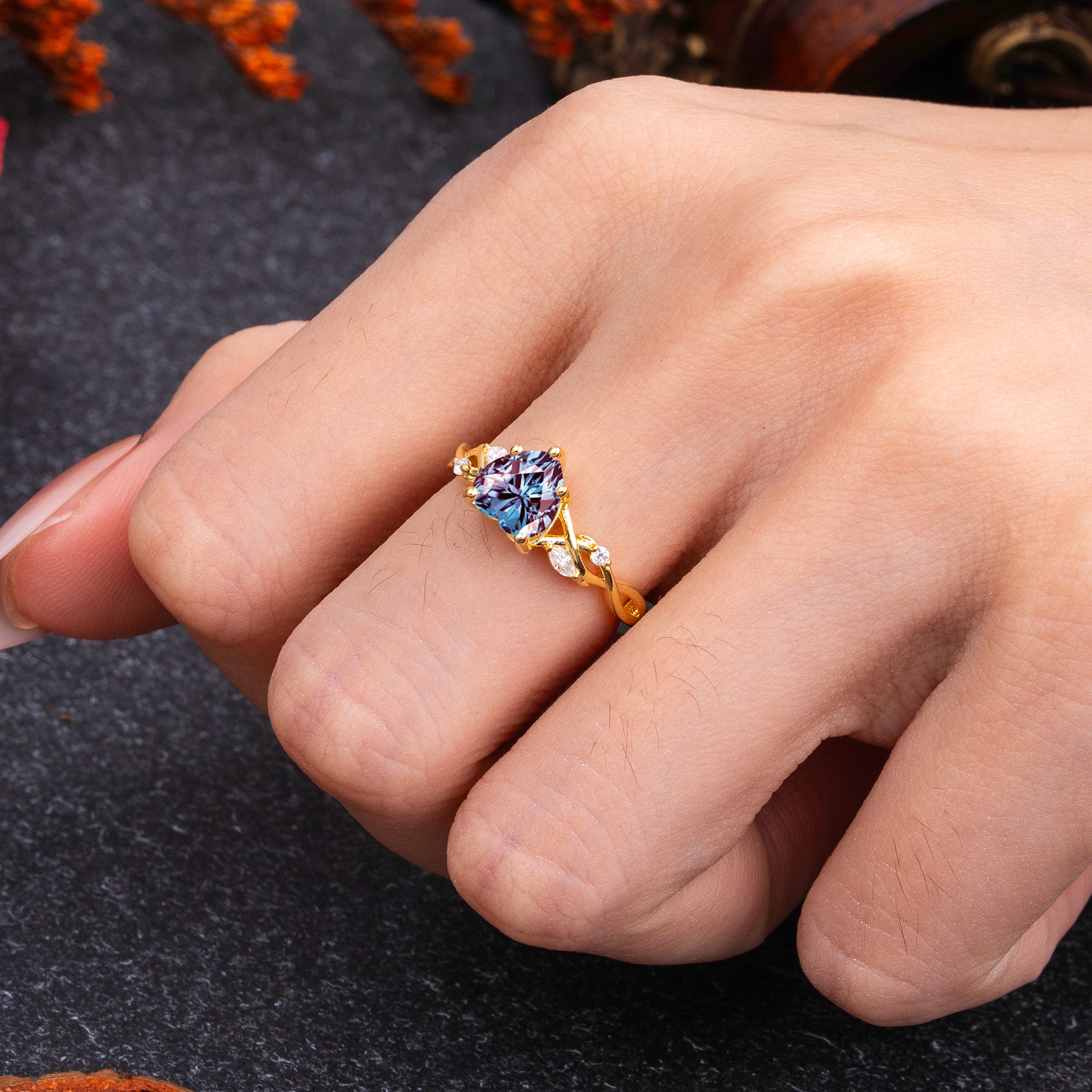
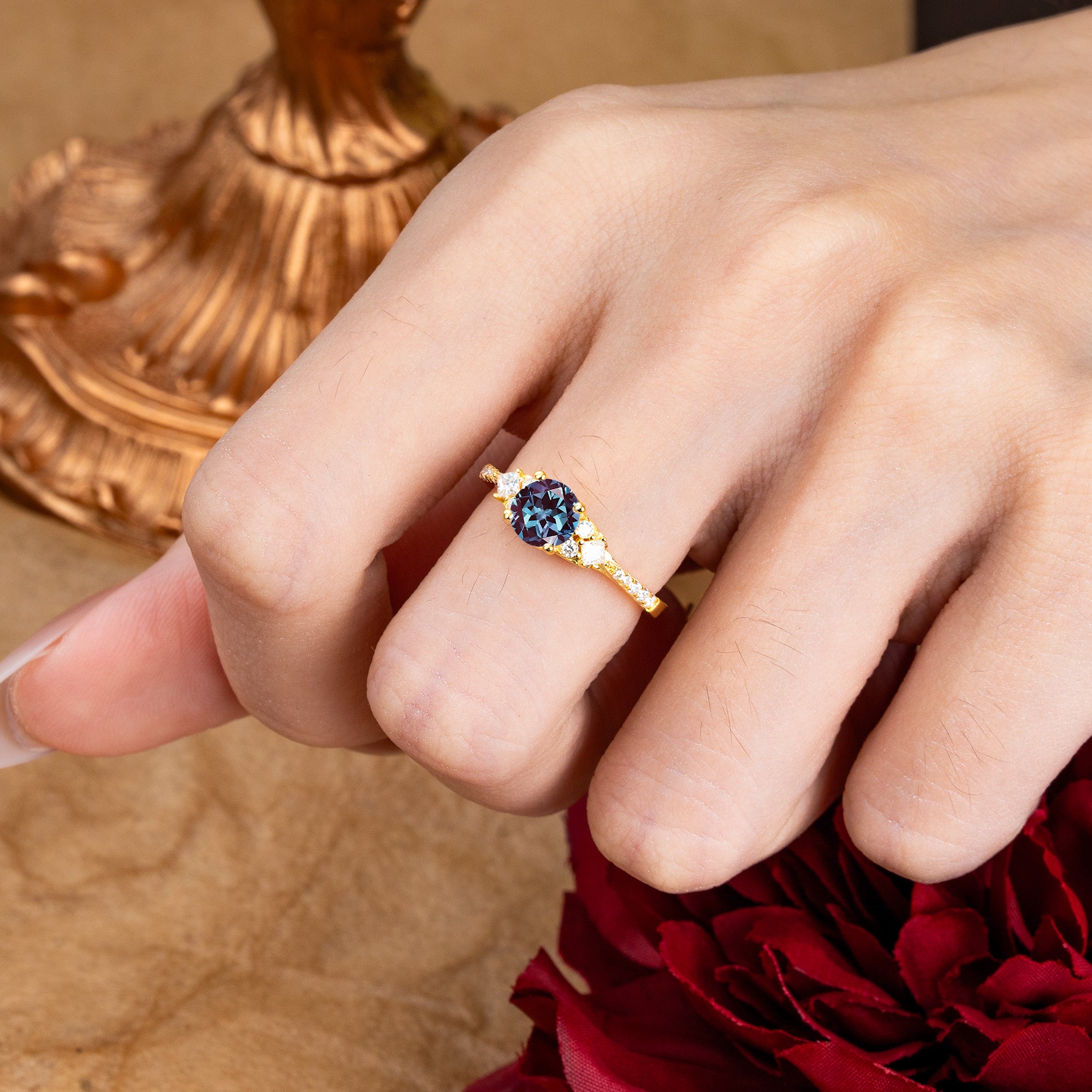
If alexandrite stone speaks to you, browse Romalar's collections of alexandrite rings, where thoughtful designs meet a range of styles and budgets.
FAQs
Is alexandrite supposed to be green in daylight and red at night?
GIA’s most-prized reference description is bluish green in daylight and red to purplish red in incandescent light. That is an important benchmark, but it is not a guarantee that every alexandrite will show the same exact pair of hues under every real-world light. The individual gem, its cut, the light source, viewing angle, and the way its color components mix all affect what you see. Evaluate the actual stone in two disclosed conditions rather than buying a color name alone.
Does a stronger color change automatically mean a better alexandrite ring?
Color change is GIA’s most important alexandrite quality factor, but it is not the only one. A ring still needs an appealing hue, suitable tone and saturation, clarity you are comfortable with, a cut that looks good face up, accurate identity disclosure, appropriate documentation, and a setting that fits your use. A dramatic shift that looks too dark or unattractive to you in ordinary lighting may be less satisfying than a more balanced stone you enjoy every day.
Can an LED bulb show alexandrite color change correctly?
An LED can produce an appearance you may enjoy, but “LED” is not one standardized light environment. Its spectral output can vary by product and temperature, and a warm LED is not automatically equivalent to incandescent light. GIA’s technical reference for the alexandrite effect contrasts daylight/daylight-equivalent fluorescent light with incandescent light. Ask the seller to identify the actual sources used and assess the stone under the lights that matter in your life.
Is laboratory-grown alexandrite fake?
No. GIA defines synthetic gem materials as laboratory-made counterparts sharing virtually all chemical, optical, and physical characteristics of the natural mineral counterpart, and it identifies laboratory processes that can produce synthetic alexandrite. The necessary issue is clear disclosure. A laboratory-grown or laboratory-created alexandrite should be described so that a buyer understands it is not mined. It should also be distinguished from an alexandrite simulant, such as a color-change synthetic sapphire or spinel.
What is “alexandrite sapphire”?
GIA says that “alexandrite sapphire” generally refers to a laboratory-grown sapphire made with trace elements that create an alexandrite-like color-change effect. It is not natural alexandrite. The material can still be attractive if accurately described. Ask for the exact species and laboratory-grown/simulant disclosure so that the invoice, media, care instructions, and expectations are aligned.
Do I need a laboratory report for an alexandrite ring?
For a significant purchase, GIA recommends an independent laboratory report when in doubt. A report can help confirm key facts within its scope, including natural versus laboratory-grown identity and detectable treatments, and may provide an origin opinion when the service is requested and the laboratory can reach one. A report does not replace viewing the actual stone’s color under defined lights, reviewing the setting, or confirming the seller’s commercial terms.
Is alexandrite durable enough for an engagement ring?
GIA lists alexandrite at Mohs 8.5, with excellent toughness and no cleavage, and describes it as a good choice for rings and mountings subject to daily wear. That makes it a strong material candidate. Nevertheless, finished-ring durability still depends on the cut, exposed edges, setting design, prong condition, ring height, metal wear, and the wearer’s activities. Choose a design that addresses the actual shape and maintain it through professional checks.
Can I use an ultrasonic cleaner on an alexandrite ring?
GIA says ultrasonic and steam cleaners are usually safe for alexandrite, while warm, soapy water is always safe. It gives a critical exception: fracture-filled gemstones should only be cleaned with warm, soapy water. If identity, treatment, or mounting security is uncertain, select the conservative method and obtain written care guidance for the exact ring before using ultrasonic or steam cleaning.
Does a color-change video prove a stone is natural alexandrite?
No. A color-change effect alone does not prove natural origin. GIA notes that synthetic alexandrite exists and that color-change synthetic corundum and synthetic spinel can imitate natural alexandrite. A video is useful as visual evidence of an item’s appearance only when tied to the same stone, described lighting, and honest media conditions. Identity requires appropriate disclosure and, when warranted, independent laboratory documentation.
Share