



Home
›
Trends & Style
›
Dark Statement Rings in 2027: Black Onyx, Rutilated Quartz, and Gothic Design

Dark Statement Rings in 2027: Black Onyx, Rutilated Quartz, and Gothic Design
by zhousamuel on Sep 14 2026
For years, the safest ring was designed to disappear into the category of “classic”: a pale center stone, a fine band, a little pavé, very little visual friction. One 2027 direction to watch is not simply bigger or louder. It is darker, more deliberate, and more material-aware. A black onyx signet ring, a rutilated quartz cabochon crossed by mineral needles, or a sculptural ring with a sharply defined bezel can make the hand feel considered before it feels adorned.
A dark statement ring is not one rigid historical style, nor does it require a skull, a cross, or a theatrical silhouette. It is a modern design category built around contrast: dark or smoky stone color, saturated metal, graphic geometry, an architectural setting, or a visible natural inclusion. The most persuasive examples are not costume jewelry. They are pieces with a clear point of view, proportioned well enough to be worn repeatedly.
The essential question is not whether a dark ring is “too bold.” It is whether the stone, finish, setting, and wearer’s daily routine are working together. This guide explains the material reality behind black onyx and rutilated quartz, translates gothic-inspired design into wearable choices, and gives practical buying and care advice grounded in gemological sources.
Why Dark Statement Rings Belong in the 2027 Conversation
The move toward darker rings sits within a broader shift away from automatic sameness. In its 2026 engagement-ring forecast, Vogue reported client interest in individuality, crafted settings, thick gold bands, sculptural profiles, and strong bezels—design choices that give a ring more physical presence than a delicate pavé stack. That reporting does not establish a universal Gothic trend, but it does make a purposeful, material-led dark ring a credible direction to explore.
This signal does not prove a universal 2027 trend. It does, however, explain why dark statement rings are a timely direction to consider. A black center stone can make a wide band look intentional rather than heavy. A visible inclusion can make a cabochon feel more like a miniature artwork than a generic gemstone. A bezel can be both protective and graphic. The best designs turn practical components into visual character.
The deeper appeal is authorship. Buyers increasingly want a piece that looks selected, not auto-generated from a familiar formula. The modern dark ring is often defined by a restricted palette, a tangible surface, a history-referencing silhouette, and one unusual material decision. It can work as an engagement ring, a signet, a right-hand ring, an anniversary ring, or an heirloom-minded gift.
Gothic-Inspired Does Not Mean Costume: A Design Framework
“Gothic” can mean very different things to different wearers. Historically, revival jewelry has long borrowed from earlier visual languages. GIA notes that revival jewelry may copy or reinterpret historical motifs, and its research on 19th-century revival styles documents techniques and details such as twisted wire, granulation, beading, enamel, and central colored gems. Contemporary gothic-inspired rings should be understood in this same spirit: a reinterpretation, not a claim of period authenticity.
For some people, the look is spare and architectural: a black oval in a knife-edge bezel, a wide signet with a single carved plane, or a dark stone set east-west. For others, it is romantic: a pointed-arch gallery, milgrain borders, scrolling shoulders, or a star-set band. For others still, it is expressive and maximal: a large cabochon, a deeply engraved shank, or a cluster that mixes black, smoky, and metallic tones. The common thread is controlled darkness, not a required symbol set.

|
Design language |
Visual ingredients |
Best gemstone direction |
Why it works |
|
Modern Gothic |
Clean bezel, black-and-silver contrast, low geometry, signet mass |
Black onyx, black spinel, black sapphire |
The dark stone reads as architectural rather than ornate |
|
Romantic Gothic |
Arches, milgrain, engraved lines, softened points, warm gold |
Rutilated quartz, onyx, deep sapphire |
Historical references feel intimate rather than theatrical |
|
Cathedral Gothic |
Vertical lines, pointed gallery, structured shoulders, symmetry |
Black onyx, sapphire, spinel |
The setting carries the architectural idea without overloading the stone |
|
Celestial Gothic |
Star-set accents, matte metal, midnight palette, subtle engraving |
Rutilated quartz, black spinel, smoky quartz |
Small light-catching details animate a restrained dark surface |
|
Relic / Heirloom Gothic |
High-polish cabochon, engraved shank, antique-cut accent stones |
Onyx, rutilated quartz, sapphire |
Texture and proportion create a sense of history without imitation |
A successful dark ring does not need all of these elements at once. In fact, restraint is usually more effective. If a rutilated quartz has dramatic needles, a plain bezel gives the inclusion room to speak. If the setting has elaborate engraving, a clean black onyx cabochon can provide a calm visual field. The more unusual the material, the more useful it is to simplify everything around it.
Black Onyx: The Graphic, Grounded Center Stone

Black onyx is a natural starting point for dark statement jewelry because it gives designers a near-black plane that works like ink: crisp against silver, moody against yellow gold, and dramatic against pavé accents. Yet “black onyx” is also a term that deserves careful handling. Gem-A explains that, in traditional gem-trade usage, onyx is a straight-banded form of agate (a chalcedony variety), traditionally associated with black-and-white banding. In modern trade use, the name is often applied to uniformly black stones; Gem-A notes that “dyed black chalcedony” can be a technically more precise description in some cases.
That is not a reason to avoid black onyx. It is a reason to buy it transparently. A knowledgeable seller should be comfortable stating what the material is, whether color treatment is known, and how the stone should be cleaned and serviced. Dark color is not a problem; undisclosed identity or treatment is.
Material Profile: Chalcedony, Not Black Magic
Black onyx belongs to the quartz family through chalcedony. Gem-A describes chalcedony as a quartz gem composed of very small interlocking crystals and identifies agate as one of its forms. The International Colored Gemstone Association identifies black onyx as a chalcedony form and gives chalcedony a Mohs hardness range of 6.5–7, suitable for everyday jewelry when the design and wear routine are sensible. That places a black onyx ring in a useful middle ground: harder than many soft ornamental materials, but not as scratch-resistant as corundum or diamond.
The practical implication is straightforward. Black onyx can be an excellent ring stone when the design respects it. A low dome, a full bezel, a partial bezel with well-protected shoulders, or a sturdy signet-style setting limits edge exposure. A high, exposed cabochon on a very fine shank may be visually dramatic, but it demands more care in everyday use.
Why Black Onyx Is So Effective in Gothic Design
Onyx contributes more than color. Its opaque, even appearance can create negative space in a ring composition, making metalwork and engraving easier to read. It works particularly well with polished white metals, brushed silver-toned surfaces, warm yellow gold, or tiny white accent stones. A black oval set east-west feels modern; a rectangular onyx signet feels scholarly; a shield-shaped cabochon feels ceremonial; and a round cabochon with a milgrain bezel can reference Victorian-era jewelry without turning literal.
Because the material is visually quiet, it is also generous to personal styling. It can sit beside a tailored blazer, a dark evening look, a wedding stack, or a minimal everyday wardrobe. The ring does not need to communicate a fixed “meaning.” A wearer may associate black onyx with steadiness, privacy, mourning, protection, or simply great contrast—but those are personal interpretations, not gemological properties.
Black Onyx Buying Questions That Prevent Regret
Ask to see the exact stone under ordinary light, not only against an inky studio background. Look for an even polish, a silhouette that suits the hand, and a setting with adequate support. If the seller uses “natural,” “untreated,” “black onyx,” “agate,” or “chalcedony,” ask what those words mean for the individual item and request the answer on the invoice.
For many chalcedony rings, gentle hand cleaning with warm water and a small amount of mild soap is a sensible baseline. That advice must yield to the care instructions for the finished piece, particularly when it includes plated metal, patina, enamel, glue-set elements, delicate pavé, or other stones.
Rutilated Quartz: When the Inclusion Becomes the Design

If black onyx is a controlled field of darkness, rutilated quartz is a controlled interruption. The host is quartz; the visual drama comes from rutile needles enclosed within it. GIA describes rutile as one of the five forms of titanium dioxide and documents acicular—needle-like—rutile crystals in quartz, where intersecting needles can form a striking star-like inclusion. The inclusion is not an imperfection to hide. In rutilated quartz, it is the reason to look.
The material can read in several ways depending on the density, direction, color, and scale of its needles. Sparse threads create an atmospheric, almost celestial effect. Dense crossing needles can look stormy, industrial, or web-like. A dark or smoky-looking quartz host can make the inclusions feel mysterious; a clearer host can turn them into bright lines suspended in space. This range makes rutilated quartz especially useful for a gothic-inspired ring that is artistic rather than simply black.
What to Look for in Rutilated Quartz
Start with composition, not carat weight. Look at the stone as you would a small drawing. Do the needles create a direction or focal point? Does the pattern remain interesting from conversational distance? Is the center of the stone clear enough for the material to have depth, or so dense that it reads as visual noise? There is no single “best” pattern, but a good stone looks intentional rather than accidental.
Next, inspect the cut. Cabochons often emphasize the depth and three-dimensional quality of inclusions, while faceted rutilated quartz may add flashes of light around them. A broad, low cabochon can suit a signet-like ring. A calibrated oval can be made more formal in a delicate bezel. A geometric, freeform cut can become the whole narrative of a one-of-one ring.
Finally, assess the stone in motion. Inclusion-rich materials change as the finger turns, so request a daylight video and an indoor-light video of the actual gem. Do not accept a general product image as proof of the stone you will receive. The particular inclusion scene is central to the value of the design.
Durability and Care for Rutilated Quartz
Rutilated quartz is quartz at its core. GIA lists rose quartz, another quartz variety, at 7 on the Mohs scale, describes it as generally stable under light and heat, and advises that warm, soapy water is safe while ultrasonic and steam cleaning should be avoided. This is a useful conservative care baseline for a rutilated quartz ring, but it is not a substitute for disclosure of a particular stone’s condition, treatment history, or mounting.
A quartz ring can be worn often, yet the point of rutilated quartz is visual depth rather than brute toughness. Choose a setting that protects the girdle, avoids a precariously high profile, and does not force the stone into a shape it cannot support. Remove it for high-impact activities. Clean it gently, dry it carefully, and do not assume that the inclusion-rich look means the stone can tolerate every cleaning method.
The Dark-Stone Spectrum: Onyx, Rutile, and Beyond
The phrase “dark gemstone” can hide meaningful differences. Some stones are opaque; others are transparent but smoky. Some derive their visual interest from color; others rely on inclusions or luster. Some are especially appropriate for frequent wear; others are best when treated as a care-forward statement piece.
|
Material |
What creates the dark effect |
Mohs hardness |
Best fit for a ring |
Key buyer question |
|
Black onyx / black chalcedony |
Opaque, near-black body color |
6.5–7 |
Graphic signets, cabochons, low bezels |
Is the material and any known color treatment disclosed? |
|
Rutilated quartz |
Rutile needles within a quartz host |
7 (quartz baseline) |
One-of-one cabochons, artful bezels, elongated silhouettes |
Can I see this exact inclusion pattern in multiple lighting conditions? |
|
Black spinel |
Dark faceted stone with a high-polish look |
8 |
Faceted solitaires, tailored clusters, low prongs |
What is the cut quality and face-up color in daylight? |
|
Black sapphire |
Deep corundum body color |
9 |
Durable daily-wear rings, angular cuts, sculptural settings |
Are any treatments disclosed, and what care does the treatment require? |
|
Smoky quartz |
Translucent smoky brown-to-dark body color |
7 (quartz family) |
Larger statement stones, vintage proportions, warm metal |
Does the cut preserve depth without looking overly dark indoors? |
Black spinel and black sapphire are particularly useful alternatives when a wearer wants a darker faceted stone with stronger scratch resistance than chalcedony or quartz. GIA lists spinel at Mohs 8 and describes it as suitable for everyday wear. GIA places sapphire at Mohs 9 with excellent toughness and no cleavage, making corundum a notably strong candidate for rings subject to daily wear. Treatment still matters: GIA notes that fracture-filled, cavity-filled, or dyed sapphires require gentler care than untreated or heat-treated material.
This does not make onyx or rutilated quartz “inferior” choices. It makes them different design choices. A wearer who wants an opaque black signet with quiet presence may prefer onyx even when a black sapphire is more durable. A wearer who wants a ring that never looks the same twice may choose rutilated quartz for its internal architecture. The right stone depends on what the ring is meant to do.
Ring Architecture: How to Make Darkness Wearable
Dark statement rings gain power from structure. The central stone is only one element; the bezel thickness, band width, gallery height, metal finish, and wedding-band relationship determine whether the ring feels balanced or burdensome.

Start With a Low, Protective Profile
A low profile is both visually modern and practical. It makes a substantial ring feel closer to the hand and reduces the leverage created when the ring catches a hard surface. This is especially valuable for cabochon-cut onyx and rutilated quartz, where the stone may be broad rather than deeply faceted.
A full bezel can create a clear outline around a dark gem and guard more of its edge. A partial bezel opens more of the sides and can make a stone feel lighter. Well-built prongs can work beautifully with faceted black sapphire or spinel, but they should be proportioned to the stone rather than reduced to near-invisible decoration. The goal is not to conceal the engineering; it is to make the engineering part of the design.
Make the Band Carry Its Share of the Story
The center stone should not have to perform alone. A broad, softly sculpted band can ground an onyx cabochon. A tapered shank can give a large rutilated quartz a direction of travel. Engraving can echo the line of a rutile needle, while a matte surface can make a glossy black stone feel even darker. Vogue’s 2026 reporting on thicker bands, sculptural profiles, and bezel settings helps explain why this kind of material-focused construction feels contemporary rather than heavy-handed.
Avoid adding every gothic marker at once. If the ring has ornate engraving, skip the oversized halo. If the stone is highly included, keep the gallery clean. If the band is extremely wide, consider a lower stone and a smoother inner profile. Dark rings are most elegant when there is one primary visual statement and one supporting texture—not five competing ideas.
Use Color Contrast With Intention
Black onyx beside yellow gold often feels warm, almost antique. Onyx beside platinum, white gold, or silver-toned metal reads cooler and more graphic. Rutilated quartz works especially well when the metal repeats an undertone found in its needles: yellow gold for warmer threads, white metal for silvery contrast, and rose gold for a softer, romantic version of the look.
Surface treatment deserves a direct question. If a design uses black rhodium, oxidation, enamel, plating, or a patinated finish, ask the jeweler how that finish is produced, how it is expected to age, whether it can be refinished, and which cleaning methods to avoid. This is not an argument against dark metal finishes; it is part of buying them responsibly.
A 2027 Design Brief: Five Dark Statement Ring Directions
|
Ring direction |
Center-stone suggestion |
Setting and metal |
Who it suits |
Practical watch-out |
|
The Obsidian Signet |
Black onyx cabochon or flat-topped onyx |
Heavy bezel, wide yellow-gold or silver-toned shank |
A wearer who values graphic simplicity and daily versatility |
Confirm stone identity/treatment and keep the profile low |
|
The Needlework Ring |
Rutilated quartz with a directional inclusion scene |
Minimal bezel, tapered shank, warm gold |
A wearer who wants a one-of-one, art-object feel |
Buy the exact stone shown; check it in daylight and indoor light |
|
The Black Cathedral |
Black sapphire or spinel |
Structured gallery, secure prongs or bezel |
A wearer who wants gothic geometry with higher durability |
Ask about stone treatment and avoid a needlessly tall gallery |
|
The Night-Sky Cluster |
Rutilated quartz or dark spinel with tiny light accents |
Low cluster, star setting, matte band |
A wearer who likes detail without a large solitary stone |
Ensure small accents do not create snag-prone or difficult-to-clean areas |
|
The Heirloom Shield |
Shield-cut onyx, sapphire, or smoky quartz |
Engraved shoulders, protective bezel, balanced band |
A wearer drawn to historical references and tailored silhouettes |
Test comfort and finger coverage before finalizing the proportions |
These are starting points, not formulas. The best custom design begins with the wearer’s actual hand, wardrobe, work habits, and tolerance for care.
What a Trustworthy Seller Should Disclose
A compelling dark ring deserves a clear paper trail. The most trustworthy purchase conversation is not the one with the most dramatic story; it is the one with the most specific information. The Responsible Jewellery Council’s Code of Practices addresses responsible business practices across the jewelry supply chain, including due diligence, accurate product disclosure, and the colored-gemstone sector. This is a standard for company practices, not a blanket guarantee that any individual stone is ethically perfect. Still, it gives buyers a useful principle: claims should be backed by records.
|
Ask the seller |
Why it matters |
A useful answer includes |
|
What is the center stone, exactly? |
“Onyx,” “quartz,” and “black stone” can be broad sales terms |
The mineral/material identity stated plainly on an invoice |
|
Is the color natural, treated, coated, dyed, or otherwise enhanced? |
Appearance and care can depend on treatment |
Any known treatment and relevant care restrictions, recorded in writing |
|
Is this the exact rutilated quartz I will receive? |
The inclusion pattern is the point of the material |
Unedited image/video of the specific stone, in more than one light |
|
How is the stone protected? |
Edge exposure and ring height influence everyday risk |
Explanation of bezel, prongs, gallery support, and profile |
|
What is the metal and finish? |
A finish may need different care from the base metal |
Metal fineness, finish type, expected aging, and refinishing options |
|
What documents are included? |
Records help with care, insurance, and future service |
Itemized invoice, any relevant lab report, care instructions, and repair policy |
For a significant purchase, an independent laboratory report may be appropriate. A report can help identify the material, distinguish natural from laboratory-grown material where that service is available, and document detectable treatments. It is not a substitute for personal taste, and it does not establish a retail price. It is simply another form of clarity—especially valuable when a seller makes meaningful claims about identity, origin, rarity, or treatment.
Care for Dark Rings: Preserve the Finish, the Stone, and the Setting
Dark rings often look indestructible. That impression can be misleading. A black center stone can hide surface dust but still show scratches; a wide band can feel substantial but still catch on hard edges; and a dark finish can age differently from the metal beneath it. Care begins with knowing what the ring is actually made of.
For chalcedony, gentle hand cleaning with warm water and a small amount of mild soap is a sensible baseline; the International Colored Gemstone Association identifies onyx as a chalcedony form and describes the group as suitable for jewelry. For quartz, GIA identifies warm, soapy water as safe and advises avoiding ultrasonic and steam cleaning for rose quartz. Because rutilated quartz is a quartz-hosted inclusion stone and because a finished ring may include additional treatments or materials, gentle hand cleaning is the prudent default unless the seller gives a more specific written protocol.
GIA advises that chemicals can damage or discolor precious metals and may harm colored gemstones. It recommends removing fine jewelry before household cleaning and chlorinated swimming, and it emphasizes special care for treated gems. GIA also cautions that ultrasonic vibration can sometimes loosen gems or cause damage in certain mountings. Those cautions are especially sensible for dark rings with wide bezels, delicate accent stones, coatings, or unknown treatment history.
Remove the ring before weight training, gardening, home repair, climbing, contact sport, chemical cleaning, or any task that puts the hand in repeated contact with hard surfaces. Store it in a padded compartment or soft pouch, not loose beside harder jewelry. If a prong catches fabric, the ring begins to rattle, a stone appears to move, or a dark surface finish changes unexpectedly, have the piece inspected by a qualified jeweler rather than attempting a home repair.
The 2027 Takeaway: Darkness With Intention
Dark statement rings are a compelling 2027 direction not because they follow a trend checklist, but because they resist generic jewelry by paying attention to material character. Black onyx brings graphic calm, provided its identity and any known treatment are disclosed. Rutilated quartz turns needle-like mineral inclusions into a personal visual signature. Black spinel and sapphire offer faceted darkness with stronger daily-wear resilience. Gothic-inspired design supplies the vocabulary—arches, texture, strong bezels, sculptural mass—but the best ring is still the one that feels like its wearer.
Choose one dominant idea. It might be a black cabochon, a field of rutile needles, a bezel with architectural weight, or a dark finish against warm gold. Then make the rest of the design support it. When the stone, setting, and care plan agree, a statement ring becomes more than a moment. It becomes a piece you reach for repeatedly.
For a broader overview of Black Onyx Ring and Black Rutilated Quartz Ring, visit Romalar Jewelry for engagement rings. The goal is not to replace one “correct” ring with another. It is to choose a material story that you can genuinely live with.
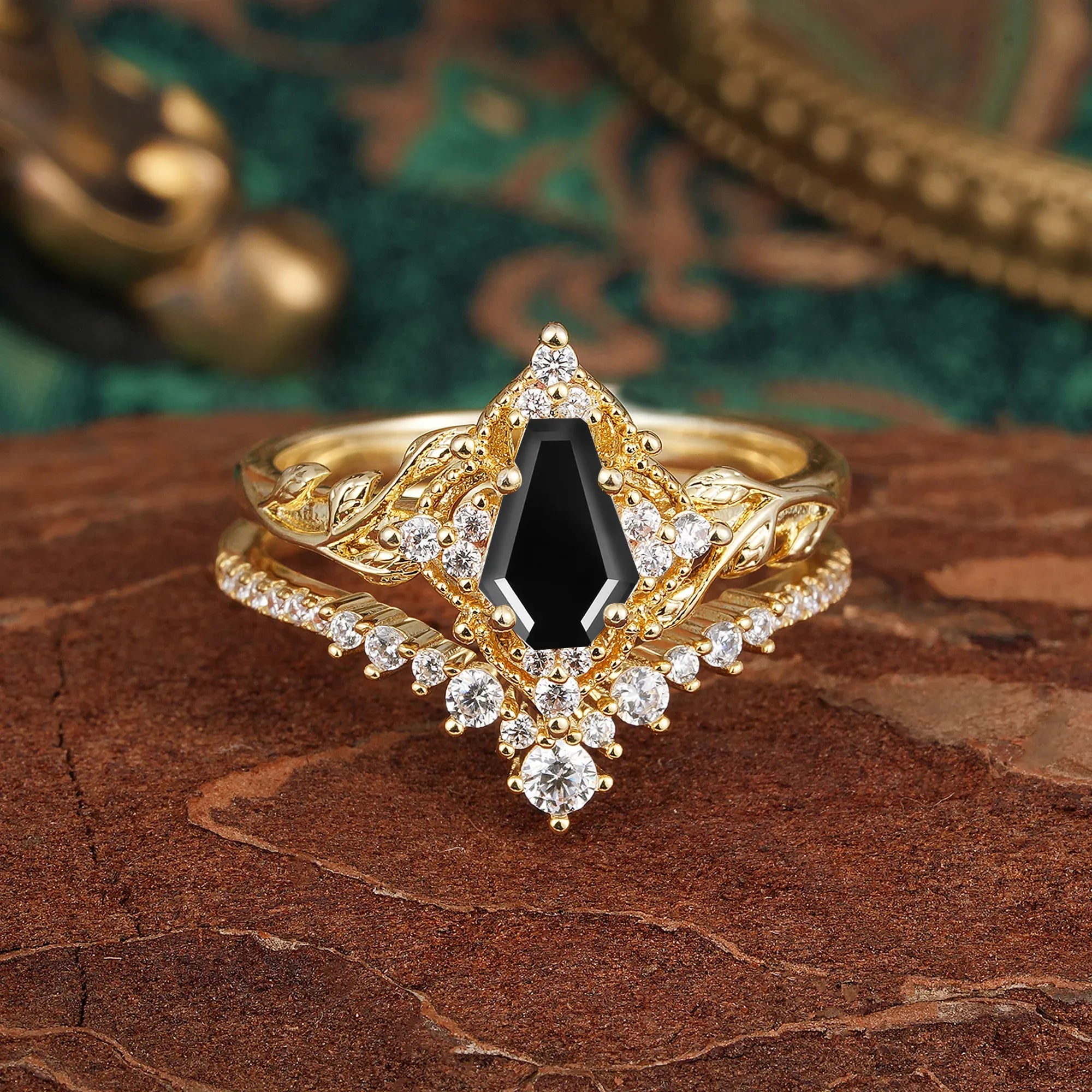 Minimalist Vintage 4-Prong Coffin-Cut Black Onyx Engagement Ring Set
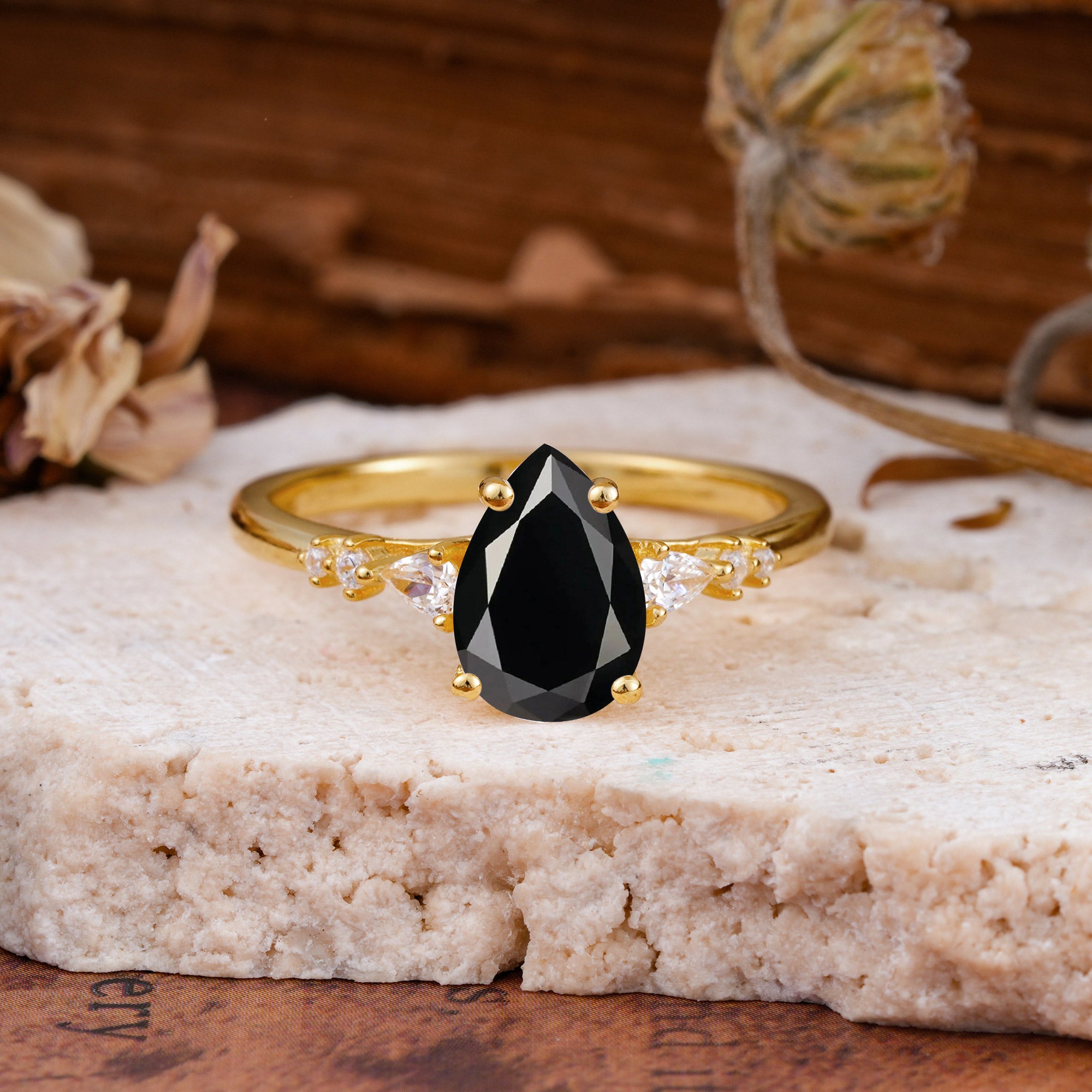 Pear Cut Black Onyx Three-Stone Engagement Ring for her
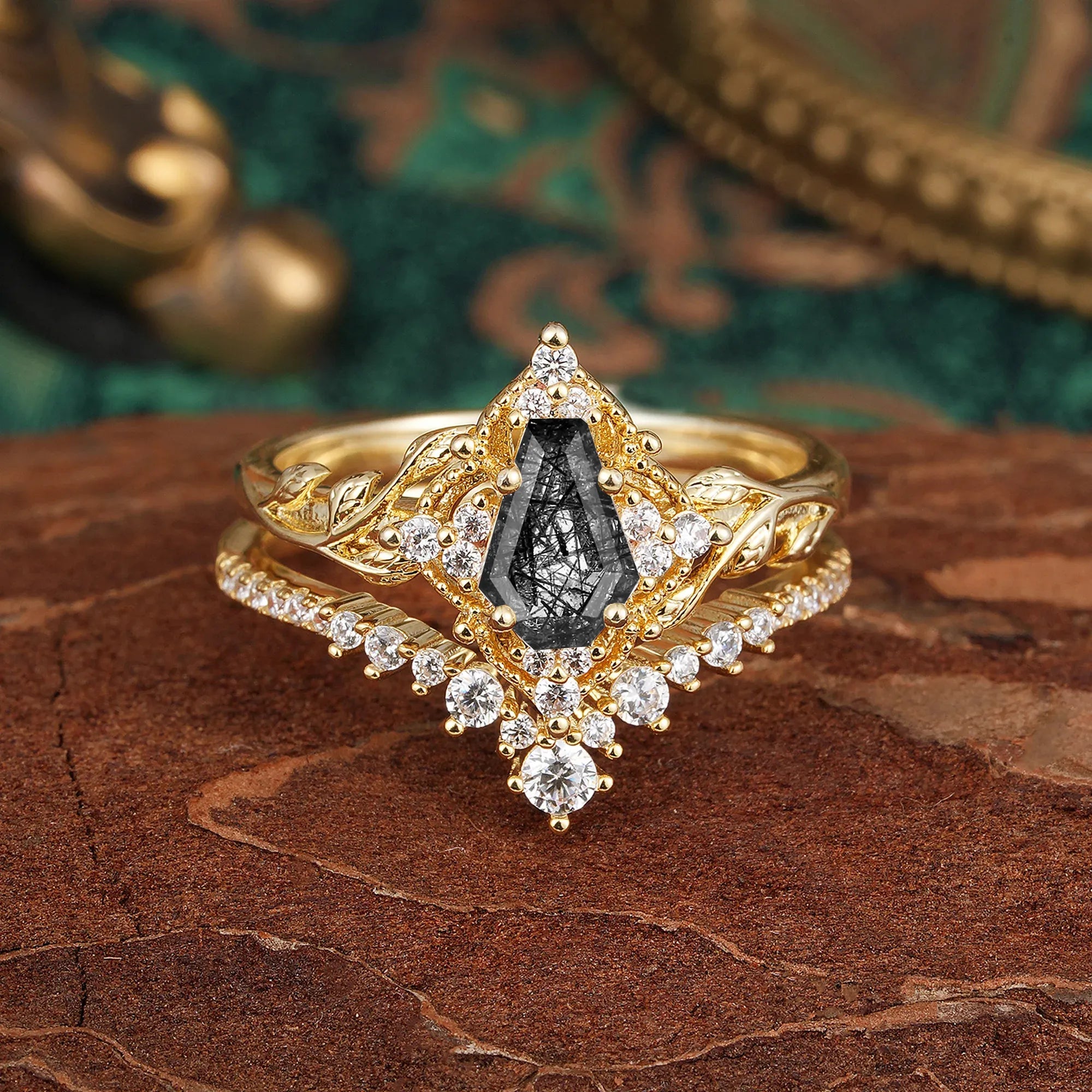 Minimalist Vintage 4-Prong Coffin-Cut Black Rutilated Quartz Bridal Ring Set
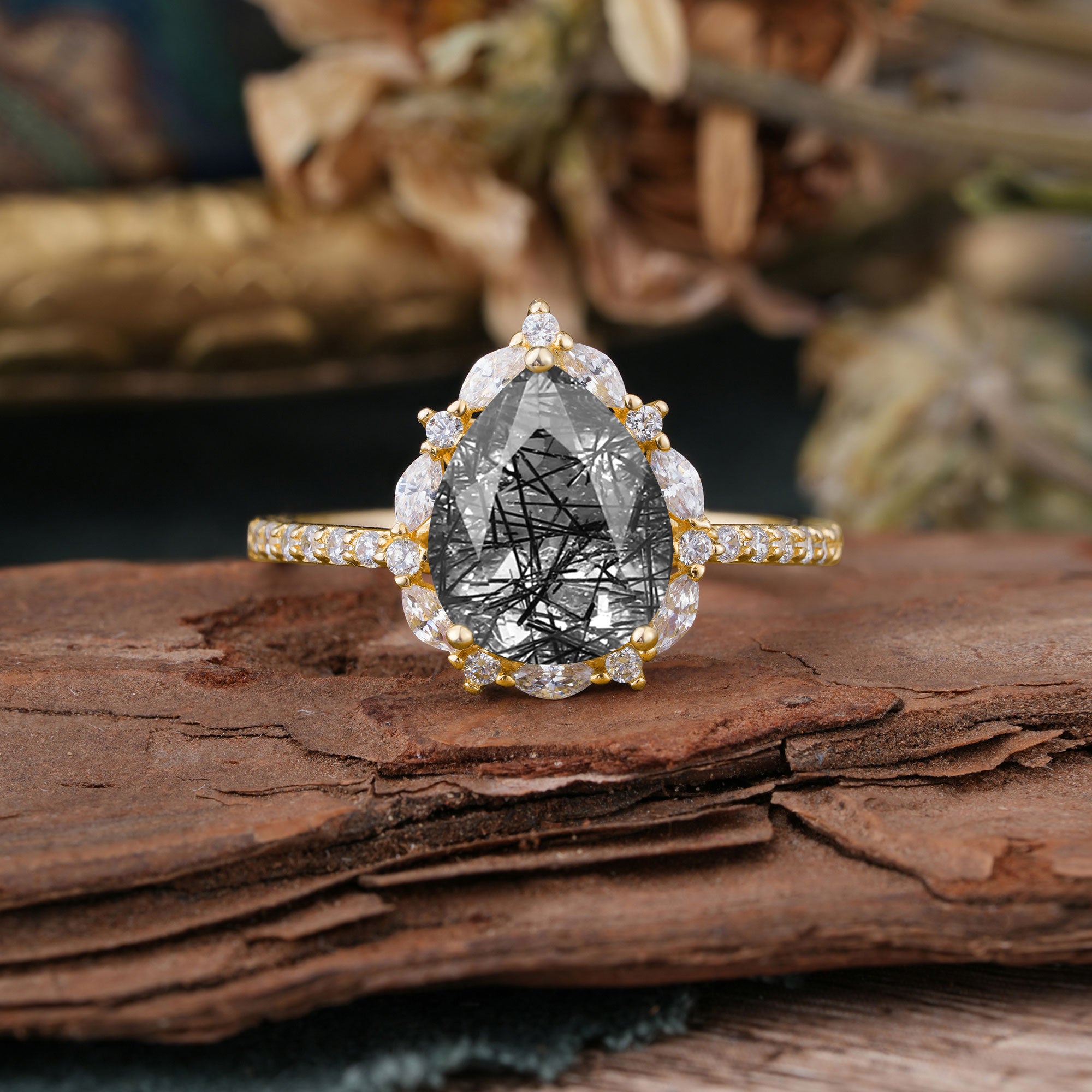 3 Carat Pear Cut Vintage 3 Prong Black Rutilated Quartz Pave Engagement Ring
FAQs
Is black onyx a good stone for an everyday ring?
Black onyx can work well for frequent wear when the ring has a protective, low setting and the wearer follows sensible care habits. The International Colored Gemstone Association identifies black onyx as a chalcedony form and gives chalcedony a Mohs range of 6.5–7, a practical range for jewelry when wear habits are sensible. It is still less scratch-resistant than sapphire or diamond, so remove it for high-impact activities and store it separately from harder jewelry.
Is all black onyx naturally black and untreated?
No. Gem-A explains that “onyx” has a specific historical meaning as a straight-banded agate and that the name is often used in the contemporary trade for uniformly black stones; it notes that “dyed black chalcedony” may be technically more precise in some cases. Ask the seller to identify the material and disclose any known treatment in writing. The key issue is clarity, not whether a particular treatment is automatically unacceptable.
What is rutilated quartz?
Rutilated quartz is quartz containing visible rutile inclusions. GIA identifies rutile as one of the forms of titanium dioxide and documents its needle-like, or acicular, crystals within quartz. In jewelry, the pattern of those internal needles is the primary visual feature, which is why buyers should inspect the exact stone rather than relying on a generic image.
Is rutilated quartz durable enough for a ring?
It can be, particularly in a low, protective setting. Quartz has a Mohs hardness of 7; GIA describes rose quartz as generally stable under light and heat, with warm soapy water safe for cleaning, while recommending avoidance of ultrasonic and steam cleaners. As with all inclusion-rich and custom-set stones, design, treatment disclosure, and the wearer’s habits matter alongside the hardness number.
What makes a ring “gothic” without looking like costume jewelry?
A refined gothic-inspired ring usually relies on proportion, contrast, and one or two historical-reference details rather than an excess of symbols. Consider a strong bezel, a pointed gallery, a shield or oval silhouette, engraving, milgrain, or a dark stone against warm metal. GIA’s discussion of revival jewelry provides a useful context: historical elements can be reinterpreted thoughtfully rather than copied literally.
Which dark gemstone is most durable for a daily-wear ring?
Among the stones discussed here, black sapphire is one of the strongest options. GIA places sapphire at Mohs 9, with excellent toughness and no cleavage, making it highly suitable for rings subject to daily wear. Black spinel at Mohs 8 is also a strong alternative. However, treatment status, setting construction, and daily activities still affect how well a ring performs.
Do I need a bezel setting for black onyx or rutilated quartz?
A bezel is not mandatory, but it is often a smart design choice. It can protect more of a stone’s edge, create a crisp graphic outline, and keep the profile low. This is particularly useful for broad cabochons or stones with visual details near the edge. A skilled jeweler can also use secure prongs or a partial bezel successfully when the individual stone and design support it.
How should I clean a dark statement ring?
Start with the exact care guidance provided for the finished ring. For chalcedony, gentle hand cleaning with warm water and a small amount of mild soap is a sensible baseline. For quartz, GIA lists warm soapy water as safe and advises avoiding ultrasonic and steam cleaning for rose quartz. When a ring contains treatments, coatings, pavé, or an unknown finish, choose gentle hand cleaning and consult a qualified jeweler before using mechanical cleaning methods.
Editorial and Gemological Scope Note
This article is an educational style and buying guide, not an appraisal, laboratory report, warranty, or a substitute for advice from a qualified jeweler or independent gemological laboratory. Gem color, identity, treatment, durability, setting suitability, and value can vary from one stone to another. Request written disclosure, view the actual gemstone where possible, and seek independent verification when the representation or value of a purchase makes that appropriate.
References
Vogue, The Engagement Rings You’ll See on the Chicest Brides-to-Be in 2026
GIA, A New Life for Revival Jewelry Styles: Archaeological, Renaissance and Egyptian
Gem-A, Buying Guide: Get to Know the Different Types of Chalcedony
Share