



What Is the Color of October's Birthstone? Opal and Tourmaline Guide
by zhousamuel on Oct 07 2026
October has two recognized birthstones: opal and tourmaline. There is no single October birthstone color.
Opal is traditionally associated with a shifting, rainbow-like play-of-color. Depending on the stone, its background or body color may be white, black, gray, transparent, yellow, orange, brown, pink, blue, or another shade. Its flashes may include red, orange, yellow, green, blue, violet, or several colors at once.
Tourmaline, the newer October birthstone, is one of the most color-diverse gems. It can appear pink, red, green, blue, yellow, orange, purple, brown, black, or multicolored. Bicolor and tricolor tourmaline can show two or more colors within a single crystal, including the pink-and-green zoning associated with watermelon tourmaline.
The simplest way to remember the answer is:
Opal is October’s shifting rainbow birthstone, while tourmaline is October’s broad-spectrum birthstone.
That distinction is more useful than calling October birthstone ring “white,” “rainbow,” or “pink.” Opal and tourmaline are not merely different colors of the same gem. They produce color in different ways, have different durability profiles, and require different buying and care considerations.
Why October Has Two Birthstones
Opal is generally regarded as October’s traditional birthstone, while tourmaline is the newer addition. Both gems as having extensive color combinations and distinctive coloring characteristics.
Opal has been valued for centuries because its play-of-color can imitate the appearance of many other gems. GIA connects the name with upala, a Sanskrit word meaning “precious stone,” and later forms of the name used in the Roman world. The American Gem Society also discusses the Greek opallios, meaning "to see a change in color."
Tourmaline is recognized as the newer October birthstone, a fitting choice given its exceptional range of hues. Its name is related to Sinhalese terms translated as “stone of mixed colors.” The gem’s color diversity also caused historical confusion: red tourmaline was mistaken for ruby, and green tourmaline was mistaken for emerald before mineral science identified tourmaline as its own mineral group.
The two stones offer different kinds of personal meaning. Opal has traditionally been associated with hope, purity, truth, creativity, and inspiration. Tourmaline is linked in folklore with artistic expression, and different colors have developed their own symbolic associations. These are cultural traditions, not scientifically demonstrated medical effects, so a responsible jewelry article should present them as symbolism rather than treatment claims.
Opal is traditionally given for the 14th wedding anniversary, while tourmaline is associated with the 8th wedding anniversary. Either stone can also represent an October birthday, a personal milestone, an anniversary, or a preference for colorful jewelry.
Opal’s Color: Body Color Plus Play-of-Color
When people ask what color October’s birthstone is, they are often thinking of opal. The most important concept is that opal color has two separate dimensions:
1 Body color: the background or base color of the stone.
2 Play-of-color: the moving flashes of spectral color that appear as the viewing angle or light changes.
GIA lists opal’s overall color range as all colors and describes its chemistry as hydrated silica, approximately SiO₂·nH₂O. In precious opal, orderly arrays of microscopic silica spheres diffract light and separate it into visible spectral colors. The size and spacing of those spheres influence which colors appear. Silica-sphere structures around 0.2 microns can create red play-of-color flashes.
The American Gem Society likewise explains that microscopic silica spheres produce opal’s characteristic play-of-color. This is why a red flash does not mean the entire opal is red. The flash may appear only from a particular angle while the stone’s underlying body remains white, gray, black, brown, or transparent.
The Common Opal Color Terms

White opal has a white, milky, or pale background. It may show soft blue, green, yellow, orange, red, or multicolored flashes.
Black opal has a dark gray-to-black body color. The dark background can create strong contrast with red, orange, green, blue, or violet play-of-color. Lightning Ridge in New South Wales is famous for prized black opal, but a locality name alone does not establish quality or value.
Gray opal has a medium-toned background between light and black opal. It can provide a neutral setting for colorful flashes and often looks sophisticated in contemporary jewelry.
Crystal opal is transparent to translucent, allowing color to appear within the stone rather than only across an opaque surface. Transparency does not automatically make an opal more valuable; it must be assessed with play-of-color, pattern, clarity, cut, and durability.
Fire opal usually has a yellow, orange, or reddish-orange body color. Some fire opals show play-of-color, while others are appreciated for their warm transparent or translucent body color alone.
Boulder opal retains part of its ironstone host rock. The dark or earthy host may intensify the appearance of the opal’s blue, green, orange, or red flashes. Queensland is especially associated with boulder opal.
Common opal does not show visible play-of-color. It may still occur in attractive pink, blue, green, yellow, brown, or other body colors. The absence of play-of-color does not make common opal worthless; it simply places it in a different category from precious opal.
How Opal’s Color Is Evaluated
GIA identifies color, pattern, and clarity as central quality considerations and explains that play-of-color may be the most spectacular feature of an opal’s appearance. In practice, evaluate:
• Brightness: how vivid and lively the color appears
• Color range: whether the stone shows one, several, or many hues
• Pattern: how the flashes are arranged across the face
• Distribution: how much of the visible surface shows play-of-color
• Body color: the contrast between the background and the flashes
• Transparency and clarity: how the stone transmits light and whether inclusions or fractures affect it
• Cut and polish: how effectively the finished shape presents the color
A vivid blue-green flash may be more attractive than a weak rainbow spread across a dull surface. Red is traditionally considered a highly desirable prominent color in many opal markets, but it is not automatically the best choice for every buyer or every stone. GIA emphasizes that intensity, color range, pattern, transparency, clarity, and cut must be considered together.
Tourmaline’s Color: October’s Broad-Spectrum Gem

Tourmaline differs from opal because its color is primarily associated with chemical composition and trace elements, while opal’s famous spectral flashes are an optical effect created by its internal silica structure. The American Gem Society summarizes the distinction clearly: tourmaline color depends on trace elements, while opal diffracts light to show multiple colors.
GIA describes tourmaline as a gem that can show every hue of the rainbow, with a wide range of tones and saturations. This makes it possible to select an October birthstone by a specific color rather than by a shifting optical effect.
Pink Tourmaline
Pink tourmaline can range from pale blush and rose to intense magenta. It is a popular choice for romantic jewelry, October birthday gifts, and feminine designs, but it can also look modern when cut into an emerald, oval, or geometric shape and paired with white metal.
Red Tourmaline and Rubellite
Red to purplish-red tourmaline may be described in the trade as rubellite. The term should not replace an examination of the actual stone. The term should be considered alongside the actual color, saturation, clarity, treatment status, and laboratory documentation. A red tourmaline can offer a rich alternative to ruby, but it should not be represented as ruby simply because the color is similar.
Green Tourmaline
Green tourmaline ranges from pale mint and yellow-green to forest green, bluish green, and intense chrome-like green. A strong green tourmaline can be visually impressive, yet it has a different optical character and mineral identity from emerald.
Blue Tourmaline and Indicolite
Blue tourmaline is often called indicolite. Its color may be blue, teal, greenish blue, or violetish blue. Fine examples can be rare, and their appearance can change noticeably with tone, saturation, cut orientation, and lighting.
Paraíba and Paraíba-Type Tourmaline
Copper-bearing tourmaline from Brazil’s Paraíba region became famous for electric blue, neon green, and violet colors. Similar copper-bearing material has been found in Mozambique and Nigeria and is often called Paraíba-type tourmaline.
Fine Paraíba and Paraíba-type tourmalines can command substantial premiums because of vivid hues, strong saturation, and rarity. Buyers should not rely on the name alone. For a high-value stone, an independent laboratory report can help document detectable characteristics and, where possible, geographic origin.
Watermelon Tourmaline
Watermelon tourmaline typically shows pink or red in the interior and green around the outside, sometimes with a pale transitional band. It is a form of bicolor or multicolor tourmaline in which natural color zoning becomes the main design feature.
A slice cut may reveal the zoning clearly, while a conventional faceted cut may show a different relationship between the colors. The value and appeal depend on the visibility of the zoning, the quality of the cut, clarity, size, and overall color.
Yellow, Orange, Purple, Brown, and Black Tourmaline
Tourmaline also occurs in yellow, orange, purple, brown, and black. Black tourmaline, often associated with schorl, is widely used for bold or minimalist jewelry. Some cultural traditions assign protective meanings to black tourmaline, but such meanings are symbolic rather than scientifically verified.
Both strongly saturated colors and muted earth tones can be desirable. This is useful for shoppers who prefer olive, smoky, brown, or subdued green instead of neon color.
October Birthstone Color Comparison
|
October birthstone |
Main color characteristic |
How the color is produced |
Visual effect |
|
White opal |
White or milky body with possible flashes |
Diffraction from microscopic silica spheres |
Soft, luminous, changing color |
|
Black opal |
Dark gray-to-black body with possible flashes |
Diffraction plus strong body-color contrast |
Dramatic, high-contrast color |
|
Crystal opal |
Transparent to translucent body |
Diffraction visible within the stone |
Depth and floating color |
|
Fire opal |
Yellow, orange, or red-orange body |
Body color; may also show play-of-color |
Warm, glowing, sunlit appearance |
|
Boulder opal |
Opal attached to ironstone |
Play-of-color against natural host rock |
Earthy, organic, one-of-a-kind |
|
Pink tourmaline |
Blush, rose, or magenta |
Chemical composition and trace elements |
Romantic and energetic |
|
Green tourmaline |
Mint, forest, bluish, or chrome green |
Chemical composition and trace elements |
Botanical and versatile |
|
Blue tourmaline |
Blue, teal, or violetish blue |
Chemical composition and trace elements |
Cool, unusual, refined |
|
Paraíba-type tourmaline |
Neon blue, green, or violet |
Copper-bearing chemistry |
Electric and collector-oriented |
|
Watermelon tourmaline |
Pink/red and green zoning |
Natural color zoning in one crystal |
Graphic, playful, multicolored |
Opal or Tourmaline: Which October Birthstone Should You Choose?

Choose opal if you are drawn to movement, iridescence, and a stone that appears to change as it catches the light. Opal ring is especially suitable for someone who wants a birthstone with an artistic, atmospheric quality rather than a single predictable hue.
Choose tourmaline if you want to select a defined color such as pink, green, blue, red, or yellow. Tourmaline is also generally more practical for frequent ring wear because it ranks 7 to 7.5 on the Mohs scale, compared with opal’s 5 to 6.5.
Neither gem is automatically better. The right choice depends on color preference, lifestyle, budget, setting design, treatment disclosure, and willingness to follow care instructions.
|
Buying consideration |
Opal |
Tourmaline |
|
Color identity |
Body color plus possible play-of-color |
Usually a more defined hue or natural color zoning |
|
Typical hardness |
5 to 6.5 Mohs |
7 to 7.5 Mohs |
|
Toughness |
Very poor to fair |
Fair |
|
Main visual appeal |
Iridescence and changing flashes |
Color range, saturation, transparency, and zoning |
|
Ring suitability |
Best with protective construction and mindful wear |
Often more forgiving, but still requires care |
|
Treatment questions |
Impregnation, smoke, sugar, doublets, triplets |
Heating and irradiation are important disclosures |
|
Safest cleaning |
Warm, soapy water |
Warm, soapy water |
|
Cleaning to avoid |
Ultrasonic, steam, harsh chemicals, prolonged soaking |
Ultrasonic and steam cleaners; excessive heat |
|
Best for |
Wearers who love unique optical movement |
Wearers who want a chosen color and greater hardness |
Durability, Treatments, and Care

Opal
Opal ranges from 5 to 6.5 on the Mohs scale, and its toughness is rated very poor to fair. It is suitable for jewelry but vulnerable to scratches, chips, and breakage. High heat and sudden temperature changes can cause fracture lines called crazing.
GIA identifies treatments including impregnation with oil, wax, or plastic, along with sugar and smoke treatments. Doublets and triplets are layered constructions that may be attractive and practical at different price points, but prolonged water exposure can weaken adhesive in some assembled stones.
The safest cleaning method is warm, soapy water. Avoid steam, ultrasonic cleaning, harsh chemicals, abrasive materials, high heat, and sudden temperature changes. Store opal separately from diamond, ruby, sapphire, emerald, and other harder gems that can scratch it.
Tourmaline
Tourmaline ranks 7 to 7.5 on the Mohs scale and has fair toughness. It is generally stable to light and chemicals, but heat can damage or alter some tourmalines. Sudden temperature changes can cause fracturing.
The two important treatments identified by GIA are heating and irradiation. Color changes produced by irradiation can fade with exposure to heat or bright light in some cases. Warm, soapy water is the recommended cleaning method, and ultrasonic and steam cleaners are not recommended.
For either birthstone, a jeweler should know the material and treatment history before using heat during repair or resizing.
How to Buy an October Birthstone Responsibly
Questions for an Opal Seller
Ask whether the opal is natural, laboratory-grown, treated, a doublet, or a triplet. Confirm its body color, opal type, treatment status, and any origin claim. Request photographs or video under more than one lighting condition, because play-of-color can disappear or change at different angles.
A valuable opal should not be judged solely by the words “black,” “fire,” “Australian,” or “rainbow.” Look at brightness, pattern, distribution, transparency, clarity, cut, and durability. For a significant purchase, consider an independent colored-stone identification report.
Questions for a Tourmaline Seller
Ask the seller to identify the actual color, treatment, and whether the stone has any special variety name such as rubellite, indicolite, or Paraíba-type. Inspect the cut and color orientation. Tourmaline crystals can be strongly directional, and the cutter may orient the stone to lighten or deepen its apparent color.
Inclusions can be common in tourmaline, but surface-reaching fractures and extensive inclusions may affect durability. For rare or expensive material, especially Paraíba or Paraíba-type tourmaline, documentation is particularly important.
Questions for Either Stone
Confirm the metal, setting, ring size, return terms, treatment disclosure, and cleaning instructions. Consider whether the recipient works with their hands, plays sports, cleans with chemicals, or wants a ring that can be worn without removing it.
A beautiful birthstone is a successful purchase only when its appearance, construction, care requirements, and ownership expectations align.
October’s two birthstones resemble two kinds of autumn light: opal moves like a sunset across glass, while tourmaline offers a chosen hue that can feel more like a single leaf, flower, or evening sky. For shoppers attracted to opal’s changing character, Romalar currently presents an opal ring collection with white-opal designs, products identified as lab-grown opal, moissanite accents, and classic, vintage, botanical, and modern settings.
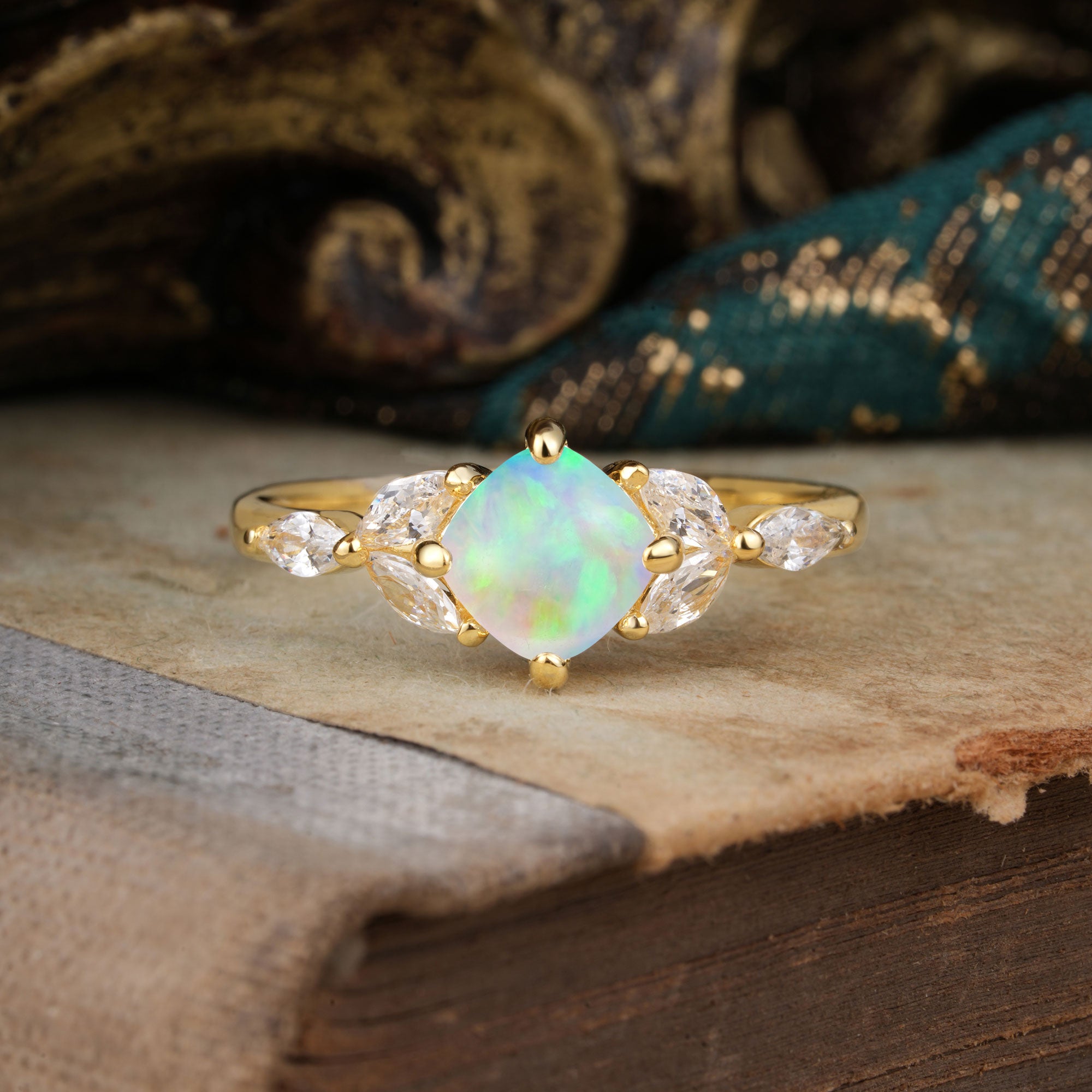 Cushion Cut 1 Carat Opal Anniversary Engagement Ring Classic Side Stone Ring
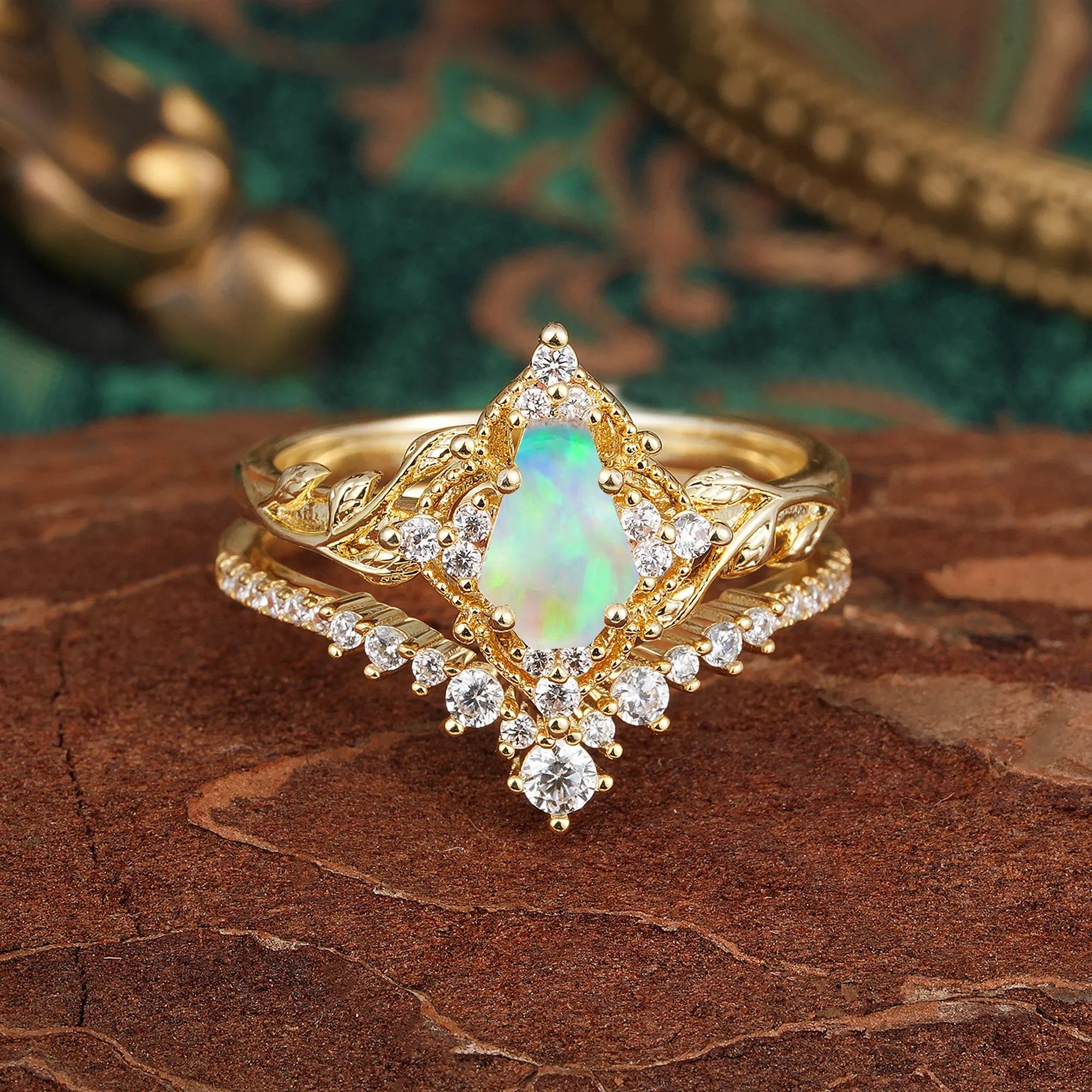 Minimalist Vintage 4-Prong Coffin-Cut Opal Engagement Ring Set
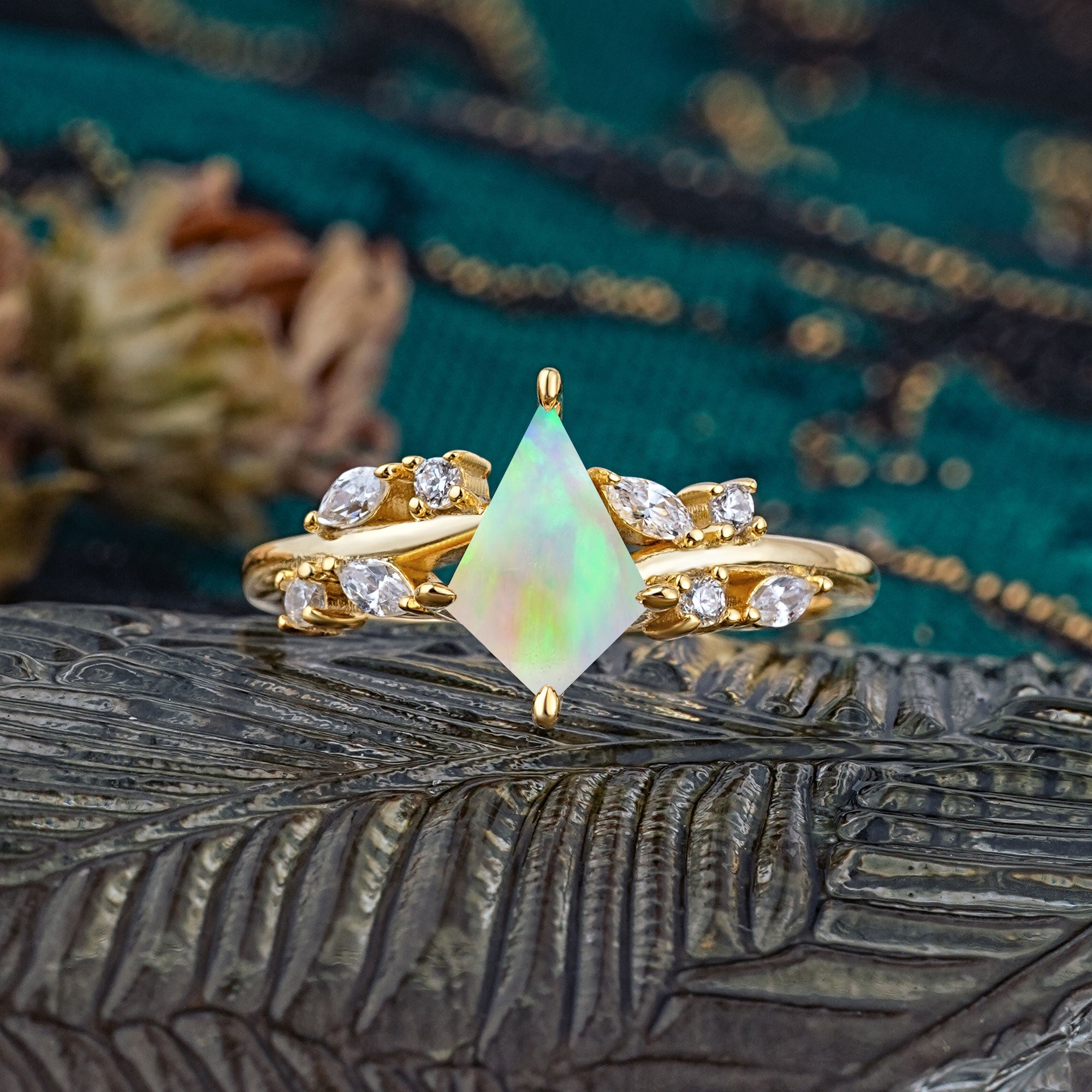 Unique Sparkling Kite Cut Fire Opal Engagement Ring
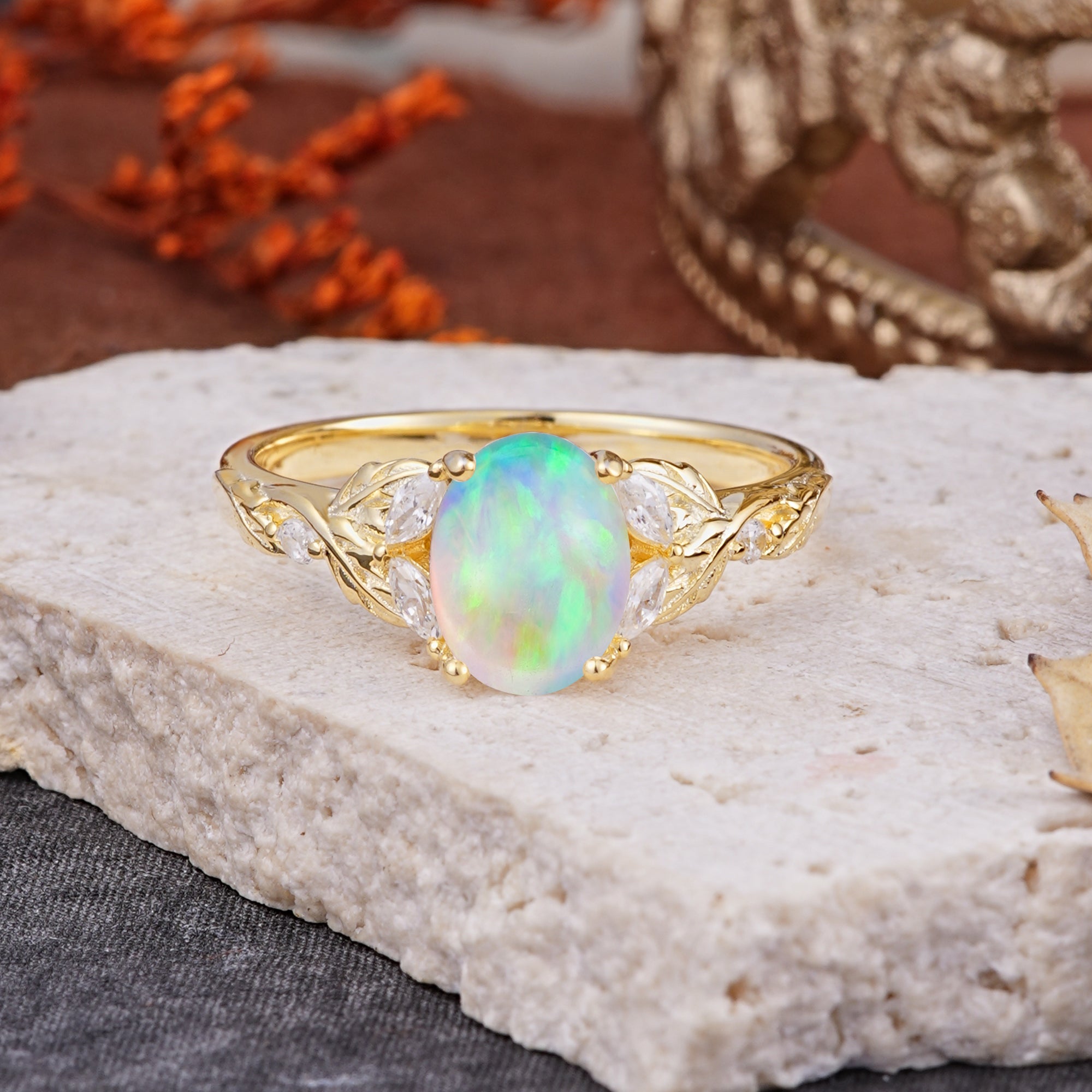 Vintage Leaf 4-Prong Oval Opal Engagement Ring for Women
Final Thought
The color of October’s birthstone is not one color because October has two birthstones. Opal offers a body color that may be white, black, gray, transparent, orange, yellow, brown, pink, blue, or green, often with shifting rainbow play-of-color. Tourmaline offers an even broader palette, including pink, red, green, blue, yellow, orange, purple, black, and multicolored crystals.
Choose opal when you want movement, iridescence, and a stone that seems to change as light travels across it. Choose tourmaline when you want a defined hue, natural zoning, greater hardness, or a more predictable color identity. In either case, evaluate the actual gemstone, confirm its material and treatment, choose a suitable setting, and follow the care instructions.
The most useful answer to the October birthstone color question is therefore also the most accurate: October is represented by a shifting opal rainbow and tourmaline’s full spectrum of color.
FAQs
What is October’s birthstone color?
October does not have one birthstone color. Its two birthstones are opal and tourmaline. Opal is known for shifting play-of-color over different body colors, while tourmaline occurs in nearly every hue, including pink, red, green, blue, yellow, orange, purple, brown, black, and multicolored combinations.
Is October’s birthstone opal or tourmaline?
Both are recognized October birthstones. Opal is generally considered the traditional October birthstone, and tourmaline is the newer addition. They offer different color experiences: opal changes with light and angle, while tourmaline is often selected for a more defined color.
Is opal always rainbow-colored?
No. Rainbow flashes are called play-of-color and are characteristic of many precious opals, but common opal does not show visible play-of-color. An opal may also show only one or two dominant flash colors rather than a complete rainbow.
Is opal white or black?
Opal can be white, black, gray, transparent, yellow, orange, brown, pink, blue, green, or another color. White and black opal are body-color categories, not complete quality judgments.
What color is tourmaline for October?
Tourmaline can be pink, red, green, blue, yellow, orange, purple, brown, black, or multicolored. Pink tourmaline, green tourmaline, blue tourmaline (indicolite), rubellite, Paraíba-type tourmaline, and watermelon tourmaline are among the best-known color expressions.
What causes opal’s changing colors?
In precious opal, microscopic silica spheres are arranged in structures that diffract light into spectral colors. The visible flashes change with the viewing angle, light source, sphere arrangement, body color, and cut.
What is play-of-color?
Play-of-color is the moving display of spectral hues in precious opal. It is different from body color, which is the background tone of the stone. A white opal can show blue and green play-of-color, while a black opal can show red, orange, green, or blue flashes.
What is the difference between fire opal and red-flashing opal?
Fire opal generally describes a yellow, orange, or reddish-orange body color. It may or may not show play-of-color. A red flash in a white, black, or crystal opal is an optical effect and does not by itself make that stone a fire opal.
Is black opal the most valuable opal?
Black opal can be highly valuable when it has vivid play-of-color, strong pattern, good transparency or clarity for its type, and attractive cut. However, “black” alone does not guarantee high value. The complete quality of the individual stone matters.
Which October birthstone is better for an engagement ring?
Tourmaline is generally more practical for frequent ring wear because it is harder than opal. Opal can also be used in an engagement ring, but a protective setting and careful wear are especially important. The decision should consider durability, design, lifestyle, and personal preference rather than color alone.
Can I wear an opal ring every day?
You can wear an opal ring regularly with care, but opal is softer and less tough than many traditional ring stones. Remove it for heavy work, sports, cleaning, bathing, high heat, and activities involving impact or prolonged water exposure.
How should I clean an October birthstone ring?
For opal, use warm, soapy water and a soft cloth. For tourmaline, warm, soapy water is also recommended. Avoid ultrasonic and steam cleaners, and ask about treatment before exposing either stone to heat or professional repair equipment.
What is watermelon tourmaline?
Watermelon tourmaline is a bicolor or multicolor tourmaline that commonly shows a pink or red center with a green outer zone, sometimes separated by a pale band. The natural color zoning is part of its appeal.
Is Paraíba tourmaline the same as blue tourmaline?
No. Paraíba refers to copper-bearing tourmaline associated historically with vivid blue, green, or violet colors. Not every blue or green tourmaline is Paraíba. A high-value stone should have appropriate independent documentation.
Does opal color determine value?
Color is important, but value also depends on play-of-color brightness, pattern, body color, clarity, transparency, cut, size, treatment, natural or laboratory-grown status, and durability. A color name alone is not a grading report.
What should I ask before buying an October birthstone?
Ask whether the stone is natural or laboratory-grown, whether it has been treated, whether it is a doublet or triplet, what its body color and type are, how it should be cleaned, and whether the setting suits the intended wear. For a significant purchase, request an independent colored-stone report.
References
Gemological Institute of America. October Birthstones: Opal and Tourmaline
American Gem Society. October Birthstones: Tourmaline and Opal
Share